Rosa Irigoyen’s latest exhibition at San Juan’s Galería Botello comprises eight digital photographic prints and three videos on DVD. The photographs deal with the theme of nails polished by professional manicurists in contexts that are unexpected, and not usually associated with the representation of the female body in Puerto Rican Art, in fashion magazines, and in the mass media. The artist inscribes herself in a visual discourse that is in turn contained within a theoretical arc linking transgression, kitsch, and codes related to the female body. Irigoyen, an artist with an already solid career and graduate studies at Norwich University’s Vermont College in Montpelier, Vermont, uses her own experiences to investigate practices and techniques employed by women in the beautification of their bodies, in this case, their hands.
The eight photographs in this series are complemented by several DVDs documenting the painstaking technique used in painting floral, geometric, and figurative designs on plastic fingernails, and the tasks carried out by the artist after putting on fake nails.
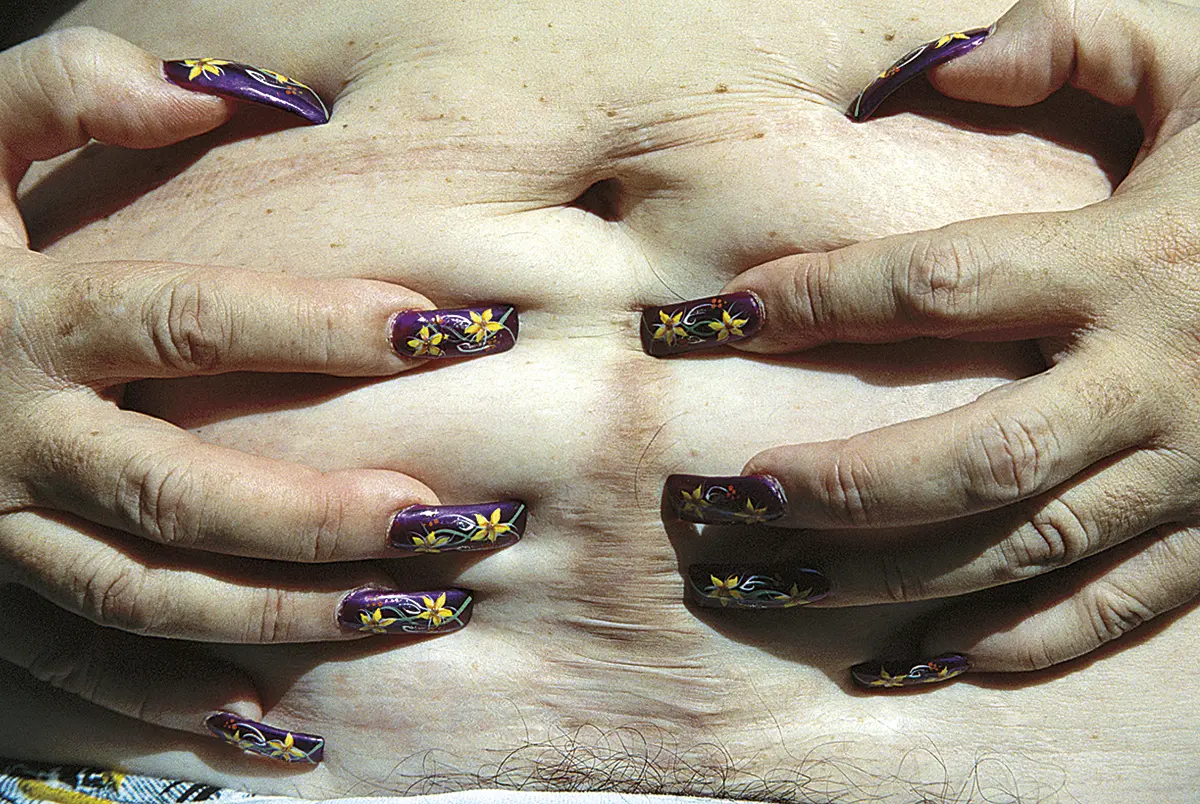
Irigoyen’s hands “pose” variously in the photographic series. They hold a plush toy. They grab a piece of raw meat and some fruit. They rest on her pet’s genitals, her son’s leg, or a patch of skin peppered with moles. In one of the photographs, painted nails intertwine with blank ones, the latter known as “practice nails,” thus underscoring the double artifice and highlighting the point in which artist and manicurist join each other: the art of painting. The “painted landscapes” and floral motifs on the plastic fingernails’ minuscule format bring to mind Chinese miniature paintings and represent a type of labor that demands time and vast supplies of patience.
Irigoyen gives dignity to a profession that is part of a multi-million dollar industry, inscribing it in an artistic context. She highlights the artifice and artificiality that links it to the art of photography and alludes to the implied possibility that through this practice every woman and every client can be an artist. In a magazine titled Nails Magazine on the Web there is an advertisement that puts it like this: “Keep it simple! Not everybody is born an artist. Don’t let that come between you, your clients, and the art of nails. Using glitter, paint, nail polish, and prepared designs will turn the clumsiest of us into a Picasso.”
Closeness as a photographic strategy in Rosa Irigoyen’s work privileges fragments of the female body, such as the hand, at the same time it forces viewers to see what is traditionally absent from its representation. Fingernails, the locus of this art, and this metonymic representation of the female body complement facial expressions in the language of flirtatiousness. The kitsch beauty of these small floral motifs contrasts with a wound’s abjection, an animal’s genitalia, or the rough texture of a chunk of raw meat. Rawness, artifice, and kitsch beauty are legitimized here as elements of a transgressive art whose point of view is that of female subjectivity. Irigoyen does not skimp on the visual angles employed to record a search for Being in the antipodes of the abject and the decorative, at the crossroads of a body that ages, changes, and registers the passage of time. Her search is focused on the hands that caress, cook, and speak in the language of seduction.
The juxtaposition of a flaccid abdomen, a wound, and painted nails in the piece titled Flower Girl subverts the mass media’s canon of beauty in a local culture that prides itself in having produced four Miss Universe winners. Some photographs explore the tension between an all-powerful nature, the passage of time, and human efforts to recover lost youth —something that can only be achieved through artifice. Nails is a challenge to the materialism of the body, the conception that Being begins and ends with the flaccid, aged wounded body.
Traditionally, works of art have sought to explain the world and to make the viewer comfortable in it. Nails explains one aspect of a contemporary Western woman’s life; by subverting the conventions used in representing that life, however, Irigoyen is not attempting to make her viewers comfortable. Photographs like Sangría and Nuez moscada subvert the canon of commercialized beauty, breaking with its tyranny and its doctrinaire sense. On the other hand, Irigoyen’s work is not a violation of the artistic canon, since it is inscribed in the tradition of shock or provocation that, since Manet in the nineteenth century and Duchamp in the twentieth century, has marked a trajectory based on the freedom achieved by art in modern times.
Irigoyen’s transgression is against the expectation of a “proper,” light treatment of issues in Puerto Rican art. In the local context, this exhibition could be a headstrong clash with the aesthetic sensibilities of a public accustomed to propriety in art. Nails renders transparent those “codes” associated with women that are marginalized in the local arts; its referents are the fashions of secretaries, maids, cashiers, and office workers in the public or private sector. Irigoyen assumed the aesthetic sense of salaried women and mixes it with the ugly-ism of the abject, the comical, and the banal.
This exhibition also illuminates the complicity of art with licentious fantasies that tend to reinforce conventional sexuality and unequal representations of the genders. With wit, courage, and creativity, Rosa Irigoyen also questions and dismantles the folkloric or neo-national cultural project that applauds what some call “living culture,” in the attempt to preserve what it understands to be authentically Puerto Rican.
Given that a visit to the art gallery is not a widely socialized activity in Puerto Rico, Nails does not stir things up and incite “the masses to lose their self-control.” Rosa Irigoyen’s work, without causing an upheaval, can generate uncertainty and discomfort among those members of the public who do go to galleries, and it can provoke thought in those aware of the history of artistic transgression. One achievement among many in this artistic proposal is its demand for a reflexive approach on the part of the viewer, and its widening of the definition of native art.
INGRID MARÍA JIMÉNEZ MARTÍNEZ