Un Poco de mí was the title of Roberto Fabelo’s recent exhibition at the Museo Nacional de Bellas Artes. There the public could see, presented for the first time as a sculptural group, a number of “vital fragments” of such importance for the artist in the exercise of his obsession with drawing, watercolors, and of course painting. These fragments emerged as a decisive element in Fabelo’s performance as a draftsman since the 1980s, after the artist received, the International Drawing Award Armando Reverón at the first Havana Biennial, in 1984.
The vibrancy of those years was anchored in gesture and expressionism, in the way in which figures were arranged on the humble Kraft paper surfaces after being executed only in the indispensable spaces, ripped, cut up, and also readied for further manipulations and montages. Papers that were memorably intervened by crayon, while the fractured characters (various types, animals, and objects) turned what could have been a complaint into a heart-rending scream, an unequivocal sign of anxiety, inconformity, and despair.
Fabelo’s almost-always unusual work, already abundantly described by commentators in their many attempts to define it, is above all greatly intense —in each and every manner in which the artist chooses to express himself.
Recently, after a period spent using different supports a grand group of splendid beings —splendid in the absurdity of their nature, in their mixed quality, devilish of poetic—, the pieces of a singular dinnerware set, already announced in different works, became central. Sometimes they are sketch-like, traced nervously, and freely but not without precision; sometimes they are veiled in Fabelo’s watercolors.
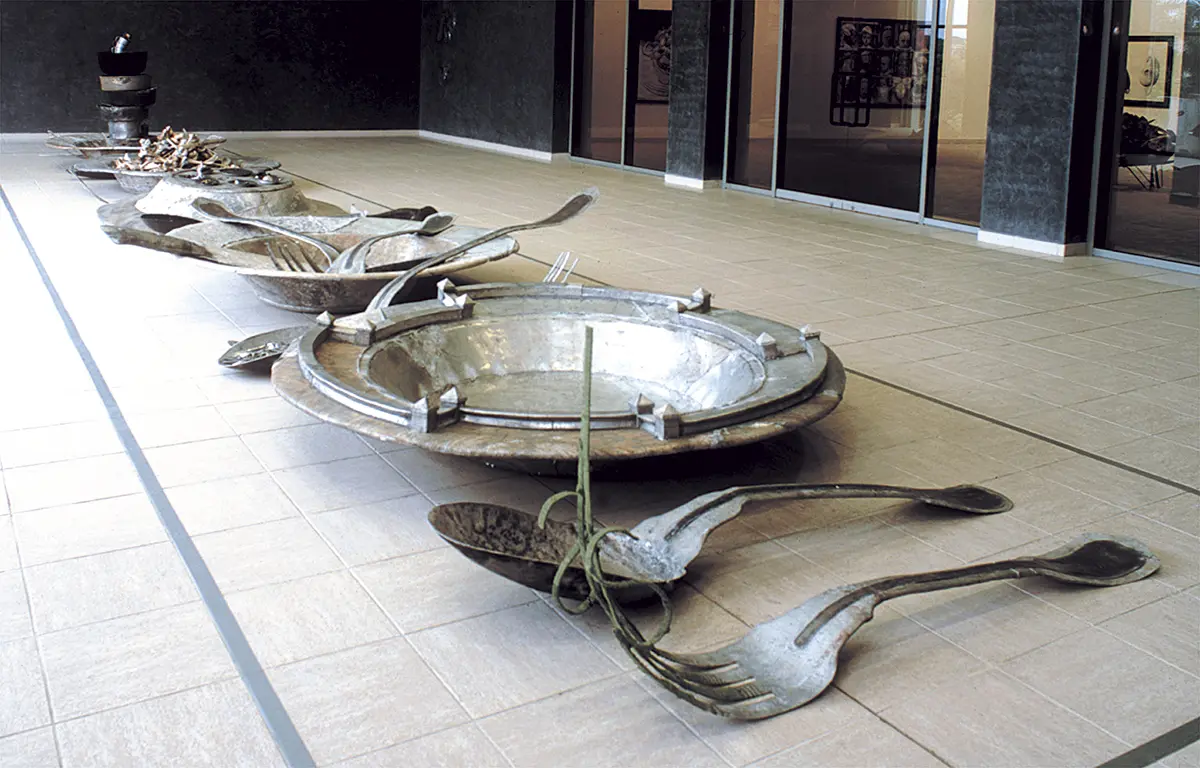
Un Poco de mí greeted visitors with a table that was already set, inaugurating it as a series and highlighting its relationship with a memory —a memory that, used aluminum to recreate in large-scale everyday, domestic objects, expands with its reference to poverty and to recycling. A humble material that has been, and still is, an essential presence in our lives, in our private and public history.
The pieces in Fabelo’s installation La Mesa (The Table) would retain their autonomous meaning even if extracted from that context. Plates, knives, forks, spoons, ladles, pans, jars, and coffee pots were displayed as if to say: the table is ready. Ready for a serving of absences. It spoke of scarcity, of want. Where was the food, the nutrition for the hungry masses in a world that is sick with consumerism? Consumption, a right reserved for the few, by force results in the destruction of our environment. On one spoon there were only the remains of small animals, raw bones, and skeletons; on another, we could see rhinoceroses, hippopotamuses, elephants, and pigs running in the stampede. They were fleeing the destroyers of their natural habitats, those responsible for the loss of their sources of food. They were fleeing from hunts organized to combat boredom, or from poachers in search of ivory to be exchanged for paper notes. The power of money was indeed alluded to in La pasta verde, where the “fingers” of a fork were stretched to form the dollar sign. For these and other reasons, Fabelo’s was a show of crossroads, of life-or-death, of red-or-black, with a will to make us dream and to make us be. It was a bet for life, without any possible alternative.
A plate offered, as a feast, Havana’s oceanside malecón. That same malecón of romance and lust, a public space shared by so many. At once historic and everyday, simple and mystical, naïve and perverse. A retaining wall, but retaining what waters, what peoples, what dreams, what obsessions? Mute witness to the passage of a century, a vantage point where the breeze caresses the future, from where we gaze at the uncertain horizon of those who one day jumped into the “death corridor.” A great silence, a prelude to a tragedy, loomed over the show. The show signaled its consternation, the depth of its sadness. Un Poco de mí refers to the lesions of the contemporary spirit, the enormous waste, the scarcities, and the excesses. This was the landscape illustrated by Platos negros and by the watercolors in the series Un poco de nosotros, Retratos locos, and Naturaleza casi viva o casi muerta. Jars overflowing with beings that barely survived asphyxiation, mermaids agonizing one on top of the other, faces that bore witness to the global barbarism and the global madness.
Mamey and Plato preferido were two touches of tenderness in the midst of such dread, with an erotic vision that turned a woman into the seed of an exquisite fruit and a mermaid into the most craved-for, tempting presence. The visions expressed in these pieces are noble ones, situating love, women, hope, and earth, front, and center, and revealing those other motivations that drove Fabelo through such paths. The retable that was Un Poco de mí included and almost compiled, in a kind of game, works covering an eight-year period. These were created using armoire doors as supports, and the beams contributed in some measure to the mounting of each painted —and sometimes sculpted— a piece of wood. Different doors on which a multitude of segments piled up, organized like a puzzle as if those doors had at some point provided access to the artist’s inner world —as if the artist’s inner world opened and closed according to his will.
La cafedral was a temple, the space of liturgy, of the Cuban people's ritual of coffee. A meeting point to which the first to arrive is the liquid’s vapors and the spirit of its aroma. That body of coffee we enjoy almost always in good company, the same as a celebration of dawn or as we say our farewells to the dead. La cafedral is the place where, upon entering, we (somewhat) cease being the devils we are, to become (somewhat) more innocent and vulnerable; divided and fragmented through so many moments stringed together like beads, comprising the mystique of the ceremony in which we have invested singular pieces of our existence.
Fabelo spoke in the first person, colloquially. He assumed what was dealt to him in his personal history. The Fabelo we encounter now —sober, devoid of stridencies— overflowed with his show in the temporary space in which it was mounted. He made us think of human beings as universal subjects, of the feast of scarcity and abundance, and he grabbed society’s attention. There he left some clues as to who he is. That was his narrative, but Un Poco de mí spoke of us. Those small theaters have become major stages where plenty has been said about us all.
CARIDAD BLANCO DE LA CRUZ