The distinguishing characteristic of Renata Lucas’s (Riberão Preto, 1971) work has been the reconfiguration of space in galleries and institutions. For a little more than three years, her works in the art circuit have comprised an expressive group of precise interventions on architectural spaces. Her interests center on issues like the relationship between sculpture and architecture, geometry and construction, content and container, and the viewer’s perception of space and of the work of art. Lucas’s work revitalizes and gives new breath to the formalism of the Brazilian constructivist tradition. This artist has come closer and closer to the path followed by earlier generations of São Paulo artists, such as Iran do Espírito Santo and Jac Leirner who, over the past two decades, dealt with formal issues in a way that was more open to the everyday and to the world.
In a recent project Mau Gênio (2002), at the Pampulha Museum of Art, Renata Lucas installed thirty-eight scaffolds in the mezzanine of the Oscar Niemeyer building. They were attached to each other with wooden sheets creating a temporary floor that emphasized the established link between building and landscape, and while reiterating the mezzanine suspended space, also generated an effect that was far from the nostalgic, precious atmosphere of the old Casino.
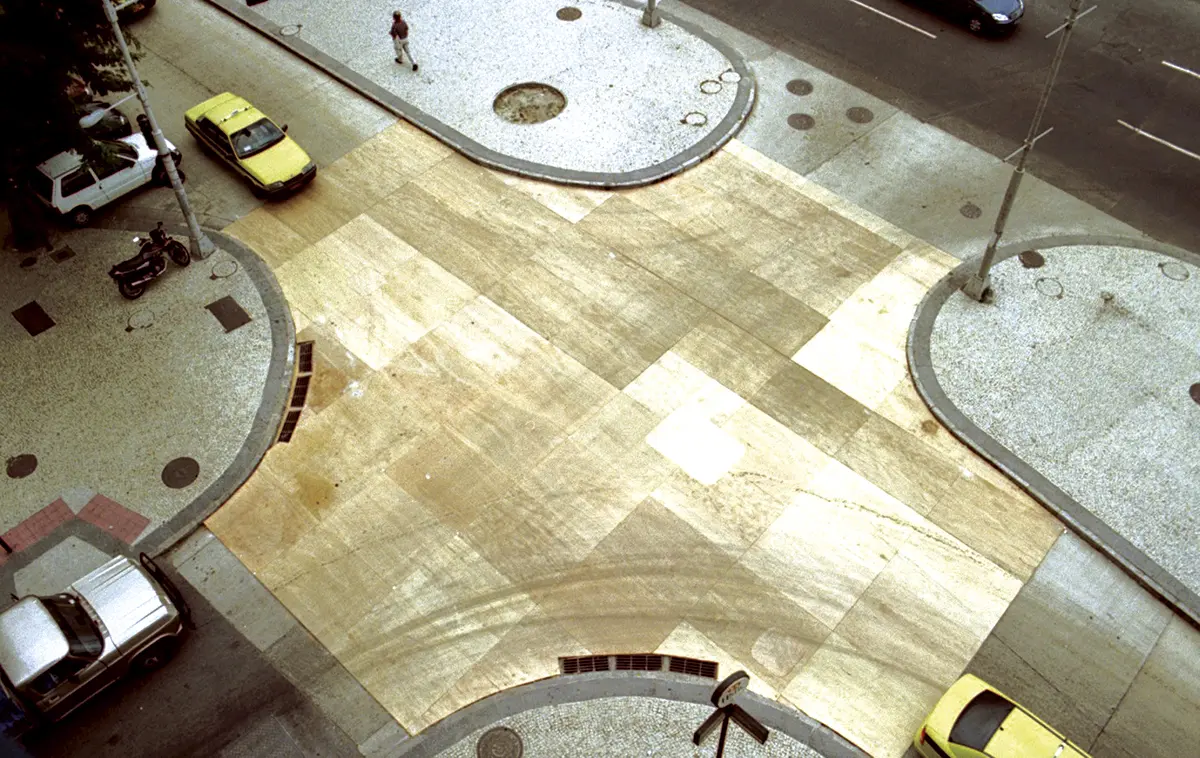
Cruzamento (2003) was shown last March at the Castelinho do Flamengo, in Rio de Janeiro, and is Lucas’s first project created directly in an urban space. The installation consisted of covering the street crossing opposite the institution in wood. The work was on view for eighteen days with the approval of the authorities, and it was dismantled at the request of the neighbors, who were upset by the noise of cars running over the wood. Sixty-eight wooden cleats (each, 2.2 m x 1.6 m x 15 mm) were screwed directly into the ground over the city pavement on the intersection of Praia do Flamengo and Dois de Dezembro streets, creating a mimetic relationship—and friction—with the original covering. Passing cars were sensitive to the small bumps, and the locals identified Lucas’s intervention with the renovation work that Castelinho was undergoing simultaneously, which reinforced the tension that Lucas’s work always generates.
Cruzamento intensifies the artist’s strategy of commenting on spaces by altering them. We need to note Lucas’s constructivist process and her adaptation of the work to the pre-existing space. The wooden cleats were trimmed along the gutter and following the contours of the site (they were rounded, according to Castelinho’s belle époque spirit). The street’s small openings were cleared to allow water to drain and removable lids were installed on the sewers so that they could be opened if necessary. In the artist’s own words, “Cruzamento was created directly on the surface of the world, in the middle of the street, contained between gutters.” Faithful to its environment, in eighteen days the wood had turned gray and was stained with oil and tire tracks, which made it even more like the asphalt it covered.
The artist also establishes a significant relationship between the materials (words and things) used in her work and those used in the building. An important semantic game is at the center of this dialogue. Lucas invokes dual meanings for words in a reconciliatory gesture that directly assumes its own tension: work as physical labor and the work of art as the labor of the intellect; construction/constructivism, a formal school in art, and construction in the sense of erecting a new building in the world. In that sense, I notice an almost utopian character in Renata Lucas’s installations; and those installations always require the complicity of institutions for the deployment of their conceptual implications, as well as a considerable display of physical labor for their formal completion.
From a formal point of view, Cruzamento deals with horizontality. It presents an anti-monumental plane in the middle of the city; it is ignorant of volume and directly attached to the world. From the perspective of the material, once again wood lends itself in a flexible, liquid way, almost devoid of any character of its own. However, Lucas’s most important contribution resides in her appropriation of those spaces for art and its borders. If the work was seen from the institution’s windows, bringing the street into the building, it also transported the institutionalized space of art and culture onto Rio’s dense urban texture. The work’s power is its placement at the center of the crossing, a site of encounter for diverging, opposing forces that cross each other without touching. It takes art into the center of a storm.
RODRIGO MOURA