The Argentine artist Raul Díaz resides in Unquillo, a town not too far from the provincial capital of Córdoba, his native city. There, he lives and works surrounded by a beautiful mountainous landscape which has attracted many other artists who have also chosen to set up their studios in the area. Something of this natural beauty appears in the works Díaz included in his exhibition at the Timothy Tew Gallery. However, such natural beauty finds expression in the most indirect of ways since his figurative paintings and sculptures are not concerned with exterior reality but rather with the artist’s internal vision. Through his use of rich, sumptuous textures, diaphanous colors, and recurrent, almost archetypal themes he describes an imaginary world populated with gently enigmatic figures who appear alone or in couples either in row boats or in natural settings. All of the works included in the exhibition feature images that suggest a sense of stillness and isolation. Nonetheless, the artist’s beautiful treatment of surfaces and pleasant colors keep any sense of tension or anxiety at bay.
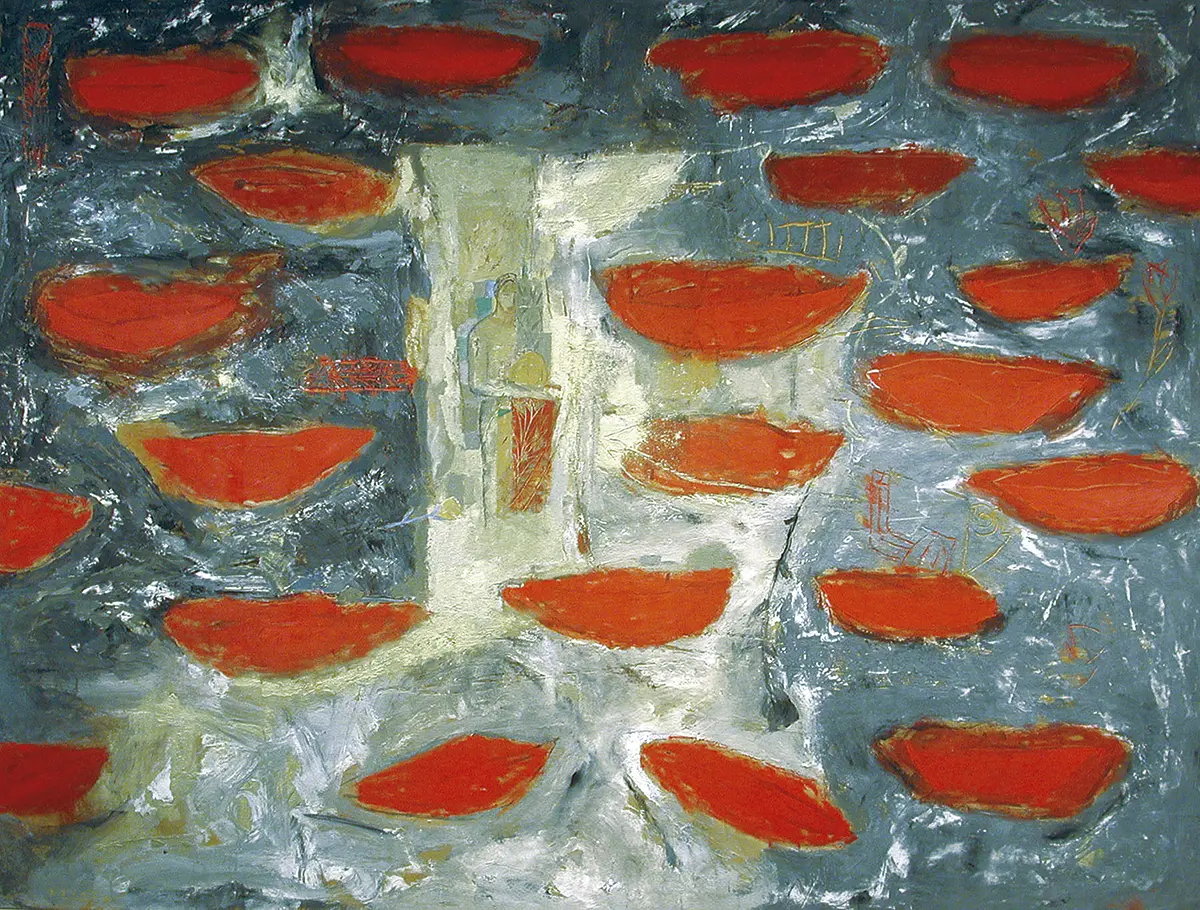
Díaz’s interest in texture has led him to synthesize certain aspects of painting and sculpture. His sculptures are subtly polychromed, and his acrylic paintings employ as their support thick wooden panels, which have been, prior to the application of the paint, coarsely hewn and then scuffed or marred into rich uneven surfaces. The man standing in a boat that Díaz depicts in Portrait in White (2003) is not only painted but also carved into the rough surface, which helps give materiality to a figure defined mostly with slightly differing tones of white and sienna. While this painting shows Díaz’s use of color at its most subtle, Red Boats (2001) and Figure on the Grass (1999) reveal an equal delight in bold color combinations that pit gray against red and red against green. Such striking color contrasts and the representation of objects —floating boats or falling leaves— in an all-over pattern combine to emphasize the flatness of the work.
This tendency towards abstraction shows a progressive departure from Díaz’s earlier work, which was more realistic and more concerned with three-dimensional space, possibly because he studied architecture for several years before he decided to become a full-time artist. During the 1990s, as he began to emerge on the Argentine national art scene, his paintings often featured well-defined interior spaces in which circus performers and other figures moved with the languid pace of a sleepwalker. Many of the recurrent themes in his work were already present: the human figure, the horse, the rowing boat, the long stemmed-rose, the kite. These are, together with his preference for stirring colors and textures, a reflection of childhood memories and nostalgic impressions which continue to shape his artistic vision.
FLORENCIA BAZZANO-NELSON