Involved in electronic art for over a decade, Mexican/Canadian artist Rafael Lozano-Hemmer (Mexico City, 1967) has developed an interesting practice of participatory art in public spaces, which, as the artist points out, is situated “at the crossroads of architecture and performance art.”
Lozano-Hemmer has created interactive interventions in cities like Toulouse, Rotterdam, Madrid, Lenz, Mexico City, and Havana, and is now showing in Mexico City a selection from his work since 1994, at the Laboratory Arte Alameda, a space devoted to electronic art.
The show comprises four installations, salient among them a project created specifically for the Laboratorio Arte Alameda, and a program of videos documenting five works by Lozano-Hemmer in different European cities.
The show’s centerpiece, Frecuencia y Volumen (arquitectura relacional 9), uses a resource that is already a staple of Lozano-Hemmer’s work: the piece’s activation by the viewer’s own shadows, created by intercepting a beam of light emanated by a potent luminescent artifact, in this case in order to tune in to radio waves and to modulate the volume of the broadcast. The computerized interaction between a video projection, a webcam, and a robotic light cannon, “interprets” the viewer’s shadow: while their position in the projection plane determines the frequency to which the piece will tune in, their physical proportions determine the audio level. Beyond the piece’s playful character, where the viewers/tuners play with their shadow in the projection that detects and chases them, there is an interrogation of the function and relevance of radio, the most popular electronic medium, ownership of which is monopolized by the State and by mass media. It should be noted that the point of view is not that of the producer (as would be in pirate radio broadcasting) but that of the listener.
33 preguntas por minuto (2000), an installation created for the Havana Biennial, includes a computer that generates all the possible combinations of questions using the words in a dictionary. These questions are presented in 21 liquid crystal micro screens, at a pace o 33 questions a minute, supposedly the threshold of readability. This piece, an update of the explorations on language carried out by conceptual artists in the 1970s, expresses perhaps an excessive interest in gadgetry. Nevertheless, the inclusion of a temporality that is ungraspable in human terms, that of the piece’s “shelf life” —the machine will generate 55 billion questions, without repetition, over a period of three thousand years.
Alzado Vectorial, the interactive installation with which Lozano-Hemmer intervened Mexico City’s Zócalo during the festivities for the arrival of the new millennium, was included in this show by means of a documentary installation of videos, photos, and a selection of web pages created for its two original presentations: in Mexico City from December 26, 1999, to January 7, 2000, and in the city of Vitoria, Spain, for the 2000 opening of the Artium museum.
Eighteen robot light cannons dubbed the “antiaircraft,” arranged on the buildings that surround the city’s central square, pointed their light beams to the sky in combinations created by web surfers through a software program that allowed them to create combinations of light on the Mexican sky from any other place. The Web public’s active participation as the work’s operators took full advantage of the medium’s potential for integration: users from many corners of the world “joined” the piece. This is key for the definition of public art that, unlike the Nazi spectacles designed by Albert Speer in the 1930s for the celebration of centralized absolute power, posits a horizontal and decentralized integration of society.
Lozano-Hemmer had already worked on these propositions in earlier works. In Re:Posicion del Miedo (arquitectura relacional 3), presented in Graz, Austria, in 1997, the artist projected onto the walls of old armory texts taken from the proceedings of a symposium on the concept of fear. Two overlapping projections rendered the texts invisible, until the public’s shadows, by obstructing one of them, made possible the fragmented reading of pieces of information in constant flux.
Many of Lozano-Hemmer’s interventions in public spaces possess a monumental, even urban scale. His action on large buildings through projections and computer-controlled mechanisms takes advantage of the building’s own cultural referentiality as part of the same work (Re: Posición del Miedo integrated the building’s own origin, one of Europe’s largest military armories, built during the Seventeenth Century to help stave off the Turkish expansion.)
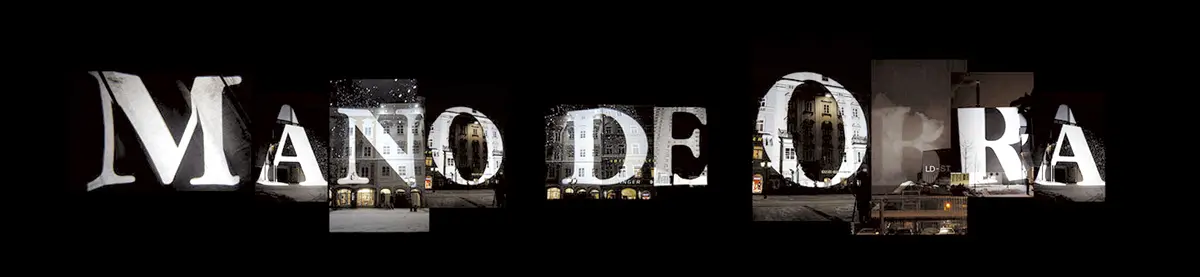
In 1000 usos tópicos (2003), in turn, Lozano-Hemmer projected letters onto all kinds of buildings and constructions (bridges, factories, malls, apartment complexes, churches) in order to generate a photographed alphabet he would later use to spell the words that “define the globalized city.” The result, a kind of “counter-photoshop,” is not as interesting as the process, whose “heroic” proportions (the world’s largest projector mounted on a 12-ton truck, moving around a city to make 75 x 75-meter projections, etc.) question the discourse of many prestigious artists and critics who since the 1990s have promoted the value of smallness.
Beyond the issues of scale, the interest of Lozano-Hemmer’s work resides in its application of technology not as an end in itself but as an actualized tool for the intervention of urban environments in ways that are at the same time analytical and festive, perhaps anti-authoritarian, integrative of a wide public’s potential for play.
ENRIQUE JEzIK