From very different formal platforms, although coinciding in the use of conceptual means and purposes, Priscilla Monge and Alexander Apóstol share a space to present individual selections of their most recent works.
In this exhibit, Costa Rican artist Priscilla Monge (San José, 1968) offers a large photographic series, one sculpture, and a small installation of blackboards. After her participation in Platea de la Humanidad at the Forty-Ninth Biennale di Venezia, her work —filled with reflections on women’s issues— has achieved international recognition. In that line of recognition, we locate interesting works in which she used sanitary napkins which, like a circumstantial prosthesis, contributed to the cleansing of their environment, adapting to all manner of bodies and spaces. In this way, on the basis of very diverse media, sometimes in an explicit way and sometimes broaching only subtly topics related to the condition of women, lack of communication, violence, and the conflict between the private and the public have been common themes in Priscilla Monge’s work.
To this end, the artist invites viewers to turn their gaze toward aspects of their everyday lives in which things seem to be normal. At first, nothing appears particularly significant. As in the more immediate reality, Monge’s images present anodyne fragments of life in which unseen, unperceived elements nevertheless abound —elements we don’t see or refuse to see, no matter how much we look.
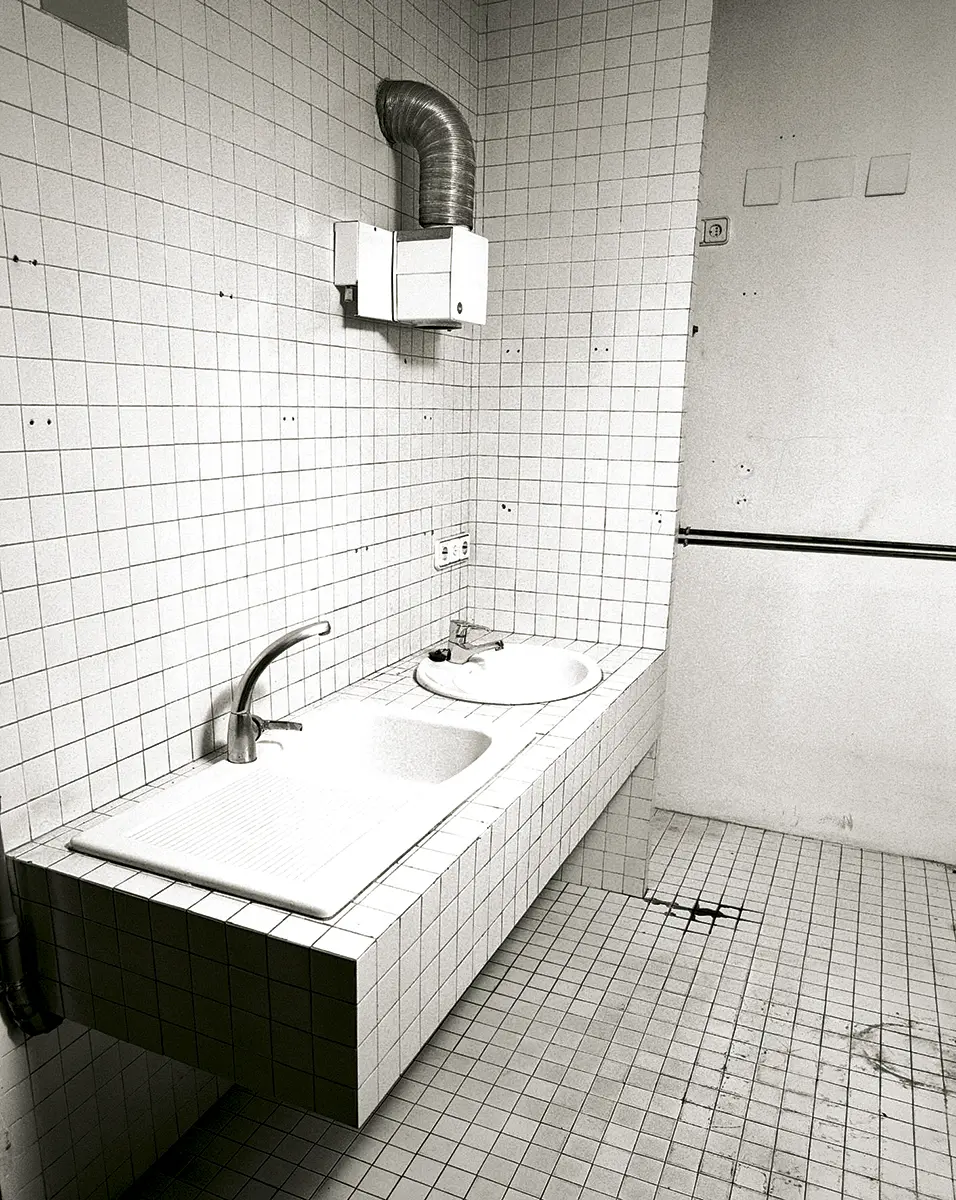
Small alterations progressively emerge, though, to paralyze our gaze and trigger a chain of uncertainties. Thus the seeming normality of things reveals its conflicted character. In this line, two groups of photographs in the current show (in fact, they are the show’s most interesting piece) deal from different points of view with the issues mentioned above. On the one hand, in a series of views of spaces that are in principle aseptic, such as bathrooms, the viewer discovers several perplexing things. These common and impersonal spaces present, on the impeccable whiteness that characterizes them, traces of pollution and violence, such as blood stains. These disturbing images scream at the eyes of viewers who find themselves suddenly unprotected before acts of violence that are near, yet whose origin is unknown. Monge calls our attention, intimidates us, and makes us complicit in a situation that reveals itself as a daily occurrence. Next to these photographs, and in tense coexistence with them, another series shows close-ups of a staircase, which turns out to be that in the gallery itself. Blobs of foam circulate through this staircase, strangely, as in a surrealist vision in turn characterizes by its ordinary quality. These images could open a multitude of perspectives and generate readings in many different directions, yet they appear in the last instance flat as if we look at their composition, size, color, or lighting.
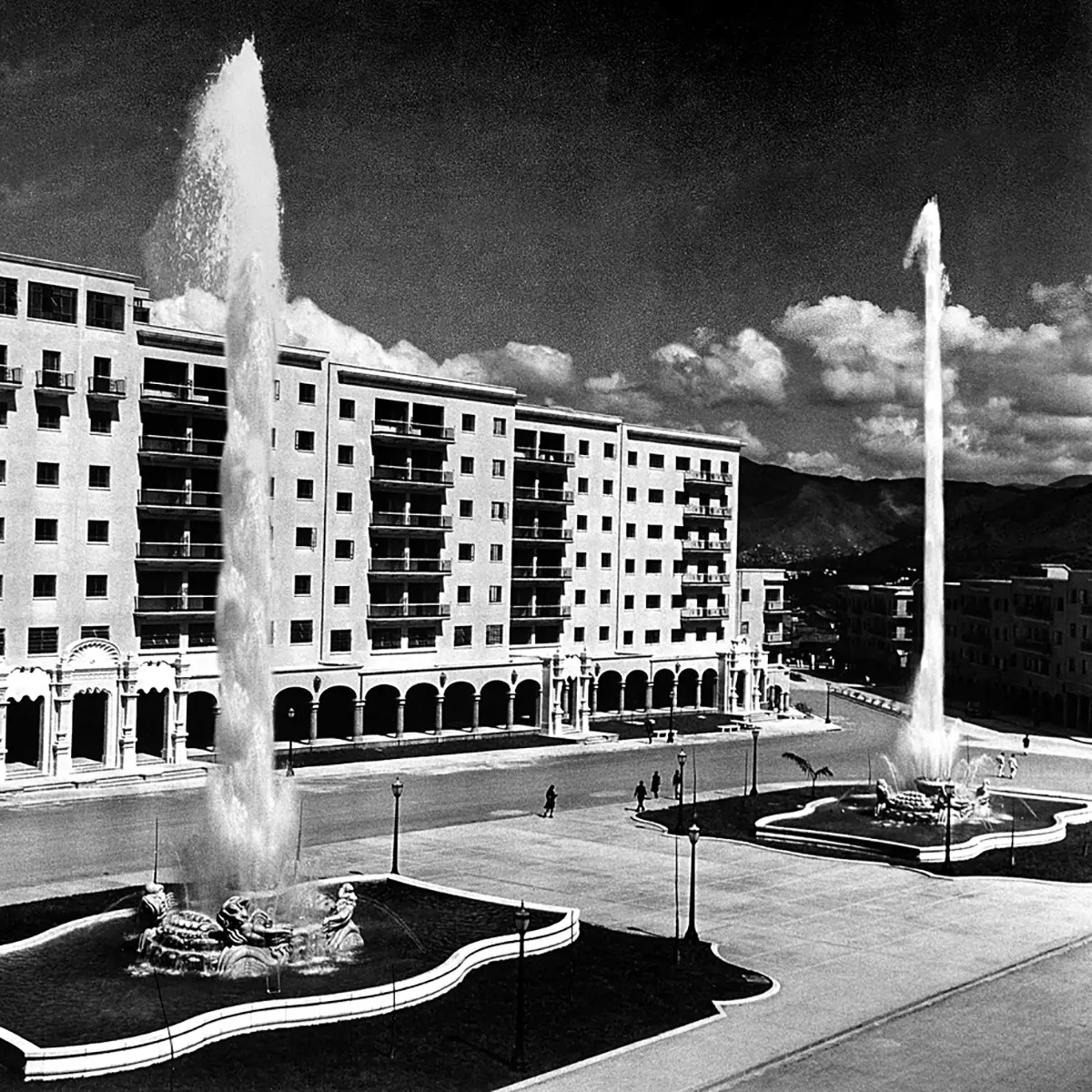
With works that are somewhat less interesting than Monge’s, Venezuelan artist Alexander Apóstol (Barquisimeto, 1969) deals with topics and reflections of a social character. Through one projection and several photographs, Apóstol’s works sanitize the confused relationship between the organization of territories and the social structure, Taking as his clue certain architectural motifs found in the city of Caracas, erected in past decades with a utopian intention, Apóstol projects a new urban vision, just as unreal as the one whose failure he posits. To conventional panoramic vistas of well-ordered façades, he incorporates monumental fountains that, instead of being integrated or contributing to cleaning up the view, end up muddying any urban mission. In this way the artist scrambles the social foundations of public architecture, situating it in the territory of the absurd.
These issues are of great interest, yet they remain obscure in Apóstol’s works. The viewer can barely discern the artist’s intention in creating them. Compared to previous works —some of them extraordinary, such as W.M., Jackson Inc. (2002), Residente pulido (2001) to What I’m looking for (2000) in which Alexander Apóstol displayed a tremendous ability to subtly project corrosive contents, the works in this show, titled Fontainebleau (2003), are excessively hermetic.
JOSÉ LUIS CLEMENTE