
The Cuban American painters Paul Sierra (b. 1944) and Sergio García (b. 1959) recently exhibited simultaneously at the Naomi Silva Gallery in Atlanta. Although they both share an interest in expressionism and in depicting images shaped more by the internal vision of the artist than exterior reality, they have arrived at quite different solutions in their art.
Paul Sierra
Sierra’s paintings included in this exhibition present his signature style and recurrent themes. His landscapes, sometimes featuring solitary figures, reverberate with thick oil brushstrokes and shimmering colors. However, Sierra’s representation of nature differs slightly from painting to painting, sometimes reflecting the exuberant nature of the tropics and other times the oblique light of the northern landscape. In Summer Pond #5 (2001), the artist revels in the vibrant greens, blues, and yellows of a forest dense with foliage, but in Home Bound (2002), the suffused light of the Midwest sunset serves to mute his colors, thereby producing a serene distancing from everyday reality. Similarly, Fields of Color (2003), an expansive view of Florida’s wetlands and vast sky, reflects a more peaceful and meditative state of mind. In spite of the specific geographic references in Sierra’s landscapes, his paintings seem more related to the artist’s internal psychological moods than to his diverse cultural background.
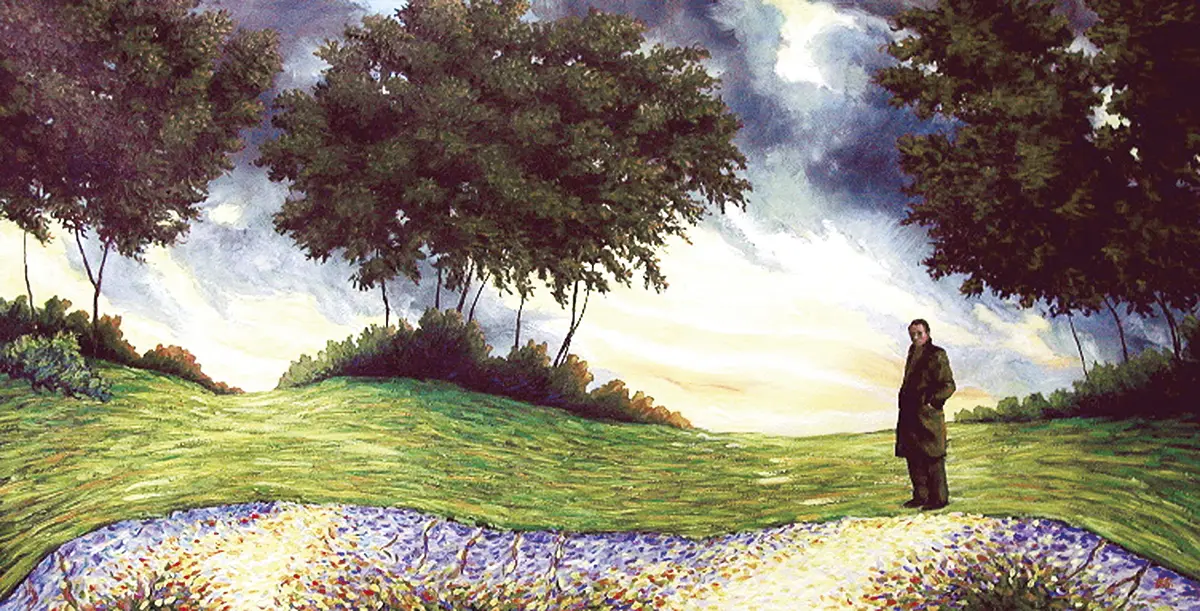
In 1963, Paul Sierra and his parents abandoned Cuba for the United States, where they settled in Chicago. From 1963 to 1967, he attended the School of the Art Institute of Chicago but eventually decided to leave without finishing his degree. During the following years, he worked as an art director for several advertising agencies while continuing to paint at an intense pace. He was finally able to dedicate himself to his art full-time after he emerged onto the national scene in the late 1980s through various traveling exhibitions, including the controversial Houston Museum of Fine Arts’ Hispanic Art in the United States. Sierra’s art also came to be viewed as controversial when other Latino artists argued that his artistic practice lacked political commitment, but social and political commentary was never the main focus of Sierra’s work. Instead, he found inspiration for his paintings in various sources, including literature and photographs in magazines but mostly in his own rich imagination.
In the late 1980s and early 1990s, Sierra played with collage-like fragmentations and odd juxtapositions which gave his paintings a slight surrealist quality. Figures dressed in suits--perhaps members of the corporate world in which he worked--embraced each other, slept, or quietly moved through puzzling spaces which shifted from indoor rooms to exterior spaces in illogical ways. This anxious fragmentation subsided in the mid-1990s when Sierra began a series of visually stunning landscapes rendered in a more expressionistic style. In Lincoln Park Lagoon (2000), a work not included in the Atlanta show, Sierra reflected the softer light of the Midwestern landscape in a manner strongly reminiscent of Thomas Hart Benton in its musical quality and sinuous lines. This undulating quality is present in several of the paintings shown in Atlanta. For example, in Swimmer No. 8 (2002) and Solitude #2 (2003), the wavy landscapes seem to dance in a circle around the lonely figures in their midst. Their warm and shimmering colors must seem like a mirage in the long and unforgiving winters of Chicago, where the artist resides.
Sergio García
While Paul Sierra has been recognized as a prominent Latino artist since the early 1990s, Sergio García is still in the process of emerging onto the national artistic scene in the United States. García considers most of his paintings as self-portraits. They are also the result of a profound but liberating psychological struggle with his own passions and obsessions, acted out on the surface of the canvas. Such strife energizes a series of tensions that the artist builds into his works: abstraction versus figuration, brutal brushwork versus the use of cold tones or even lively colors, and finally, the dark imagery bordering on the archetypal versus the redeeming meaning he finds in these symbols.
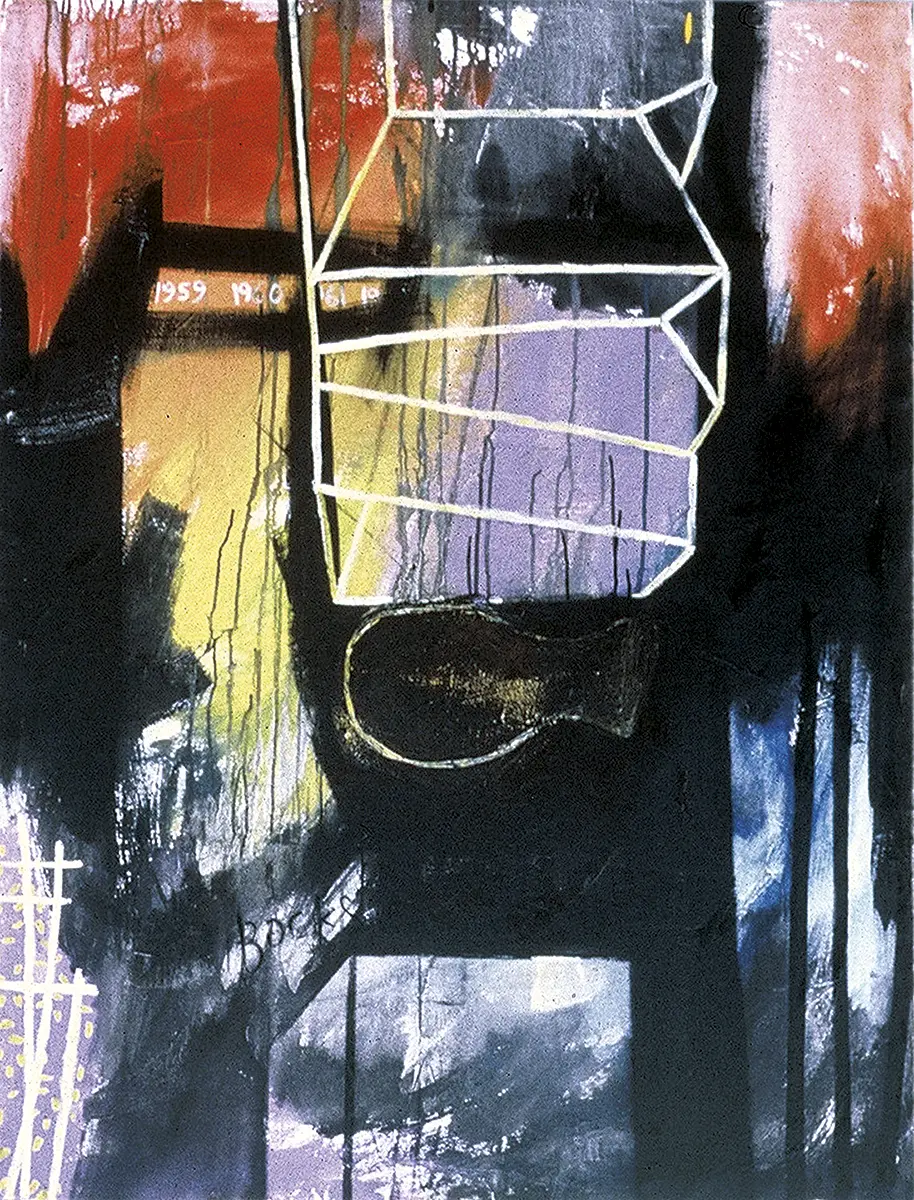
In Squashed Head (1995-2002), García shows a severed head resting on a pedestal painted in the center of the canvas. Around it, black areas create the impression of space while drips of black paint over the luminous colors suggest an ominous event. According to the artist, when he painted this work, he was preoccupied with his recent divorce and wished he could temporarily disconnect his head to give his overwrought mind a rest. This search for psychological release gives the painting a cathartic quality that is seemingly confirmed by the boldness of the colors —yellow, lavender, orange— that the black only serves to intensify.
García produces his paintings on canvas in a ritualized way. He places the unstretched canvas on the floor and walks around it, first throwing materials such as ashes and even spits onto its surface, then staining it with various colors. Next, he hangs the canvas on a wall and “plunges into the unknown,” for he not only paints without sketches but also without knowing where the painting process will take him. After the painting is done, he attacks the canvas with a knife, producing small cuts that he then stitches together to represent the symbolic healing of psychic wounds, as in his mixed-media painting War-Man (2002).
García has lived in Miami since 1961 when his family left Cuba and went into exile in the United States. A self-taught artist, he began exhibiting his paintings in 1990. Music is an important part of García’s art —he feels a deep sense of kinship with Iggy Pop, his favorite punk rocker, and listens to music with a strong sense of rhythm while he paints. One of his favorite songs is a bolero by famous Cuban composer Benny Moré whose lyrics include the phrase dolor, dolor que llevo dentro, por lo mucho que has llorado [the pain I carry inside me for how much you have cried]. By integrating such music into his creative process, Sergio García transforms his art-making into a self-healing practice.
FLORENCIA BAZZANO-NELSON