Pablo Vargas Lugo (Mexico City, 1968) is an artist whose production never ceases to amaze. His work is characterized by perfect, painstaking use of materials, refined aesthetics, and complex conceptual content. It displays a passion for form as well as for meaning; Vargas Lugo plays with meanings, and switches them, with a notable sense of humor. The titles of most of his pieces are word plays that reveal a deep knowledge of art history and of world history in general. Among his better-known works are a series of collages with perforated paper in abstract but recognizable forms. His broken maps in light boxes speak of a rearrangement of parts, freely playing with planes of representation without making them entirely abstract, instead leaving visible and recognizable to the viewer their essence —a quality that is found in most of Vargas Lugo’s production.
At first glance, Vargas Lugo’s exhibition at Sala de Arte Público Siqueiros is rather disconcerting, yet it will surprise attentive viewers and move them to profound reflection. Vague Statistique is being shown in El Cubo, a gallery for temporary shows where site-specific pieces are produced in a dialog between emerging art and the works of the famous muralist that are on permanent exhibition.
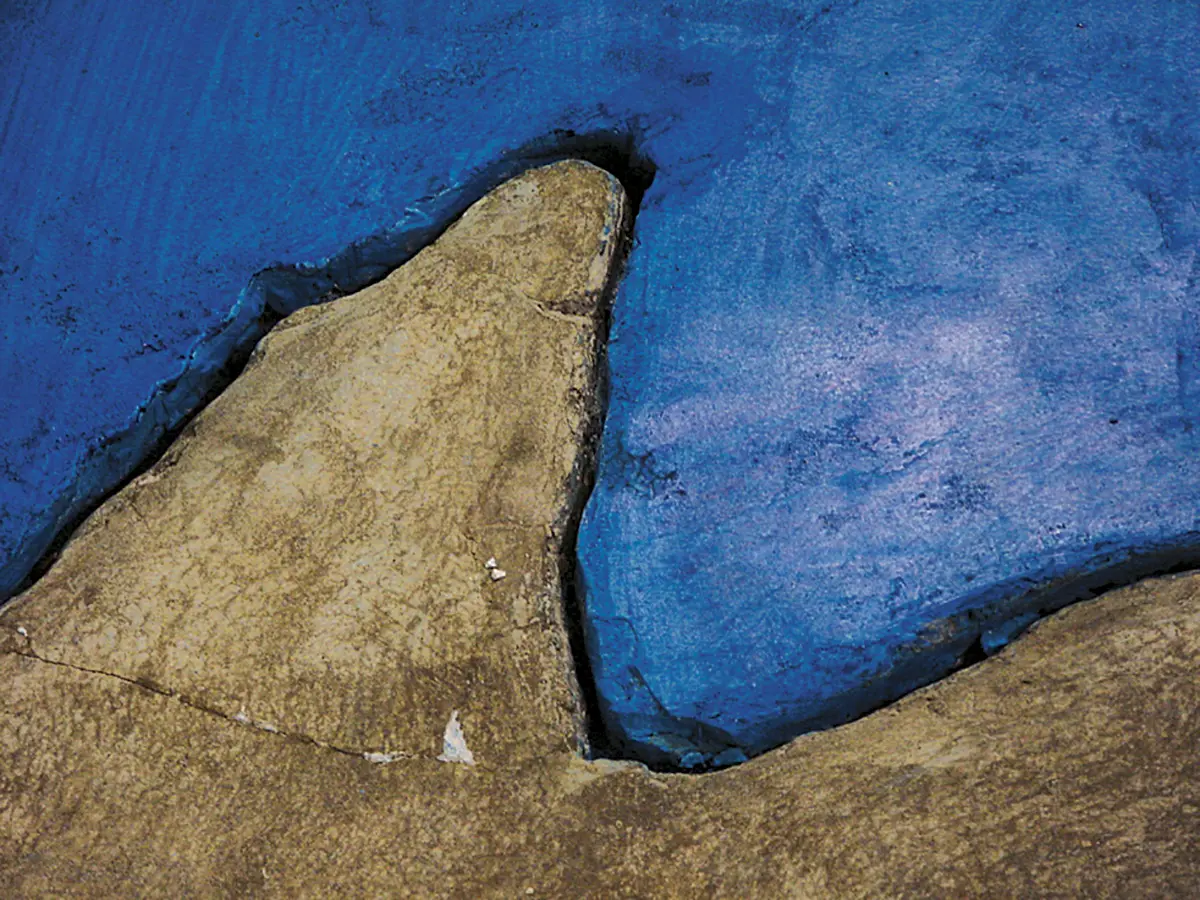
Walking towards the gallery, we discover three monitors, one on top of the other according to their different sizes. Each of them shows black numbers against a white background like those of a clock; although they are hand-written, these numbers have been digitally processed, thus marking a point of ambivalence between the human and the technological, alluding to the perfection of both types of machinery as well as to what is implied in a clock that marks or counts the passage of time —or any other quantifiable value. In front of these monitors, leaning towards the gallery’s left half, we see a sort of platform the color of blue and gray cement, whose undefined form reminds us vaguely of a pyramidal foundation. The platform is divided into two fields of color by a crack. It can be accessed through a pair of steps, but in order to climb the structure one needs to take one’s shoes off. The platform is on an incline so that the structure’s angular border is at its highest point. The colors are disconcerting and pose further questions, since its form suggests an interpretation of the sea, but inverted. Once again, as the gallery text put it, nothing is what it seems in Vargas Lugo’s work. The piece is completed by a projection of graphics in movement onto part of the floor and walls, from a projector hanging from the roof. To fully appreciate the projection, we need to be at the highest, most angular extreme of the platform.
Now, if you climb the platform, walk towards the high border, and look down at the projection, leaving the monitors behind, the structure’s incline will force you into the same posture one adopts on a ship’s bow, a mountain summit, or a cliff. The movement of the graphs is like that of the ocean’s tide, and that of the hand-written clocks does not correspond to any apparent logic within the work, but it represents an unending count that after a specified period begins again, marking a direct relation of indefinition between the various elements. The power of this work emanates from the sensation and the experience of its different parts as a whole. On the one hand, the position we have to adopt in order to see the projection in movement from the highest part of the platform brings to mind Caspar David Friedrich’s famous 1818 painting Wanderer Above the Sea of Fog, in which the character, his back to the mountain’s summit, gazes forward upon the clouds and the world with a contemplative attitude and a firm posture. This image, emblematic of German Romanticism, deals precisely with the contemplation of the incommensurable. In the case of Vargas Lugo, the contemplation of the Vague Statistique —a play of words between a vague statistic and a statistic wave. To appreciate and experience all the installation’s elements simultaneously is impossible. The experience is, then, cumulative and needs to be carried out step by step. Vague Statistique is one of those works that constitute a challenge. Seen passively, it could be classified as a structure, three monitors, and a projection. Experienced actively, entering the fantasy that nothing is what it seems, the world changes radically. Encased in an entirely white cube, a fantastic world exists where the only requirement is to abandon oneself to the change of our schemes and to accept the new referents proposed by the artist. Vargas Lugo has the ability to reorder the world without falling into schizophrenia, changing the veil but leaving a recognizable essence, switching the values of representation.
FRANCISCA RIVERO-LAKE