Like a fragment from a labyrinth created by Jorge Luis Borges, Chilean artist Pablo Rivera’s golden dream stands strong and weighty atop its 16 columns. It is geometrically perfect. It allows not only for contemplation by the viewer’s alert eye but also for the eye’s penetration into its entire interior space. It can be described as a nude cube, an unplotted structure, and it is titled Minimal # 3: The Golden Dream.
This large-format conceptual work, created in 2001, takes over (with its 6 x 7 x 2.20 meters) the entirety of Caracas’ RG Celarg hall. Its most luminous aspect is its volume and the different divisions it displays, as it represents, from the figure’s point of view, an ironic recreation of an early Twenty-First Century Chilean social housing structure’s skeleton.
The viewer will quickly discover in the sculpture (Rivera calls himself a sculptor, in the sense of one who organizes objects in space) elements derived from Minimalism, that Twentieth Century aesthetic movement that emerged in 1965 in the United States, characterized by its simplification of forms —a “reduced art” built on the basis of the essence of primary structures.
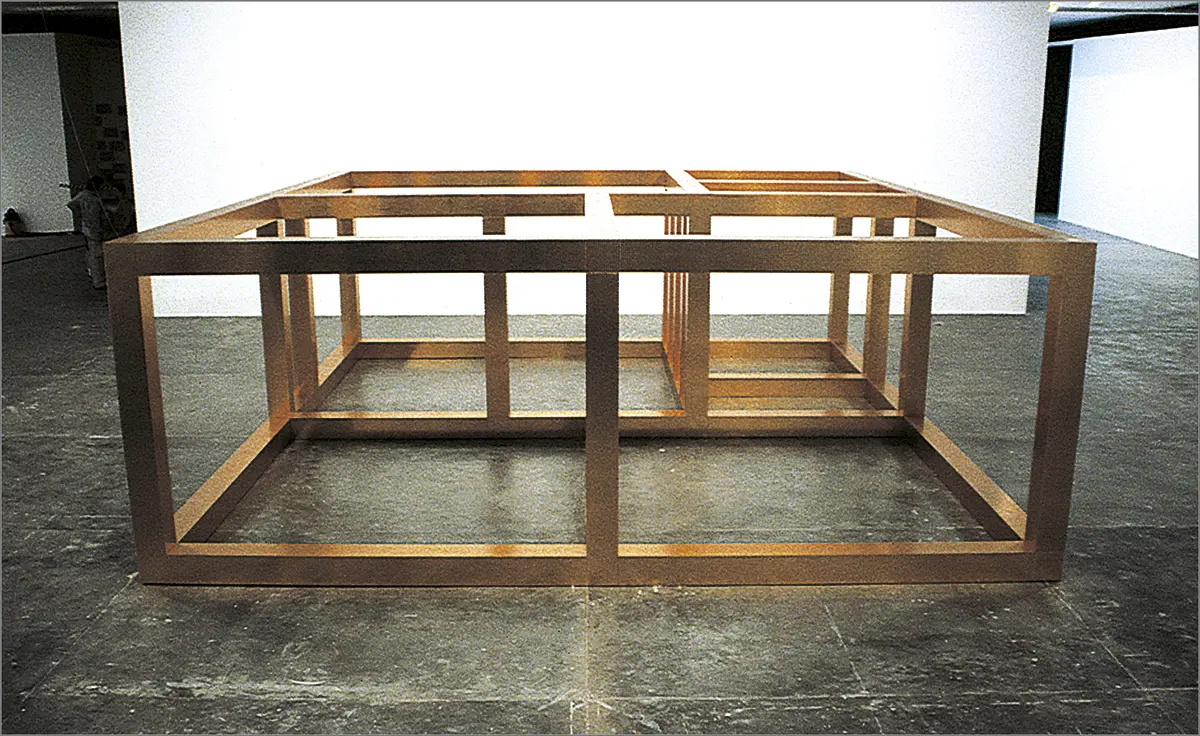
By turns, the cold and lonely image of Minimal # 3: The Golden Dream brings to mind the work of American artist Sol LeWitt, the Connecticut sculptor, and printmaker who, starting in the 1960s, used three-dimensional modular frames (particularly cubes) as a source of inspiration to express a virtual and infinite series of combinations. We review all of this mentally as Elisa, a young art student, traverses back and forth, for hours, the invisible walls that divide the five rooms comprising this piece, or imaginary house.
On the one hand, Rivas’ work functions as a blunt critique of the precarious, squalid basic housing into which many contemporary Chileans are forced. According to the artist’s declarations to the media, he faults the State for that circumstance. On the other hand, the piece is simply an aesthetic excuse the creator uses in order to transform architecture into an object.
Regarding color, the whole structure is covered with gold-colored paper. Seen in detail, this paper is itself covered by a myriad of small circles, each encircling a four-point star. “The idea is for the gold color to act as a kind of blindfold when we try to visualize a problem as raw as poverty,” Rivera exhibited.
To avoid an overwhelming golden reflection across the exhibition space, the piece is not situated under direct lighting, yet Minimal # 3: The Golden Dream can be observed clearly from any angle, despite some details related to the gluing of the gold-colored paper that can be seen around the corners and the column joints.
Another interesting fact: Rivera competed with this piece in the 25th São Paulo Biennial, March-June, 2002. Similarly, his Minimal # 2 was shown in ARS 01, Unfolding Perspectives, a 2001 exhibition at the Kiasm Museum of Contemporary Art in Helsinki, Finland. In general, Rivera’s work, relating to urban themes, has appeared in group shows in Brazil (I Bienal do Mercosul, Porto Alegre) and the United States (Prospect & Perspective: Recent Art from Chile at the San Antonio Museum of Art).
Rivera, born in Santiago de Chile in 1961, graduated from the Universidad Católica de Chile and studied for a year at the London College of Art. He currently teaches visual arts at the Unicc and Arcis, in Santiago, where he lives and works.
Rivera is considered one of the best-known artists on the alternative circuit, and many critics have pointed out that his conceptualism derives from an ironic stance, Since 1990, he has exhibited the following: Fragilidad de zona (installation, with Álvaro Oyarzún), at the Las Condes’ Instituto Cultural; Digalbondinga at the Museo Nacional de Bellas Artes; Purgatorio (1995), in Santiago’s General Cemetery; Purgatorio (or Decoralia, a piece for public parks), at the Bio–Bio Persian Fair; and Menos es más at the Galería Animal. The topic of beauty, Rivera says, is not his primary concern. “I think that at this point Beauty is a concept already installed in our culture. As an artist I must not limit myself to just one medium, much less to one style; I must seek the adequate tools to generate my questions.”
PABLO VILLAMIZAR