At first glance, Pablo Reinoso’s (Buenos Aires, 1955) powerful show at Galería Ruth Benzacar appears to be a neat furniture exhibition filled with everyday household items. Reinoso’s impeccable installation Cocina y comedor comprises the stylized photographs of the Cocina series, and A la mesa, a centerpiece of the comedor. As the artist points out, “both works seek to put in motion aspects of our daily experience and of our habitat, by means of a disorganized order.” But there is more.
The artist’s warning about that “disorganized order” comes into full meaning as the viewer moves around A la mesa, a unique, thought-provoking piece offering several perspectives created specifically for the gallery.
Seen frontally, the piece appears as an environment with wooden furniture —a table, five chairs, three chests of drawers— on a hardwood floor that resembles a dining room done in pinewood. Behind these items, we can see some out-of-place pieces of wood, but these do not fully disturb us, because our gaze tends to focus on the solid and dominant “dining room” —primarily a place for rest— where people could arrive in order to sit “at the table.”
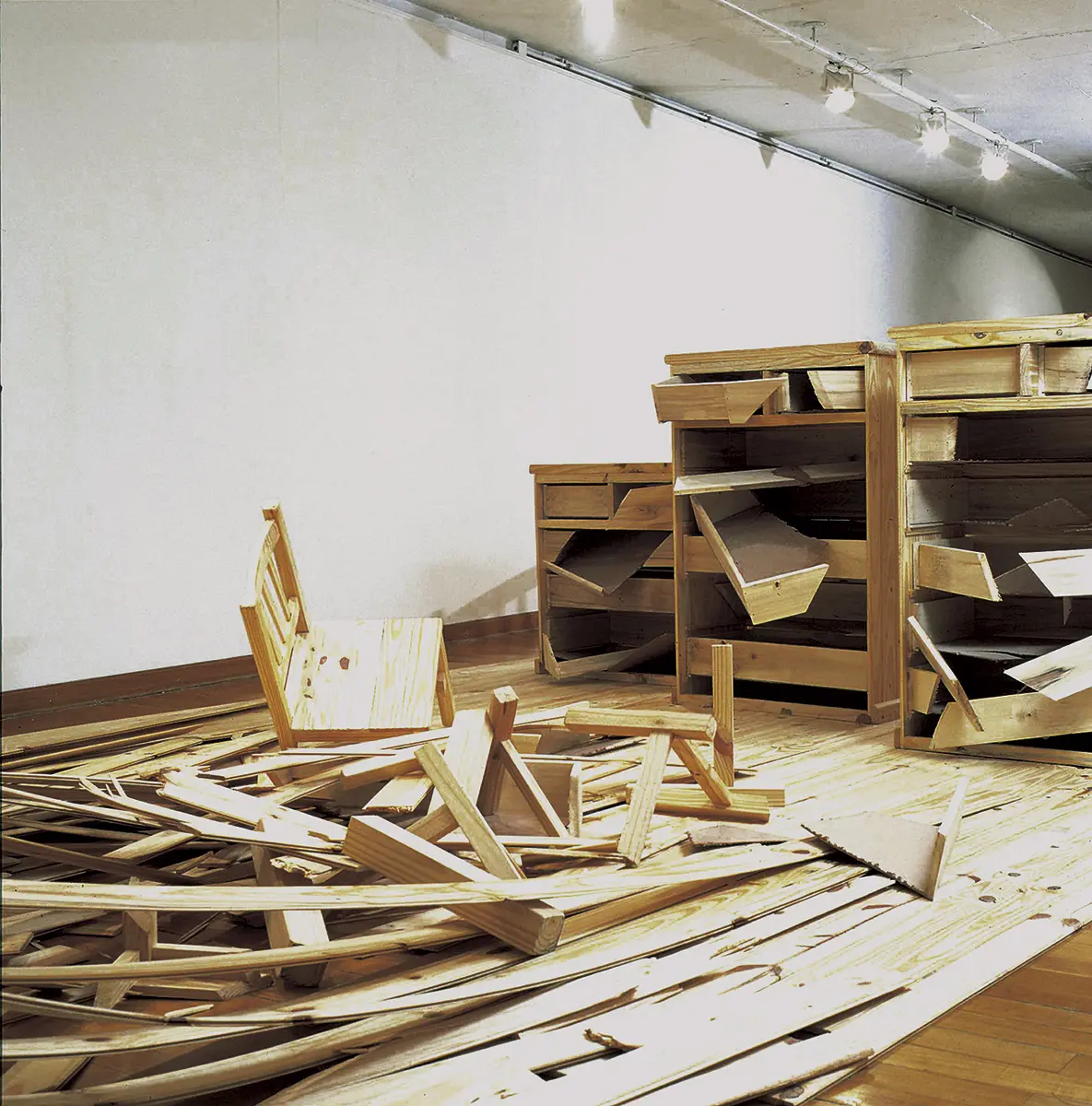
Nobody eats here, though; the dining room remains empty. The surprise is to be found behind it. As the viewer moves to the back section, it is revealed that the “dining room” is entirely out of whack. The drawers are broken, the chairs in tatters, and the floor seems to have been ripped by a tornado or an explosion. Or has this ”dining room” self-destructed?
Reinoso manipulates wood as if it were some sort of malleable plastic; unaccountably, it is even possible to find a certain harmony in this piling of his materials, reflecting perhaps society’s hardened attitude towards poverty and inequality.
One needs more than one look to understand that Reinoso’s digitally manipulated photographs represent distorted images of household appliances. The reproduction of a toaster from above shows lines that, extend to the sides, and form a grid with electrical coils. Like a wire fence, this grid keeps secured and inaccessible a small piece of bread. Many for the few, few for the many?
Beyond this seeming description of the two faces of the world’s current economic conditions and the debate over globalization, the impact of A la mesa is multiplied when seen in Buenos Aires. After all, it is not easy to remain indifferent in the face of the extreme misery and hunger of many in a country that used to be considered the “breadbasket to the world.” The impression left by Reinoso’s intelligent piece is a lasting one, and it fulfills the artist’s intention of “commenting” on the contemporary.
The most direct precursor to the works presented now in Buenos Aires is Reinoso’s 2002 installation Ashes to Ashes (Casa de América, Madrid). There, the wooden cleats of a room’s roof seem to disengage from their place and rain downwards, announcing their intention of ending up inside a decorative fireplace (also in wood, and also built by the artist.) Ashes to Ashes seems to speak of dissolution and fleetingness, of that which is lost.
In 1995 Reinoso left behind the materials he had worked on since 1973 —wood, marble, bronze, and steel— and set out on a new and bold search that remains ongoing. First, he modeled air using fabric, creating his “breathers” in many shapes, sizes, and colors. These soft objects, sort of like bags with an internal electric fan that turns on and off at regular intervals, refer to the movement of our lungs. They inflate and deflate rhythmically, with a faint wheezing, that replicates the surprising effect of breathing—the necessary requirement for life. “They alluded to habitat in its first metaphor: the body,” says the artist.
Later, starting in 1999, Reinoso started using glass and liquid crystals in his installations, challenging the viewer's eyes with the interplay of the transparent and the opaque, and of the double and the other, deepening his interrogation of the self.
Trained in sculpture, Reinoso has lived and worked in Paris since 1979 and has professional ties to the world of design. “I feel that my work as a designer has marked my artistic perception deeply,” he says, happy to be exhibiting in his native Buenos Aires after seven years. “My intention is to continue to follow those two paths on their respective registers, but leaving the field of perception open so that it is possible to allow and assume in each proposal the ‘emergence’ of a bursting-through.”
VICTORIA VERLICHAK