Homage to Michelangelo Buonarotti, Sculptor is the title of Panamanian painter Olga Sinclair’s most recent exhibition, organized by the Mateo Sariel Gallery and presented at the Interoceanic Canal Museum in Panama City. The show features oil-on-canvas paintings echoing sculptures by the great master, such as the Night, the Dawn, the Rondanini, Nicodemus, Palestrina Pietás, and the famous Slaves. As if studying human models, Sinclair based her paintings on these celebrated sculptures from 500 years ago, many of which probably caused an impression during her visit to Italy on the occasion of a recent exhibition of her work held in Florence.
The appropriation of models from the past and the practice of alluding to the work of the Masters are common elements in postmodern art. Throughout the years, Olga Sinclair’s works have quoted or paid homage to Dutch figures such as Rembrandt, Rubens, and Vermeer, and her new move is coherent with her artistic development. It is, however, a challenge, one not exempt from danger, since the quoting of emblematic images can range from a mere imitation of shapes to the reinterpretation of an atemporal aesthetic message. It needs to be understood that in this series Olga Sinclair finds inspiration in Michelangelo’s sculpture, not in his painting. The oft-repeated assertion that even in his pictorial cycles Michelangelo was a sculptor comes readily to mind. With this show, Sinclair has the opposite relationship —the case of an artist who does not practice sculpture but attempted to reproduce on canvas the impact and the volumetric mass of those human representations the Italian Master so skillfully achieved in marble.
During the show’s opening, Sinclair alluded to and celebrated Michelangelo’s magnificence. She also acknowledged her first teacher: her own father, the well-known Panamanian painter Alfredo Sinclair, who distinguished himself for his skill in the use of color and his role as Panama’s first abstract artist. Olga Sinclair’s work, in turn, manifested a predilection for the human figure ever since her beginnings some thirty years ago with early charcoal drawings of young women and black-and-white studies of figures in sfumato. Yet despite her focus on the human figure, over the years, Olga proved to be her father’s best disciple, precisely through her handling of color in a career that began with a first appearance at an art exhibition at the age of fourteen, and spanning until today with some thirty individual shows in Latin America, Europe, and Asia.
Already in 1982 José Gómez Sicre described Sinclair’s composition as “subtle, evocative, subjective, and extremely lyrical, free of literary or illustrative implications… she focuses on the human figure but provides only a schematic vision of reality…” From those charcoal studies she moved on to working with pastels and oils, generally in small formats, and she progressively incorporated color into her work. These were romantic compositions of isolated, languorous female figures, their eyes closed or their faces hidden, as if immersed in a long sleep.
Sinclair, who for several years lived in Bolivia and then in Indonesia, intensified her colors, creating compositions in larger and larger formats. Figures multiplied and gained strength, and so did contrasts of light and shadow; the artist depurated more and more of her still lives. Behind she left her tenuous dream-like atmospheres, albeit not the general somnolence of her environments. In works with a newfound anecdotal character, women or male figures such as monks or bishops appeared dressed and wearing hats, surrounded by everyday objects, often as still lives on tables.
An important shift in Olga Sinclair’s work occurred around 1999, with the aptly titled Renovación exhibition. Filled with an innovative impulse, Sinclair faced her true skill with color, leaving aside the anecdotal figures of her previous work. With this, a period started where the human figure was thoroughly subordinated to color, transformed into an element for the transmission of humanity and dynamism. This shift was evident in her images with faces as well as in her compositions of human bodies, now nude or bathed in chromatic freedom, and also in new still lives in which fruits became shapes, colors, and expressions.
This liberation has continued ever since. Sinclair’s most recent works reveal an artist increasingly abandoned the abstract values of painting and the sensuality of the human form, be it in isolation or in dynamic, overtly sexual poses. Even her still lives acquired a voluptuous sensuality, something announced by her previous work but not fully realized until now. Her best still lives are those in which there no longer is a table or a tablecloth, empty cups, or flowerless vases, but compositional elements whose sole mission is color and which refer only vaguely to everyday life.
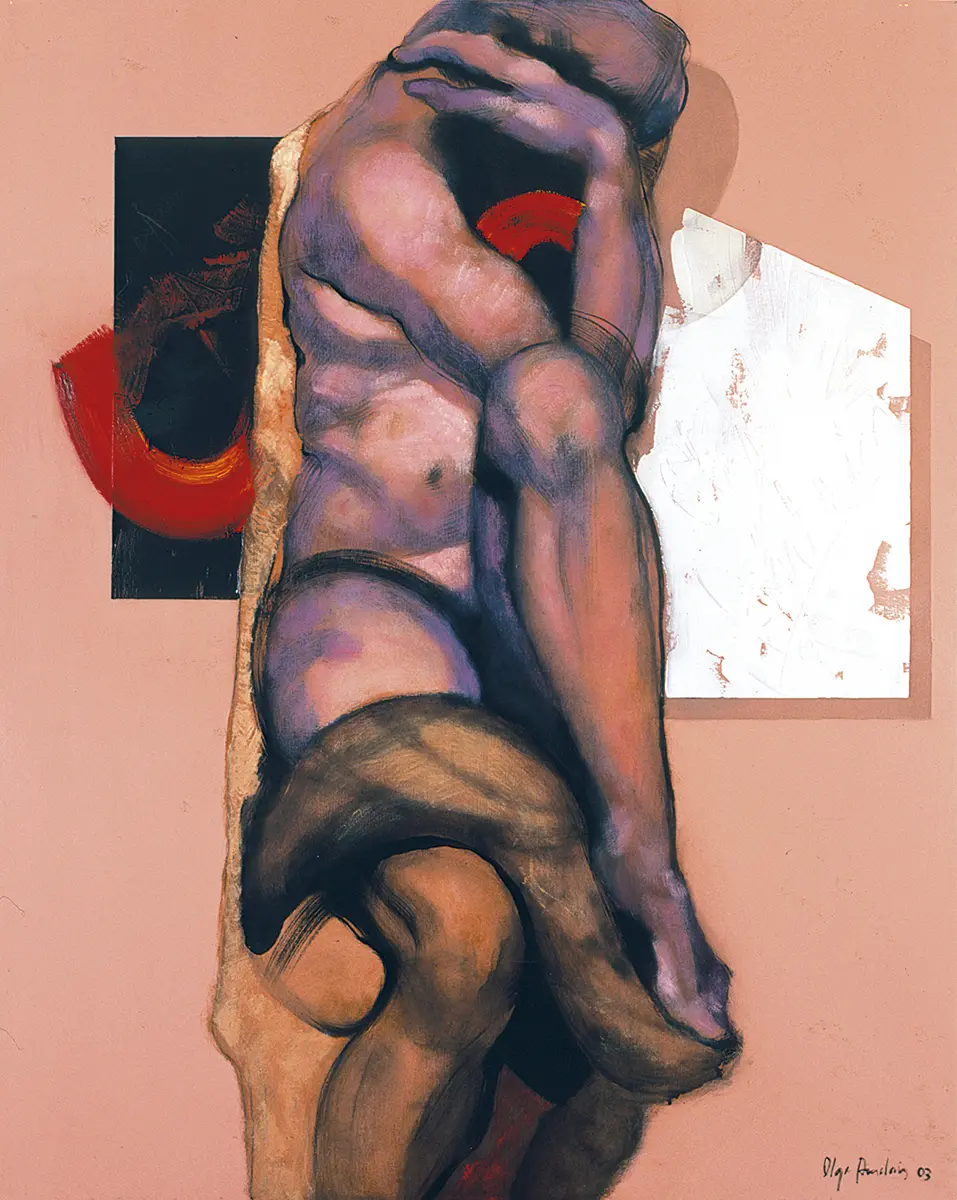
The current show is the result of all this development. Sinclair dares to borrow figures from Michelangelo’s marble in order to carry forward her exploration of the human body but, above all, of color and sensuality —the axis of her work. As a whole, the paintings on exhibit generate a highly dramatic sensation of nude figures, of physical power, of an effort to reduce everything to just the essential and to insinuate spirituality through the depiction of mortality. The note of innocence struck by some of the faces here is disconcerting, in comparison with the emotional intensity that characterizes the Italian originals. Similarly, some figures, despite their bold anatomies and colors, lack the feeling created by anatomical drawing from life, the moment when brushstrokes become veins and muscles —a moment we appreciate in Michelangelo as the result of a mastery that is worth imitating.
As a whole, these paintings are a significant step in Olga Sinclair’s development. For instance, in La Notte, she presents a sensuous three-dimensional body that simultaneously conjugates its form with a salmon-colored background with white, black, and red insertions. The human figure in Sinclair’s second interpretation of the Rondanini Pietá seems to carry the weight of the world in its shadow, as an echo of its contour. Equally impressive are the figures of the slaves, titled Giovane, Atlante, and Morente, with their contrapposto positioning and the weight of their anatomies in an acid-green, Mannerist environment, very appropriate in the context of this homage to the late Renaissance. In contrast, the show’s well-crafted still lives seem utterly modern, and they reflect the combination of unusual hues and passionate lines that this artist, at her best, conquers.
MÓNICA KUPFER