Although London-based artist Ofelia Rodríguez has lived in Europe most of her adult life and draws knowledgeably from European and American art history, her art is predominantly informed by memories of her native Barranquilla, on the Caribbean coast of Colombia. This is not to say that she rejects modernist influences. Indeed, Rodríguez’s whimsical mixed-medium paintings and “magic box” constructions bear the imprint of Pop art and surrealism. Her solid, bright colors flatly applied to broad areas, as well as her obvious fondness for kitsch and popular culture, tie her work to Pop art. However, the juxtapositions that arise when she incorporates ready-made objects onto her canvases, give them a strong surrealist twist. The artist has been collecting and accumulating objects—horns, fins, cowhide, brushes, baby–bottle nipples, and plastic toys—over the years without knowing exactly how they would ultimately fit into her work before she starts combining them on the canvas or inside the boxes. These popular and iconic objects relate to Rodríguez’s emotional memories from childhood and create a universe of signs that is essentially vernacular. The fins, for example, allude to the sharks that prowl the Caribbean waters of Barranquilla, the cowhide a reference to the carpets commonly used in the households in Colombia, and the horns are talismans recalling farm animals from her childhood. The bright colors she favors clearly evoke the tropical landscape.
Rodríguez’s work is autobiographical, not only in the way it reflects her native Colombia but also in the way that it refers to her body. She photocopies parts of her body—fingers, ears, thumbs, hands, feet, eyes—then enlarges these reproductions and hand-colors them. There are also sexual references, such as images of tongues reproduced from anatomical books, and ready-made objects like plastic nipples.
Rodríguez’s work has been exhibited primarily in Germany and in Colombia. This is her first solo exhibition in New York, and the show represents a selection of work from the last ten years. The exhibition features five large mixed-medium paintings, four wooden boxes, and ten small collages on paper. The collages are among her most recent pieces and include such works as Memories of Primary Landscapes, Bleeding Finger over Banned Territory, and Barely Touching a Thirst from the Past, all from 2003. These small works (61/2 to 91/2 inches) are collages of photocopied body parts, often shown isolated in the manner of an ex-voto. Rodríguez sews and stitches them onto painted paper. In some, a band-aid is sewn to the surface to evoke a wound. These small collages create landscapes that recall the poetics of Joan Miró’s paintings such as The Tilted Field (1923/24) and The Hunter (1923/24), with their system of signs and colors. Rodríguez’s titles add an enigmatic and humorous tone to the pieces.
In the large mixed-medium painting Searching in Darkness or Portrait of a Past (1993), a piece of cowhide is sewn into the red-painted canvas, surrounded by colored photocopies of Rodríguez’s hands extending from the cowhide, reaching out into space. Running along the top of the canvas are four photo likenesses topped by fins. Two of them depict the French aphorist La Rochefoucauld and the other two a North American Indian. It can be read as a reference to the cultural clash between European rationalist thought and the new world.
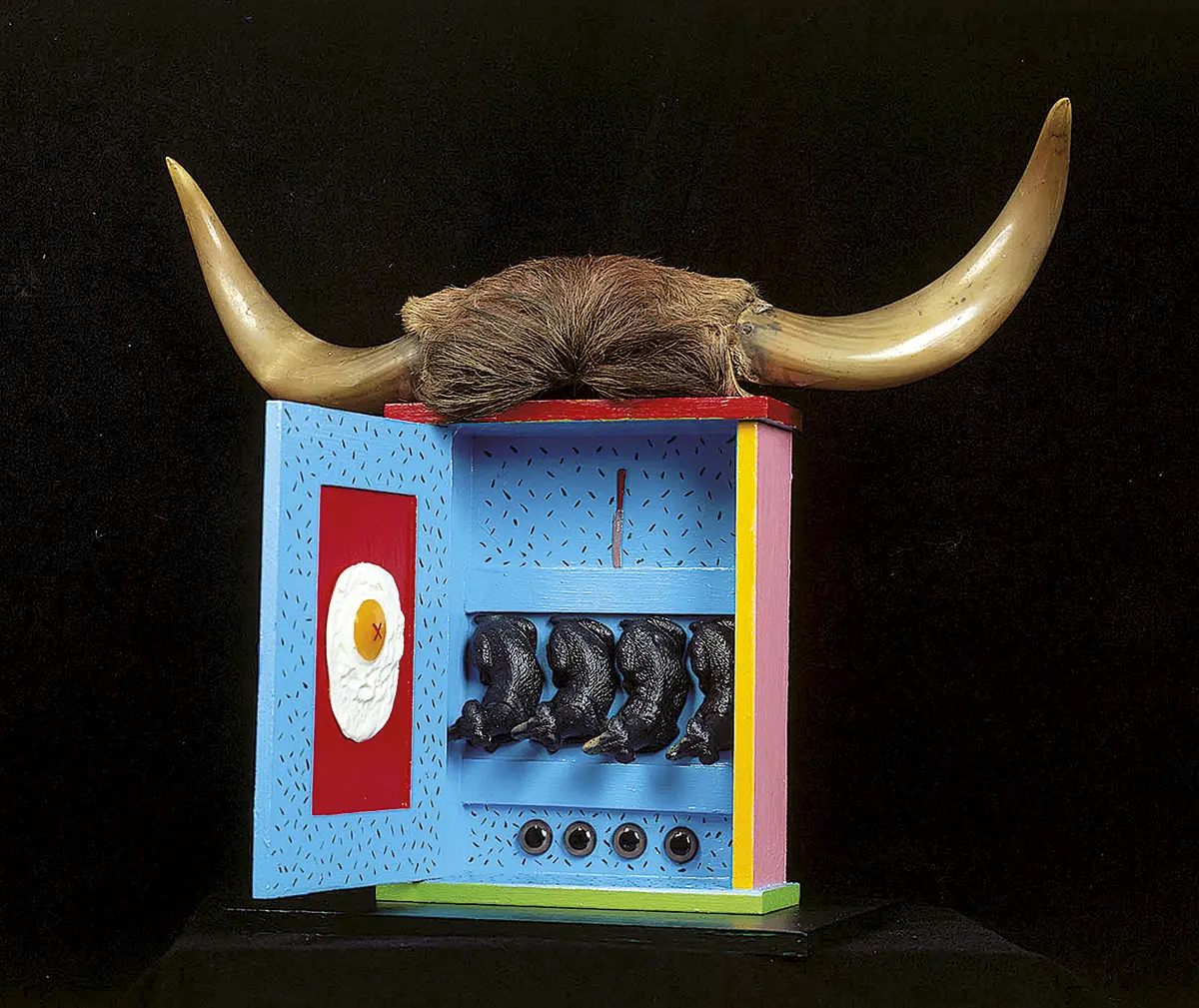
Rodríguez’s small “magic boxes” take their contents from the same universe of signs as her mixed-medium paintings. For instance, a furry horn, an ear, a fried egg, and little dog toys, all made out of plastic, are seen in works such as Dangerous Magic Box with Hot Dogs (1994). These brightly multi-colored boxes, which originally contained keys or French cheese, recall Joseph Cornell’s exquisite fetish boxes, though not as secretive caches, but rather as stages for her memorabilia and intriguing juxtapositions.
Rodríguez’s work offers visual play and pleasure. Her objects are open to endless shifting interpretation. There is an acute sense of care, of thoughtfulness, and each work is an invitation to enter the artist’s mysterious and provocative world.
CLAUDIA CALIRMAN