Just like it is possible to fly away from Earth into infinity, one can travel in the opposite direction and burrow interminably into our planet’s smallest grain of sand. Whichever direction we take, however, it seems we remain just as close to understanding and knowledge as we are far from them.
Seen in this context, Marco Maggi’s drawings constitute a leap of faith, the result of painstaking, hour-after-hour, day-after-day labor to produce an epistemological treatise about that which escapes us. Designed as a precise, perfect system, one governed by impeccable logic, these drawings take for granted that there is an explanation to it all —they are indeed based on that conviction— a trace, an open itinerary that expands in all directions to speak of what is absent.
Attentive even to the details of the invisible (there are areas in his drawings that are only perceived as gray surfaces), Maggi develops his pencil graphs on polished white or black surfaces, in the manner of a “silver tip,” or cuts common sheets of letter paper with a neurosurgeon’s precision. Although his drawings share all the characteristics of an obsession, the artist is not obsessive but stubborn, someone who repeats his melody with rhythm functions, a calm observer who finds the common denominator between high technology and the fluttering of a butterfly’s wings.
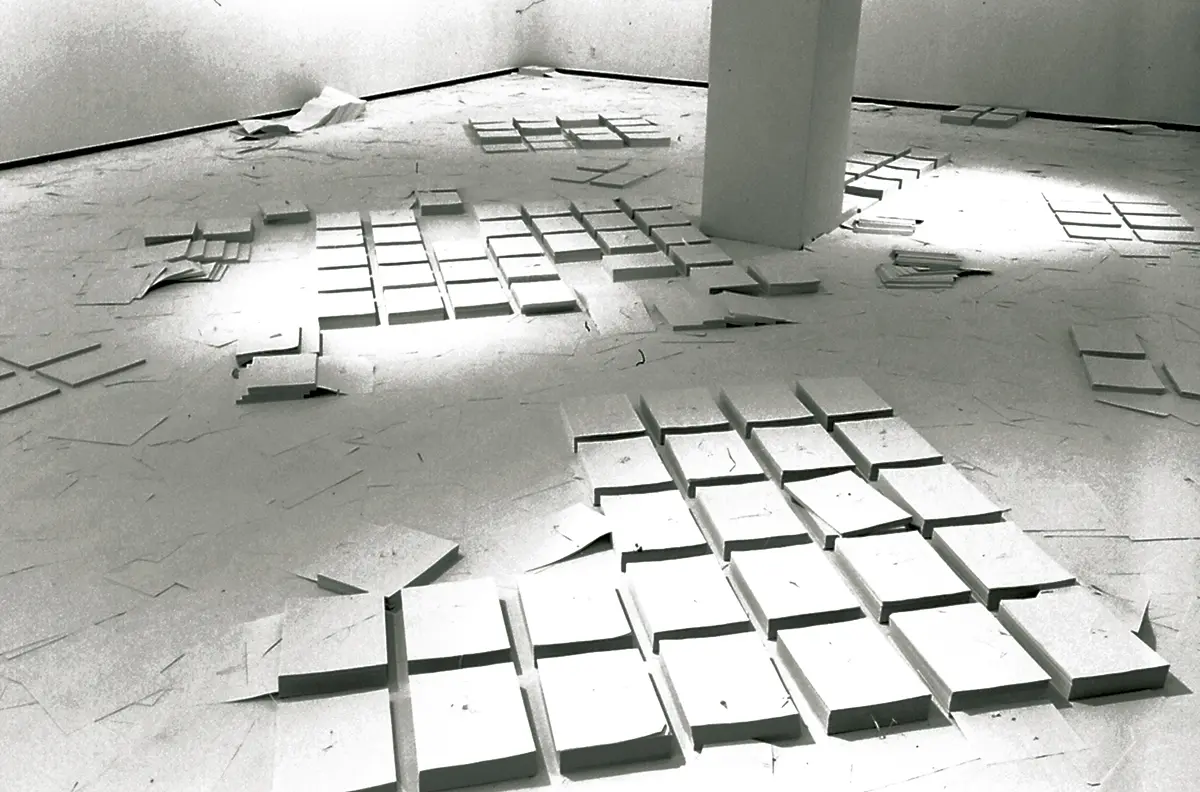
One of those rhythm functions is Hotbed, the installation that covers the gallery floor in its entirety. Reams of white paper, their top sheet worked over with a scalpel, have been arranged in fragmented reticula, suggesting the grid of a city that sinks into, or emerges from, the ground formed by yet more sheets of white paper. Viewers walk on this ground, and as they do so someone, silent and light-footed, arranges fresh sheets to cover their tracks, intent on purifying what men and women pollute in their trail. But it is also easy to imagine that, following this logic to its final consequences, the purifying impetus will end up covering the remains of the city altogether, sinking them into the ground, or hiding them in the depths of a crater.
Up to now, Maggi’s drawings could trigger many different images, according to who looked at them —no specific interpretation seemed to prevail intentionally in them. The purpose of his skill is to speak in all our voices; in this way, his drawing remains distant from interpretation, in itself a paradoxical way of reflecting on the interpretative act. An aerial view, an electronic circuit, a pre-Columbian codex, all these things and none can be hidden in his formal exercise. Maggi’s installation, however, although still open and more closely linked to its content, or if you prefer to the experience of its atmosphere. Of course, the scale and the viewer’s body's inevitable complicity in the perception of the piece contribute their part, but also do the obscure times we live in, helping us to read it as a metaphor for a world on the edge of collapse.
It is conceivable that at a certain level of intellectual friction, of philosophical speculation, Marco Maggi is attempting with this show to express a symmetrical equivalence between building and destroying (hence the show’s title, Constructing & Demolishing). Yet the exhibit grows in its dialog with its context: one fears to be witnessing the extermination of beauty, and at the same time is thankful for this brief in its defense.
ANA TISCORNIA