In her recent show at Casa Triângulo, Laura Lima presented a series of objects to dress the body that had already been seen at the Pampulha Museum of Art and the Ljubljana Museum of Modern Art. This time around, the growing costume collection occupied three of the gallery’s rooms, leaving in the main hall only two very large mirrors facing each other, and the two subsequent halls covered by the notes that preceded the creation of Lima’s pieces.
Some of the artist’s notebooks were taken apart in order to display, next to each other on the wall, graphic elaborations that allow us to follow the thought process that produced the works, among many possible variations Larger drawings showed imaginary costumes, impossible to actually make and wear. Done with yellow and purple markers on the same plastic material in which the three-dimensional pieces are built, these drawings articulate an illogical narrative where the human body develops external appendices similar to bugs or plants: long tails, beaks that become beards, members that sag to the ground, flowers, fruits, gigantic leaves, animal-like manes, crests. These mutations also retain elements of a science-fiction imagination, especially referring to extra-terrestrial beings, and to mythological figures that are a cross between gods, men, and animals.
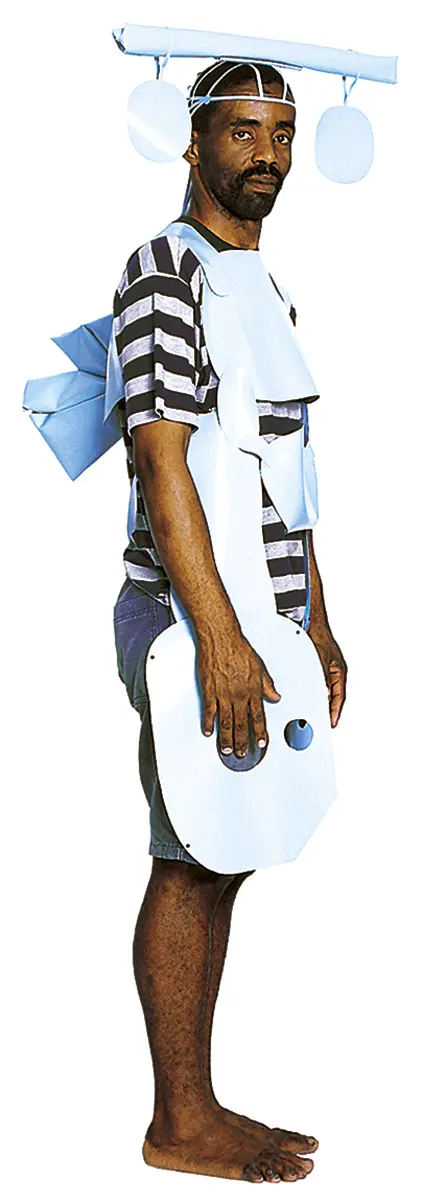
Lima’s costumes start from those graphic studies but do not repeat them. Even those pieces whose origin we can recognize acquire different characteristics in their human scale and three-dimensional existence. Done in sky-blue vinyl, these wearable pieces add to their sense of hybridity and biological mutation, the shapes, folds, and cuts of structured haute couture creations. Despite having been developed from an unending series of drawings that investigate many possibilities with small variations, and seem organic or Darwinian once they are built, it is as if they could not have come out any other way.
Created in co-production with Márcio Ramalho, these suits are manufactured using only three operations: cutting, folding, and gluing. Nothing is sewn or joined in any way other than with glue; this structural characteristic eliminates at once any possible identification with the domestic activity of sewing and any proximity to the idea of line and its relation to drawing. Lima’s pieces are made of planes and doubles, extraction and addition; almost minimalist sculptures, if we want to think of them that way. At first, glance, hanging from supports arranged as a continuous line on the gallery’s walls, these pieces, monochrome and unshapely when away from the body, pain relief. They are closer, of course, to Robert Morris’ works in felt than to de Della Robia's workshop porcelain pieces.
On the other hand, the costume’s relation to fashion and clothing, as well as the fact that they gain in volume when filled by the human body, makes them entirely distinct from minimalist works. Their reference to the world of fashion is reinforced by the way in which the pieces can be touched and handled while they hang; by the presence of the salesperson, who helps visitors try on many possible combinations and comments on the results with them; by the catalog where we can see photos of models, individually or in groups, sporting the pieces around a pool or a fireplace; or by the seductive presence of mirrors, which give us back a reflection of our own appearance as we wear these unique garments. A uniqueness that refers again to haute couture, but also to the realm of fine arts.
To understand the whole collection in a new way, we need to choose one piece, take it down, and try it on. At first, we are overtaken by anxiety in the face of these objects created for the body, which adapt to our proportions but do not jibe with our habits. After trying them on in different ways, the salesperson gives us directions for use and ties the knots responsible to keep the pieces together, since there are no zippers or buttons, nor any other element besides vinyl. Instead of helping accentuate, or reveal the body’s movements and shape, the material’s rigidity constrains them, subjecting them to its stiffness and its weight. If we think of Hélio Oiticica’s Parangolés, which seem to almost float over the body as it moves, so adaptable to the user’s desires, the contrast with these garments into which we have to struggle is absolute. Laura Lima’s pieces hide the visitor’s bodies under costumes and propose new habits for them. In the end, we walk slowly, dragging perhaps an appendage, towards the hall with the mirrors. We see the environment, our image, and the artist’s work reflected in the same space of representation so that the viewer and the gallery are both included in the artist’s narrative.
CARLA ZACCAGNINI