At a time when the visual arts, more than other realms of creativity, are undergoing deep transformations, when discourses, values, and ideas multiply and positions that even yesterday were avant-garde are challenged today, to comment on a work of art is necessarily to pose questions about its status within a given value system. Problematic by its very nature, such commentary is an epistemological expression about the intrinsic nature of the visible image, whatever it may be. The image is all; it is the communication between art and history, artist and viewer, criticism and time, and it projects itself as a concept framed coherently within a container.
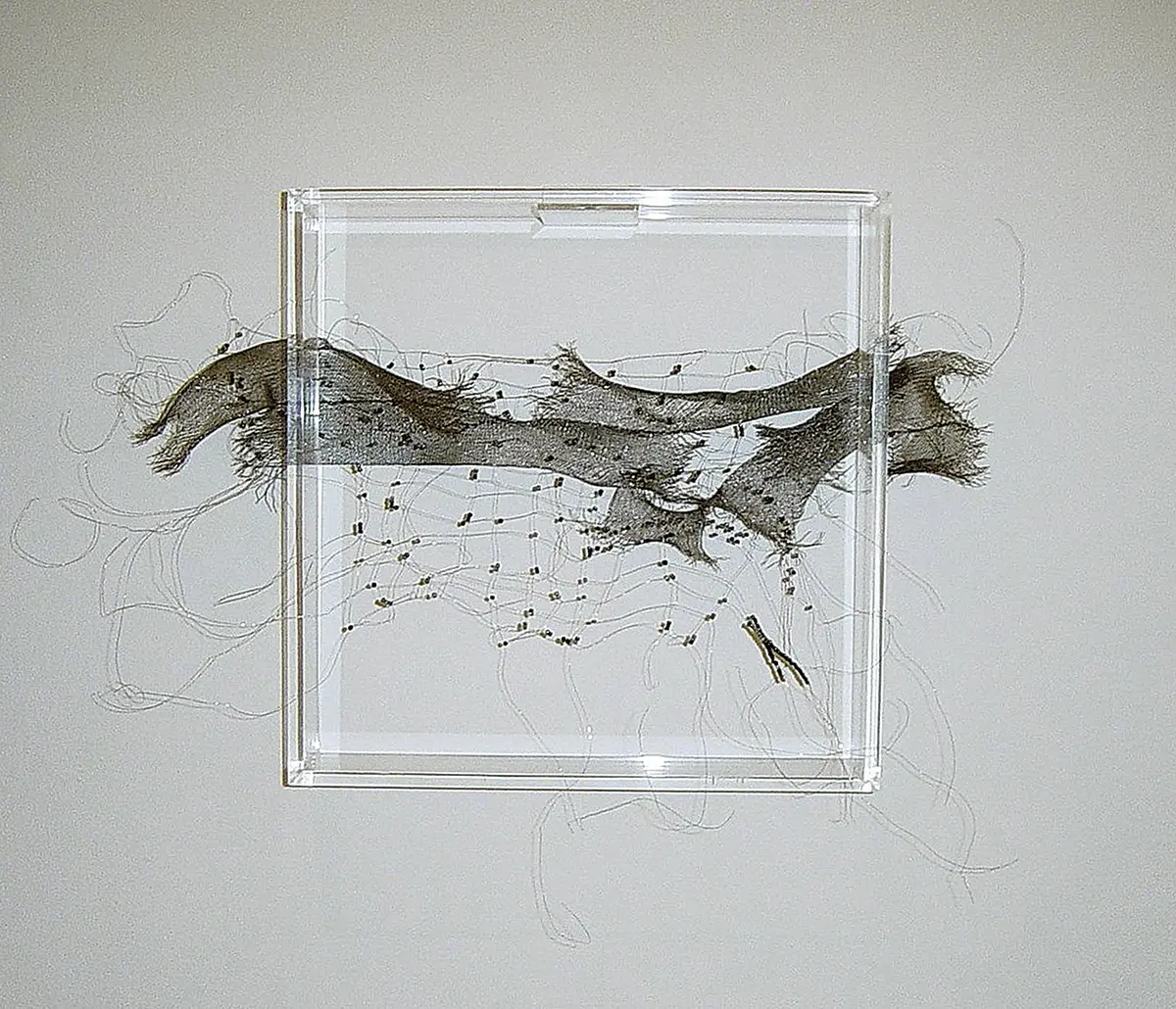
The discourse of Lamis Feldman’s recent work proposes an approach to art in a vivid constructivist conjunction of trivial, insubstantial materials that, in the context of her creativity, become precious and semi-precious. People talk of found materials, but we perhaps should talk of materials sought to achieve a suggestive design through the interplay of lines (wire) and color (beads). Colored beads, thin wires and plastic threads, and delicate metallic meshes lend themselves to the artist’s hands so that a magical weaving can combine their humble aesthetic qualities and transform them into gallantly opulent jewels within a given order and constructive structure. In its “not-saying,” the resulting image is an exquisite presence. It is an object of aesthetic pleasure—a personal, intimate object of implicit and explicit beauty. Thus, any commentary requires reflection on the concept of beauty and its aesthetic value in relation to the artist’s general proposition.
Her container is “interwoven writing,” or Escritura Entretejida as Feldman titles the series of fourteen small and medium-format assemblages that resulted from a nine-year investigation. The series alludes to the age-old art of weaving, which for the ancients was equivalent to creating. An inverted equation operates here: creating is the same as weaving, and we should add, as writing. It is to build and write a discourse on the basis of unconventional plastic values, where art and handcraft come together. Intimate and precious in their presence, each one of these pieces inhabits the border between the decorative impulse and the forcefulness of the structure. These are assemblages, but they are also the jewels of a possible beauty, projected in their incredible lightness and transparency. Supported by a structure of intricate organized weaving, these pieces expound on several statements: decorative, beauty, sensibility, and emotion. These statements are not new to the Venezuelan artist’s work. From her first works created using graphic techniques, and from the beautiful series of enamels for which she received the Arts of Fire National Award in 1980 to the series of still lives she called Gypsum, Lamis Feldman has maintained a taste for the exquisite.
Each piece of this Escritura Entretejida hosts a silence on the verge of revelation; viewers can not purposefully uncover that revelation—they can only perceive it through their gaze and in their hearts, without limits to the emotions they experience, since it does not contemplate reason. Small beads in a rainbow of variegated and joyful colors, shining as the light touches them, suggest the intimacy of dreams that hide desires. They evoke nothing but feelings, and, in an astral journey, the viewer follows the enchanting spark that emanates from them. Beauty always captures our attention.
BÉLGICA RODRÍGUEZ