“I make a lot of drawings, pastels, and paintings on paper. I work on a number of pieces simultaneously. I also pursue my ideas through graphic design and sculpture. This way of working is what I always wanted, and I am unable to work otherwise. This is what allows me to paint what I truly want to paint. Such mobile meaning of my artistic praxis allows my work to remain open, and allows me to change according to my needs, without holding on to anything.”
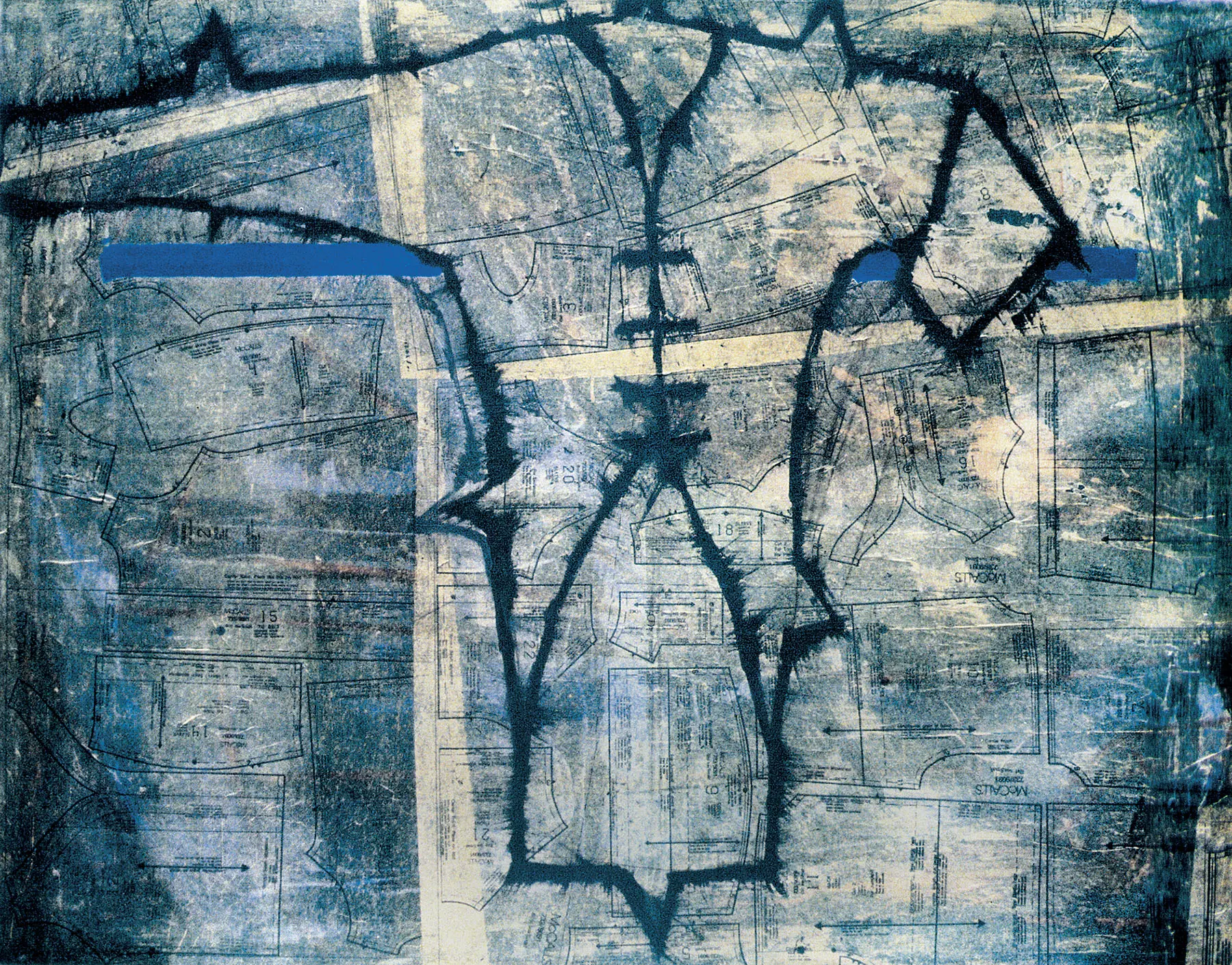
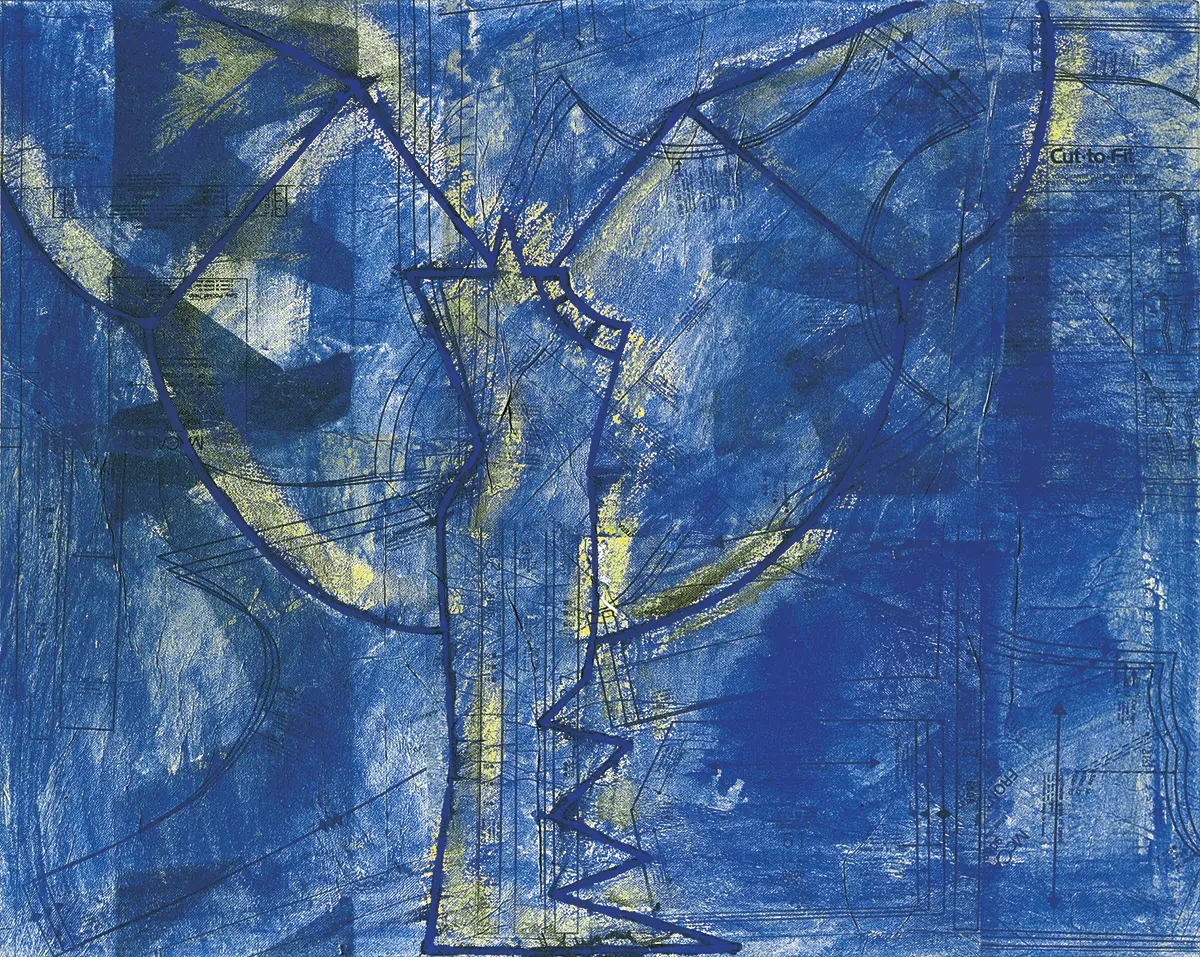
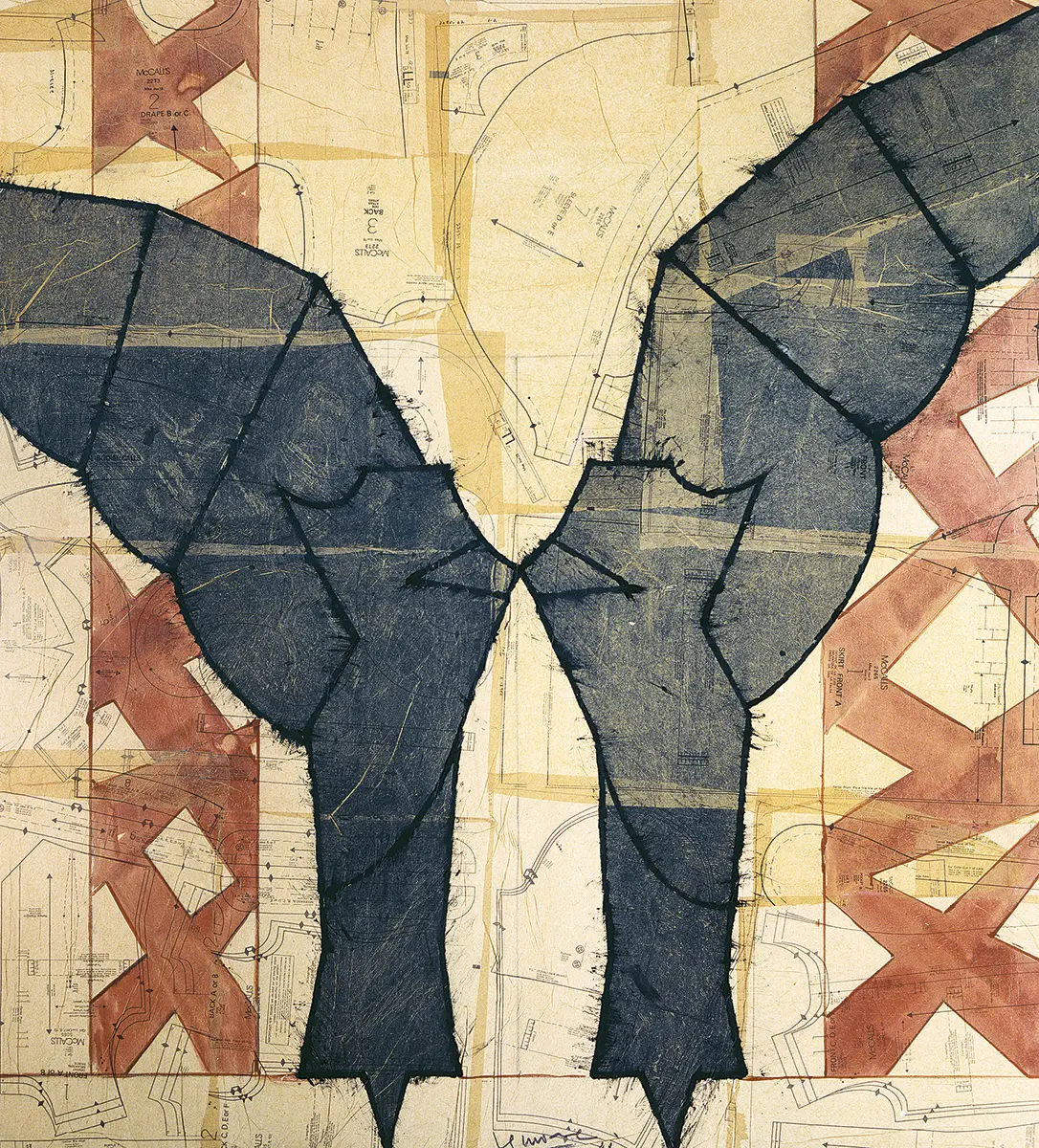
Juan Lecuona’s clarifications regarding his work confirm that the pictorial, painting-as-such (leaving aside any polemic about its validity), exerts a libidinous attraction on the artist and constitutes a decisive articulation of his work. Today, Lecuona uses sewing patterns on intensely vibrant backgrounds —sensorial, sonic backgrounds, not informal ones— thus confirming the painting’s capacity for practical renewal. For maximum quality, Lecuona researches materials and pigments and experiments with acids. He washes and dyes the canvas, superimposes layers, and makes large dilutions. The patterns are affixed to the base plane in different positions, and their profiles are simultaneously defined in a distinct manner, sometimes ragged, subject to accidents. These patterns allude to the representation of the body —the thematic axis in recent decades. They refer to an absent body, a nonexistent volume, a project displaced as a future possibility.
Lecuona reformulates the erotic charge: gender is evident; these are always “young ladies.” The title of one of his paintings, Las señoritas de Avignon (The Young Ladies of Avignon) is an ironic cultural quote. Not so long ago, these “señoritas” from the lower middle class counted clothes-making and designing among the “permissible” activities they could engage in. It all relates to a specific time, to the “good homemaker” ideal, to modest neighborhood projects, and to the presence of women in traditional households. Sewing patterns allude to domestic work, handcrafts, to wistfulness (the dress of one’s dreams is always better than the one actually creates).
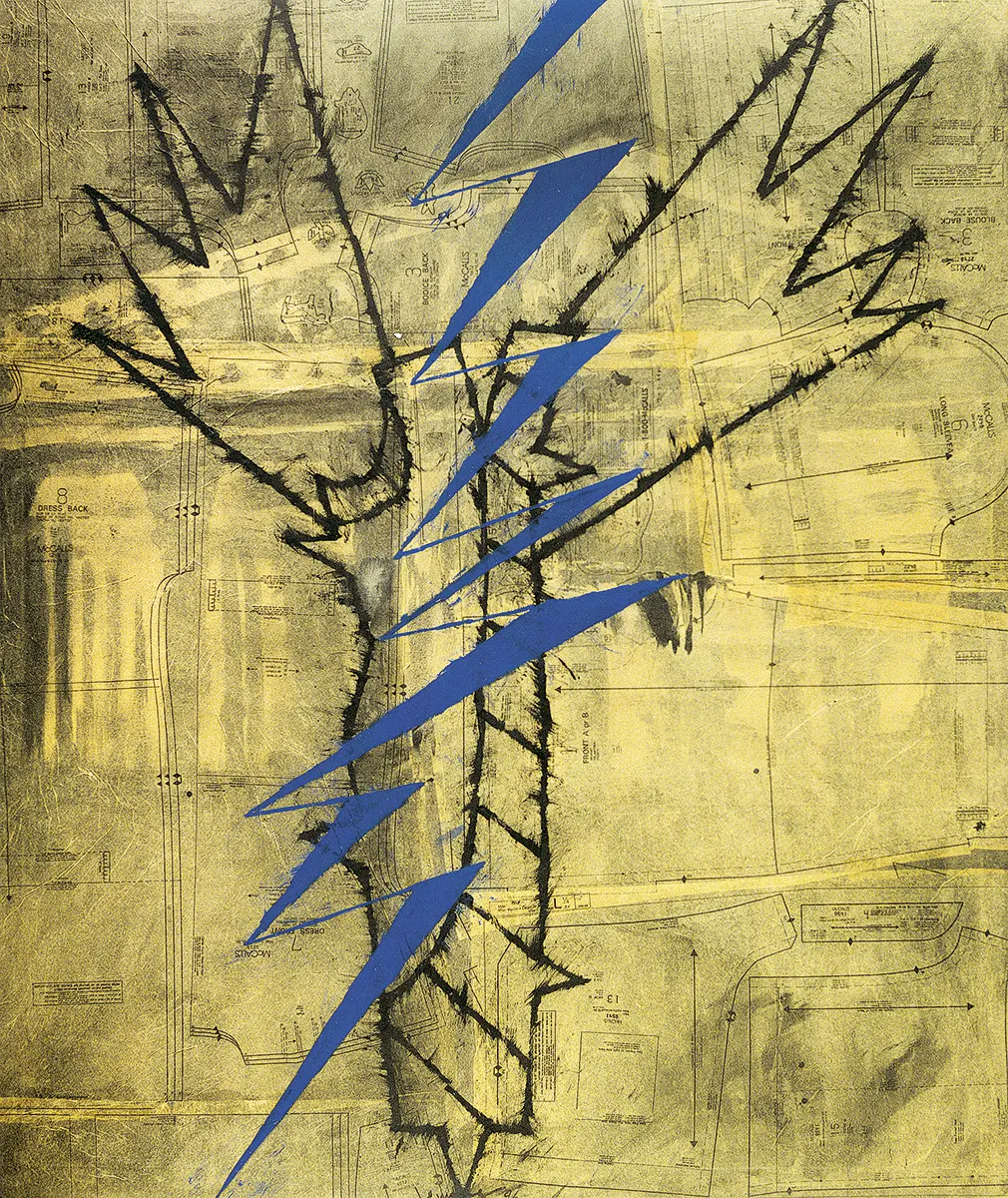
Lecuona does not set masculinity in opposition to femininity. The truly paradoxical and subtle element in Lecuona’s reference to the body as a site of meaning is his interpretation of the neighborhood, of the period’s female educational code. Such reference is more inaccessible and difficult to interpret than the presence of sewing patterns as abstract designs or formally valid textures. The need for an oblique point of view imposes itself. These “señoritas” admitted change, they became winged “angels” or “victories,” veritable nikes. Like a veiled allusion to the Victory of Samothrace, with its proudly structured wings, their profiles have incremented the creative interplay. The first one had a neoclassical background, like that of a museum. At other times the figure is duplicated and becomes phantasmal. Lecuona’s titles bring these figures back to the limited world of the neighborhood: Princesita malcriada que habita el palacio del fracaso (Bad-Mannered Little Princess Who Inhabits the Palace of Failure) —a pretty, good, angelic, naughty little princess. The interplay of images and titles turns enigmatic and private, at times referring to certain favorite haiku. As Baudrillard has said, “The world plays with us just as much as we play with it."1
These characters are not the only references we have seen to childhood, and specifically to Argentinean reality and its memory. There have also been those plumas cucharitas (“teaspoon pens”), serial objects developed in 1998 that, as an element of writing in school, bring back the school kid, the desk, the inkwell, the patriotic songs (so forgotten today), and again the neighborhood, the small world of a nonetheless strong affirmative character that is “home.”
Lecuona had already worked on another serial object, the calla lily, a flower that is typically used in funeral wreaths. His calla lilies were not only objects. They also followed a variety of trajectories. The volumetric calla lily became bi-dimensional in painting. As was the case with the sewing patterns, there is a transfer from one dimension to another. Everything can be one thing and become another, to exist in a different dimension. The motif of the calla lily was worked by Lecuona first through shapes with stained, ragged contours, highlighted or not, against backgrounds in faded colors. Later he developed the vision of an abyss. The calla lily, always modifying the relationship between background and figure, brought into being a third dimension, as in a game of mirrors. Then, reiterations emerged. The profile was repeated, but in different sizes, thus creating an ambiguous distance. In 1986 the theme of reiteration reached its climax with an exhibition of calla lilies/objects piled on the floor in columns of four, and calla lilies painted on canvas and hung on the walls.2
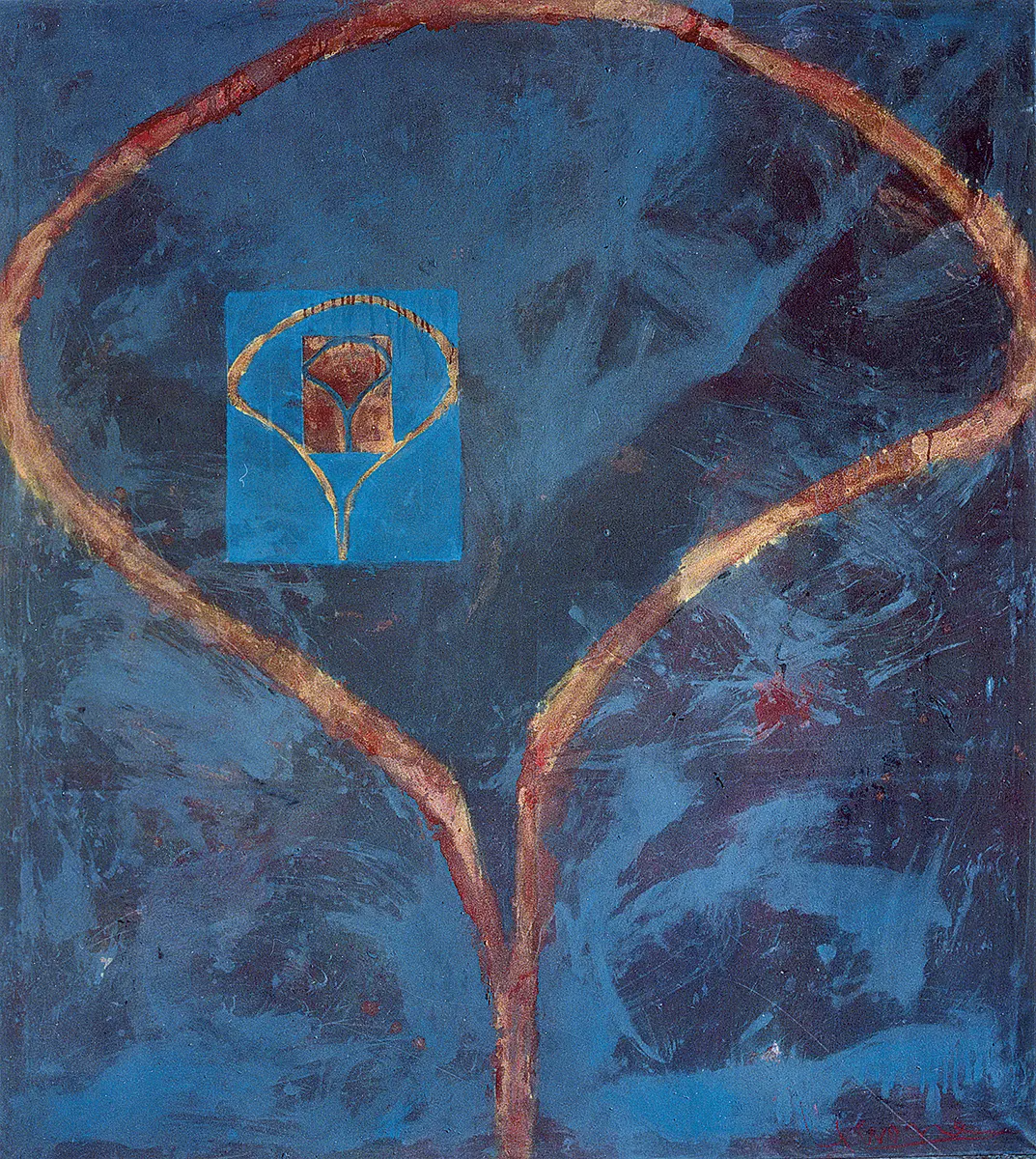
In 1987, Lecuona started using triangles as an anchoring element, as the inertia of the calla lily’s profile. The vortexes of these triangles pointed downwards. This series has had the largest amount of variations, but it always displays one shape —now more geometric, blunter, and more discernible against a highly elaborate background. There is always a marked contrast between a background that is active in itself and an action realized by means of the figure —calla lily or triangle— that anchor the work. These are not works of a purely pictorial matter unfolding ad infinitum, but articulation with a series theme that reverts the expansive and indeterminate character and situates an action, an event. The figure proposed as the background’s antagonist can happen pictorially at once through the work of matter and color, or it can establish different topics through the pregnancy of the figure and its direct or inverted relationship to the value of attention.
When looking at one of Lecuona’s paintings, it behooves us to remember Anton Ehrenzweig’s emphasis in his assertion that the artist coordinates the results of an unconscious indifferentiation with those of a conscious differentiation.3 “I want to point out the complexity of a creative search that will explore a multitude of paths and needs to move forward at once in a wide front that can keep open a thousand contradictory options.”
Thus, in order to perceive “the possible constellations” of these works one needs to look at them syncretically, extending one’s attentiveness over totalizing aspects, not over details, without recourse to the tendency to closure or contrast that characterizes the analytical gaze. At times, contours become luminescent or multiply their profiles; figures appear in pairs that are placed symmetrically, or a central shape imposes its presence. He begins to express an affinity for certain colors. Blues begin to reverberate with different resources: plenitude of color, sudden flashes. He can stretch his blue from one extreme to another: a “Lecuona blue” takes shape. “…the color blue is what takes care of infinitude, and it turns perception into a ‘cosmic sensibility’ or the most conceptual thing to be found in nature, or the most ‘propositional,’ the color when man is absent, man turned color…".4 For Lecuona, silence is black and it acts backhandedly.
In the mid-1980s, Lecuona created participatory works. One was with Remo Bianchedi, with whom Lecuona presented an exhibition titled Neither the same nor the other, which took pleasure in disorienting the viewer with respect to the authorship of certain pictorial features or procedures. Two years later, Lecuona founded the Babel group, along with Nora Dobarro, Eduardo Médici, Héctor Médici, and Gustavo López Armentía. As its name indicates, the group was distinguished by heterogeneity and the variety of its members. They remained together, nevertheless, through a good number of exhibitions.
In the early 1990s, Lecuona’s paintings were invaded by figures. They appear one within the other, differentiated by their colors, their shapes, through interruptions, shadows, and displacements. Initially, the cutout shapes are assembled, painted, and mounted on the canvas. In some cases, the cutouts are made in wood to which patterning paper is affixed. Sometimes Lecuona paints the canvas, affixes the paper, paints again, and repeats the operation, which drove some critics, commenting on the artist’s works from this period, to speak once again of palimpsest.5
The characteristic shapes of sewing patterns appear in his painting right then: erect, sequenced into a rectangle that repeats the piece’s format. They define their profile as a tailor’s dummy that vaguely resembles Duchamp’s Dulcinea (1911), Passage de la vierge de la mariée (1912), and the first version of the Mariée, from August of that year, created as preparatory work for the Large Glass. The reference is pertinent since there is an interesting relationship between Lecuona’s sewing patterns or molds and the Large Glass’s moules malic. It is not a relationship of gender, obviously, since Duchamp’s nine definitive characters are male.6 These are empty molds. Lecuona, like Duchamp, establishes an interplay between volume and flatness, between the presence of the body and its absence. In both, the presence of the feminine as a trigger for eroticism is central: it is the bride who provides the fuel for love, as much as the neighborhood girl projects her imagination onto the dress that will, perhaps, allow her to carry forward her dreams of seduction. It is a fact that in both cases energy is transmitted by women. The engine of desire is feminine. These are artists who brush aside sentimentality and “characters and their circular acts are projections, the dream of a dream."7 If we wanted to stretch things a little, we could state that the Bride’s realm, aerial and levitating, finds a correlation in the use of wings as symbols of the feminine in Lecuona.
There is also a link to the popular. In Lecuona, it is his relationship with a certain neighborhood horizon, and in the origins of the Large Glass as declared by Duchamp in 1912, it is in uniforms and domestic objects, such as a coffee grinder. Of the many differences, I will point out one: Duchamp moved decidedly away from what he called a retinal, manual painting, denouncing draftsmanship as a superstition. Lecuona, on the contrary, feels the pleasure of painting, which he embraces joyously.
It is true that the connotation of absence is essential to any approach to Lecuona’s work of recent years, but he has not imparted a specific ideological content to that absence. It is the same in the case of the Argentinean artist Guillermo Kuitca, who has said that the political reading of his work is invasive and asphyxiating.8
We have already commented, in relation to Duchamp, upon the coincidence of that which is not there and is not to be produced. Similarly, letters appear large and small, right-side up or not, up or down, forming words or not, and they always allude to figurative references that are not there. Bernard Nöel has written: “Le corps reste muet, d'un mutisme radical qu'ignore les mots. Le corps (…) s'absente derrière lui-même chaque fois que nous le nommons."9 In Lecuona, the game is doubly abstract. He names without naming. He represents the absence of the body, which is a way of marking the simulacra of art itself. He articulates a transposition in the third instance. The rigor of patterning is denaturalized, just as the body is denaturalized through naming. But this abstraction of abstraction is inverted when it impacts us physically with colors, texture, and aesthetic materiality.
In the monoprints he creates currently, Lecuona uses unwashed plaques. In washing, as the sheets are flipped, different, unexpected stains are incorporated into the work as an added pattern. A phantom image emerges. As he had sought the complicity of absence, Lecuona seeks the complicity of chance. He circles around the register of thoughts yet to be thought, the concordant or threatening accents of silence. His work is as much what he does as the poetic way in which he introduces that which is yet to come.
NOTES
1. Jean Baudrillard, El paroxista indiferente (Barcelona: Ed. Anagrama, 1998).
2. Fin de siglo, was presented at the Museum of Modern Art, Buenos Aires, 1986.
3. Anton Ehrenzweig, El orden oculto del arte, (Barcelona: Ed. Biblioteca Universitaria Labor, 1973).
4. Gilles Deleuze and Felix Guattari, ¿Qué es la filosofía? (Barcelona: Ed. Anagrama, 1993).
5. The first reference to palimpsest in Lecuona’s work was made in 1983, when he used “spider” paper that homogenized the surface, with grease pastels, and watercolors. Drippings also appeared then.
6. They started out as eight. The group, of which there are several versions in different materials, is also known as the “cemetery of uniforms and livery” and it comprises, as recorded in the reverse of the small preparatory glass of 1914-15: the policeman, the soldier, the store clerk, the priest, the station manager, etc.
7. Octavio Paz, Apariencia desnuda (México: Biblioteca Era, 1979).
8. “I tend to discourage such a view of my work because it is invasive and asphyxiating to it. But on the other hand, I feel ridiculous when I deny it.” Quoted in Juan Forn, “Kuitca y su generación,” in Pintura Argentina. Final del Siglo Veinte II, (Buenos Aires: Ed. Banco Velox, 2001).
9. “The body remains mute, of radical mutism that ignores words. The body…is absent behind itself every time we name it.” Bernard Noël, “La langue du corps,” XXe Siècle no. 44, June 1975, Paris.
NELLY PERAZZO
University professor, art critic, and researcher. Member of Argentina’s National Fine Arts Academy.