Caracas is yet another Latin American city threatened by its social and political conflicts. From this city hails José Rivas, who has lived all his life in Caracas’ most dangerous neighborhood, 23 de Enero, a place where violence is the true law.
It is intriguing, in this context, to note the way in which Rivas remains alert to the history of art and to social problems. Despite not having traveled outside Venezuela, his interest in contemporary painting keeps him in a position of ideological confrontation, in which he personally assumes a critical and defensive attitude as “a good rebel.”
In a way, Caracas’ social conflict could be assimilated and channeled through art into new manifestations, able to break with many of its “silent” languages. Rivas’ painting seems to be informed by a retrospective vision of Art History. Artistic images by modern and contemporary artists are the subject of reflection and of the attempt to create iconography through skillfully posited connections and links. Flowing relationships that remind us of the “exquisite corpse” but acquire, in Rivas, clear meanings, perhaps as a “hip-hop,” colloquial street language (yet one that is devoid of references to graffiti.) The colloquial element is perhaps the graphic aspect that globalization has so greatly generalized. Rivas’ paintings play with Pop aesthetics, to create from there their own coherence.
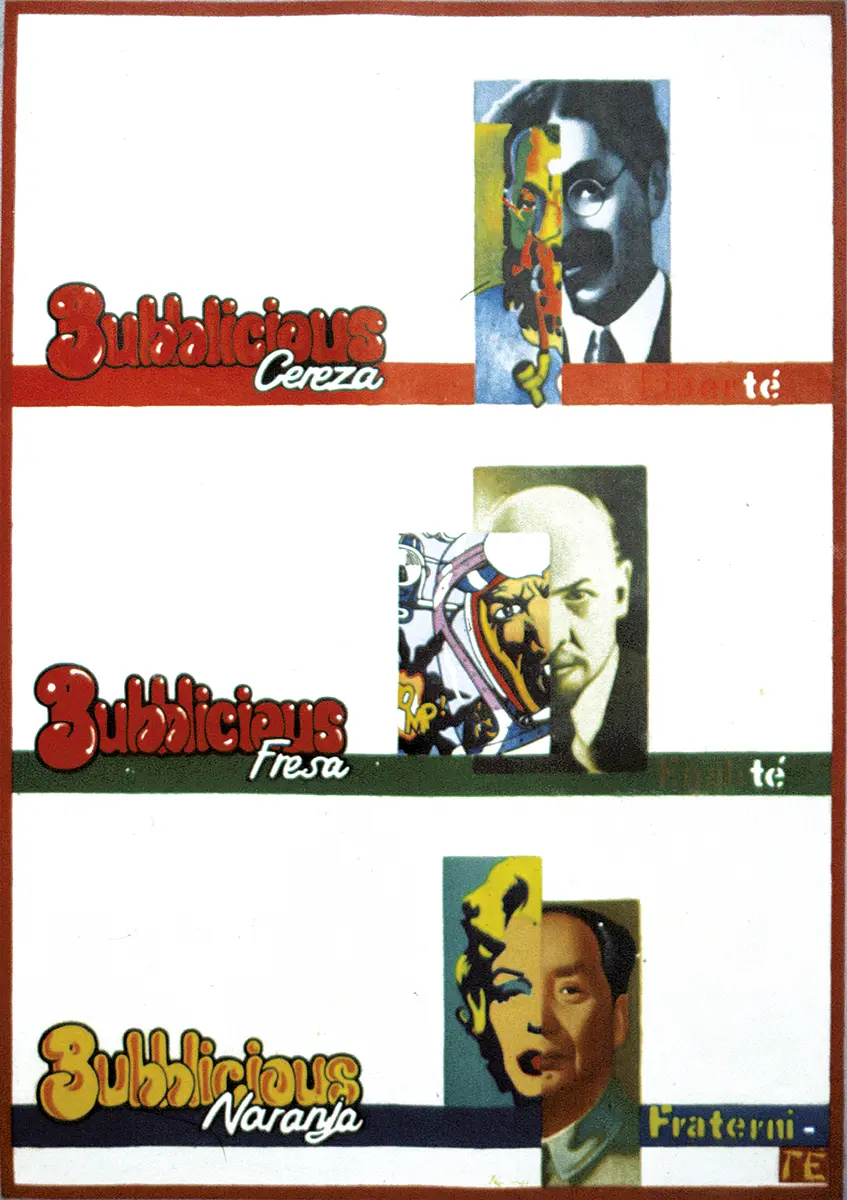
Rivas's ability to create connections and links demonstrates not only great technical virtuosity but also a refined sense of humor and irony. It is the irony one absorbs from a culture of rebelliousness, the bitter humor necessary to tolerate the daily experience of a violent reality.
The ironic expression appears in Rivas’ paintings as a constructive resource, finding a balance between innocent images and images that move us to terror or surprise. As if informed by Picasso’s and Braque’s discoveries in collage, Rivas composes by minutely painting photographic reproductions, bringing into convergence images whose natures are different and generating in the viewer the strong impression that what is being shown is paper glued to the canvas, rather than painted images.
But Rivas is after something even more complex. Basing his work on fragmentations, Rivas wants to penetrate into the depths of a historical problem —he wants to challenge the way Art History is constructed. From that perspective, he accepts the technical tradition of painting and the sublime elements contained in its practice. In his play with the ambiguity of appearance, Rivas uses vestiges of Pop Art as a volatile element. Undoubtedly, Warhol’s legacy over the past decades has been an interest in expression fueled by graphic elements, photography being its main ally and nowadays the first resource of contemporary artists.
Rivas, who comes from a practice of gestural, abstract, large-format painting, must have been at a certain point confronted by a situation that changed forever his artistic convictions. This is likely related to his work as an Art History professor. He must have had to make decisions, faced with the avalanche of installations, videos, and other contemporary forms. He chose, perhaps, the least predictable option.
Mysteriously, Rivas’ painting moved to medium formats, and its aesthetic and expressive contents changed radically. Images from the world of advertising, from the history of art, and from social and political realms appeared suddenly. A subtle portrait of Carolina Herrera is a great surprise: one half of the face looks at the viewer frontally, and on the other half, almost imperceptibly, there appears the image of Carlos “the Jackal,” the international terrorist —Herrera and Carlos, the two most famous Venezuelans before the arrival of President Hugo Chávez.
Also, the Venezuelan child, the daughter of an Arab family, who killed two youths who sold her a cat, is painted as a Japanese doll inside Baroque tableaux.
Rivas’ most recent paintings explore themes of torture and sadomasochism, but it is only on a second reading that we discover their insinuations, sometimes frightening, sometimes banal like Walt Disney cartoons appearing as jesters to attract viewers.
In the new series on Dick Tracy, the face seems taken from Warhol’s Tracy while the body has been photo realistically depicted. Deadly torture instruments used by Caracas’ Technical Judicial Police Department are applied to Tracy’s neck.
Other paintings depict innocent girls taken from Japanese comics, but this time around they seem to come out, extenuated, of some kind of bloody erotic ritual.
It is good to see in these works a break from the “heroic” formats. It seems there is nothing more decorative today than a large format painting, for which it is often difficult to find justification.
Rivas works as a follower of human events in our morbid culture, in which every second occupies center stage in the globe’s homes. His originality and his new approach to realism could turn him into as rare a painter as he is formal.
EUGENIO ESPINOZA