Let me begin with a digression: this show of works by José Alejandro Restrepo opens many paths for its viewers; I will attempt to explore only some of them: the first one is a three-way reflection on tradition; the first of these ways consists on revisiting the accumulated experience of video artists, the most representative among them, interested in images but also in television sets. In those early times of video as art, the television set, a sedentary object, an altar in the home, became nomadic, not only due to an artistic decision but also to a political decision that attempted to shake up the settled group the contemporary family had become. It can sound almost banal, but it needs to be remembered: a TV set can be cornered, piled up, placed here or there, and in that way, this black box turns, as it does in this exhibition, into a basic principle of sculpture which is to take an object out of the two-dimensional flux of everyday perception, in this case, a very trenchant act, for people to stop and focus on it. The second way relates to the artist’s run through his own oeuvre in order to salvage images from lost videos and the fact that some works are variations on a theme, which makes clear once again that art is not a question of novelty but of coming back to indelible places. The third way of exploiting tradition is more difficult to define; it can be said to be akin to a subterranean veneer that runs independent of rigid divisions of thought such as religion, East and West, styles or forms; a way of mixing traditions, and, more than that, a source having to do with an encounter of the human condition. Seeing such a realistic exhibition of black and white videos, of minimal, precise, repeated actions, we are left with the thought that what is attempted is, as Lewis Hyde says, to touch the present and to invite it to think about the ambiguities of human nature. But not with discourses, exactly: the visitor went through a series of spaces that had been sensitized with humor and grace, and with irony —but a more delicate kind of irony, one that is used not to judge but to understand what is human, one that allowed for a new path to open up.
In order to review this exhibition then, we need to let ourselves make associations with the image in front of us. Any of Restrepo’s images could work; for me, the associations started with Lilith, a video whose title reminds us of that beautiful, livid woman painted by Dante Gabrielle Rosetti as she watches herself in a mirror and brushes her golden hair; despite her beauty, this woman is somewhat frightening, with that blood-red ribbon on her wrist, perhaps a female vampire, a pure creation of Romantic imagination. And yes, we already know, after Foucault, that in modernity sex is a secret affair, and that we talk about it with a classificatory discourse designed to separate its ambiguous nature into “normal” and “perverse,” highlighting a sexuality centered around reproduction; it pushes to the margins pleasures that are fruitless, contra natura, in order to articulate a politically useful sexuality focused on the family which maintains the labor force. But for that very reason, the image breaks into delicious displacements and inventions, which are the forms of desire. Each historical period gives shape to its own shadows.
What is delicious here is that this exhibition’s Lilith is not a metaphor, but a zoological signal. The video presents a monumental female rhino in the moment of rejecting a male (who looks, frankly, fragile and puny) and expelling his semen. Many associations could be made, but the most interesting one for me is precisely the zoological association; it is wonderful to dust off lost books and find out that sexual courtship among rhinos seems to be organized by committee-approved rules, by virtue of which males, especially young ones, can visit females, as their behavior is closely watched by older females in charge of giving him instruction and, if he doesn’t understand, punishing him; males must learn to approach females cautiously. But we can also open the chapter about the Lilith of rabbinical tradition, Adam’s first wife, today a feminist icon interpreted not as a Romantic female vampire but as a woman who was able to subvert male-imposed fertility norms. What is important, I believe, is learning from the narratives of these traditions and how the creation of the human line is conceived in terms of males and females created by God with dual, hermaphroditic bodies later transformed into divided beings condemned to seek completeness through the other, through what is outside itself; the show slowly enters a more complex terrain.
In the catalog, Restrepo chooses a number of quotations from different authors as signals for those who want to open them, but one from Leonardo da Vinci moved me and I quote now partially: “Among the bodies that cannot exist without one another we find pleasure and disgust… the foundation and origin of pleasure is an effort related to disgust, whereas on its part the foundation and the roots of disgust are vain and lascivious pleasures.” The path thus opened is one of agony and exile regarding our search for ourselves in other situations. We need to remember here that hypostasis refers to the union of two natures in a single person, then what began as a diverting game generates an increasingly solemn feeling.
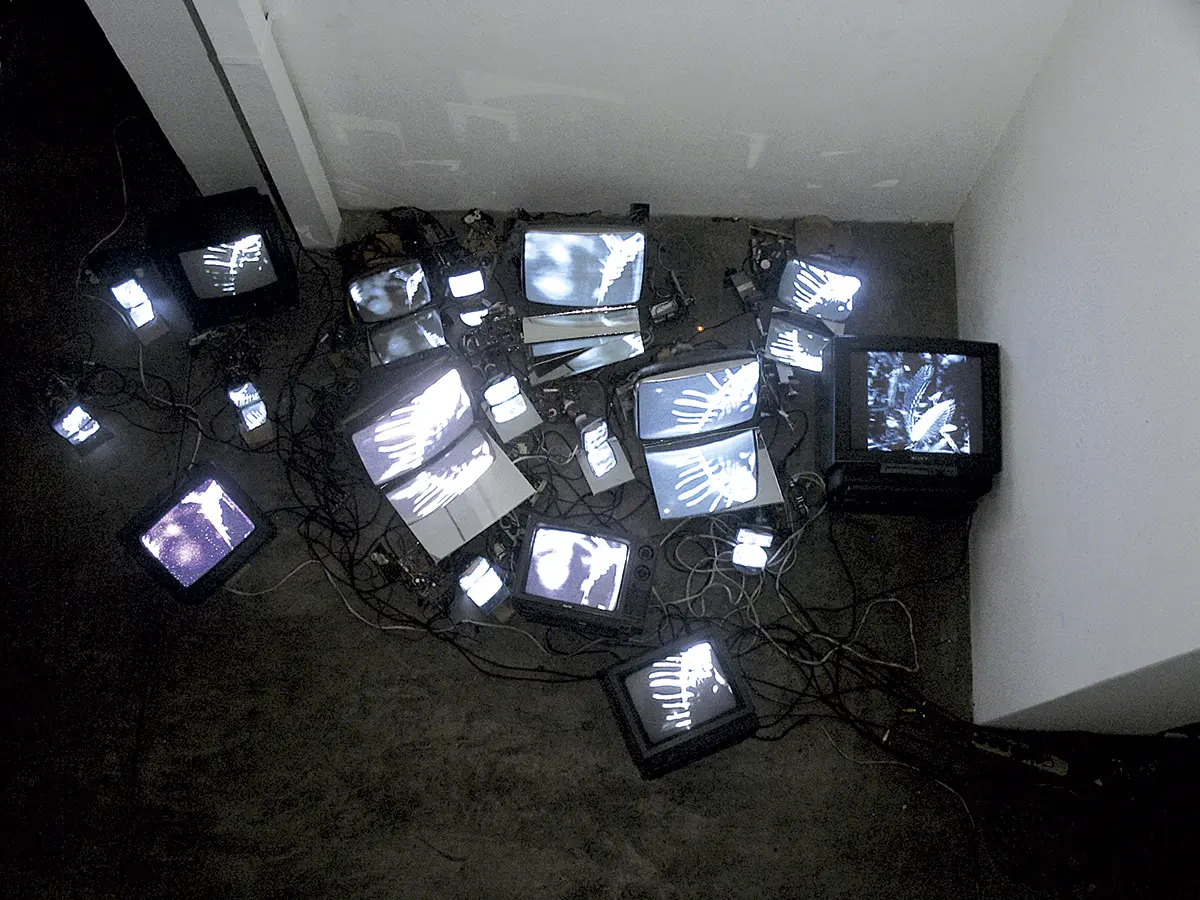
The staircases and corners of the Valenzuela and Klenner Gallery were used smartly, and the different videos sought correlations of the same theme in other situations For example, a group of television sets formed an Interior Garden of carnivorous plants, producing a frightful sound as they captured their prey, in an act of instantaneous meaning, surrounded by opium poppies that seemed to wake up upon being touched. A climate of reflection was created to think about the relationships between the sexes established almost four centuries ago, as we watched a couple of out-of-focus porcelain figurines waltz; this piece produced a sort of Nietzschean feeling, of living with our illusions without believing in them wholeheartedly. The question of whether someone is male or female is perfect for newscasts, and in Es lo mismo the answer is given with the image of a Latin American female boxer, portrayed as she trains. Some videos are a minimal edition that seems salvaged from previous works, but precisely because of their exactitude, they concentrate their conceptual charge even more; such is the case of Machiembrao, a body that urinates through one of those inversions of desire we spoke of before, an ingenious tubule, a penis that seems to have been made by folding metal, origami-like, and perhaps the most delicate image, in the very act of slowly framing one breast with a lens —male or female breast?; perhaps it is desire itself deciding to adopt its own shape, in a squaring of the circle.
NATALIA GUTIÉRREZ