I met Cuban artist Jesús González de Armas at Latin America House at the time of his first show in France (1992). Our conversation took place a few days before the news of his seeking asylum was made public. In the course of the short moments shared with this singular and attractive personage, I was impressed by the strength of his cultural convictions —particularly his knowledge of the Taino— and in a more general sense, by his attachment to Latin American culture. His passion for life was expressed back then in a fervent but serene urgency, despite the existential uncertainty that awaited him.
Jesús de Armas’s personal history was marked by tragedy both physical (loss of his right arm) and social (marginalization in Cuba, culminating in his exile in France). The permanent suffering derived from these events was to be transcended through an invincible faith in creativity and in the authenticity of his link to Latin America, which he understood not as the pretext for an easy and obvious nostalgia but as the basis for exchange with the country of his asylum. Caricaturist, cartoonist, humorist, and painter, Jesús de Armas was filled with enthusiasm and curiosity. In his last years, he was interested in certain specific links between France and Latin America, especially through botany.
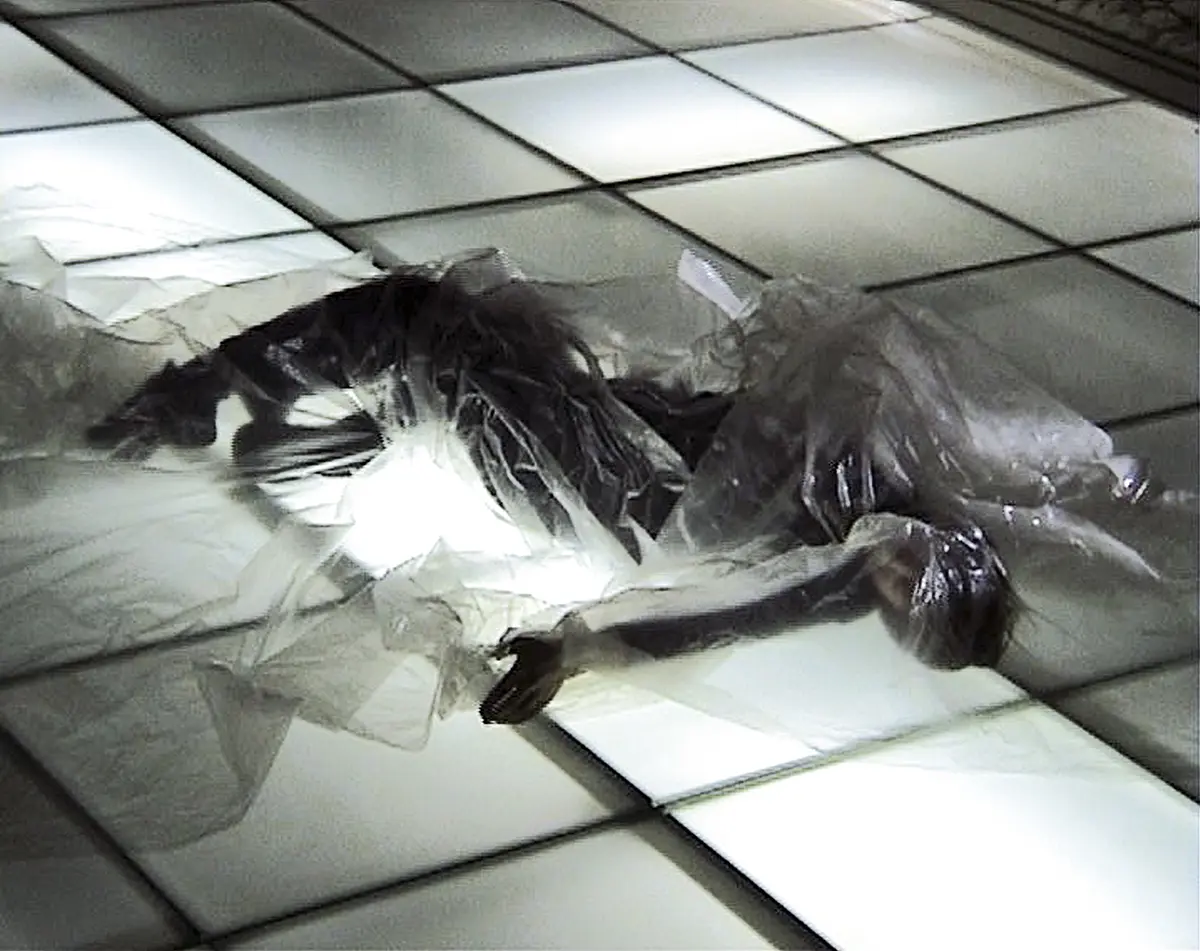
His last exhibition was held posthumously at the Mine Museum in Saint-Etienne, France a week after his brutal death, and was devoted to the research and work he dedicated to a new material: plastic. In both its banal, everyday shape, that of the plastic bag used in commerce, and in large tents, this material acquired meaning for him not only as a testimony of the ridiculous —as the refuse of a consumer society given to opulence and waste— but also and above all as a symbol of the poverty that grips those that are marginalized in that society.
The show at CNAP (including 35 works, 10 in plastic and raw paper, 14 sculptures in corrugated plastic, and several drawings on canvas) was intended to trace Jesús de Armas’s artistic journey between 1982 and 2002, in several series organized chronologically around different themes: his Neo-Taino charcoals inspired by the pre and post-Columbian stories, myths, codes, and pictographic signs of the Taino peoples of Cuba and the West Indies (created in Havana between 1985 and 1987); canvases evoking the violence of the Spanish conquest (Havana, 1987–2001); paintings created in Montmartre, Mont-ma-terre (Mount-my-land), after his establishment in France (Paris, 1993–1995); and, finally, his technical experiments with plastic tents, which he called a “contemporary archeo-aesthetic,” presented in 2002 at the Saint-Etienne Mine Museum (Alfortville, 1995–2002). On opening night a series of three shows, conceived and organized by the artist before his death in collaboration with choreographer Corinne Hadjadj, were presented in a sound environment especially created by Jean-Sébastien Mariage that consisted of noises produced by manipulating plastic in various ways.
If we pay special attention to Jesús de Armas’s French production it is because, apart from their evident interest, these works were created under extremely difficult physical conditions: in his modest workshop on the outskirts of Paris, he was literally submerged in his iron under mountains of plastic, wrinkled fragments, tents, and bags in an electrified atmosphere in which the sounds produced by the material’s displacement introduced a note of reality into the frenetic constructive utopia. It was there that, as Anne Tronche has written, Jesús de Armas invented “a new relationship to matter.” An attentive observation of his canvases and “plastics” shows how his act of creation emerged in answer to a challenge. It is a true act of the senses and of sensuality, like his fellow Cuban Ana Mendieta’s relationship with earth, or with Afro-Cuban culture in the case of José Bedia, another defender of his origins and enactor of its rites. Jesús de Armas lived the experience of his rituals by his commitment to diverse materials and cultures, in an “anthropophagic” trajectory that is characteristically Latin American: to recuperate and assimilate, within a vital and necessary perspective, the renewal of his conceptual and formal discourse.
If his canvases and his paintings on plastic emanate from that desire for mestizaje, both of cultures and of their objects or materials and images, Gilda reencarna en yahubaba, Mont-ma-terre, it is because his physical relationship to his materials was always exceptional. Crushed charcoal with the addition of ingredients such as coffee (which he prepared with a simple grinder, for pleasure and in the spirit of simplicity and innovation); the fragmentation of the body and of texts; the recurring use of an urban “icon” (the image of a dog in the streets of Paris); the multiplicity of techniques and of materials (paper, canvas, plastic, etc.), impose personal alchemy that is dictated by conjugated doses of rage, love, and a death impulse, and reinforced by his irreducible material precariousness.
Jesús de Armas’s stroke, at once tender and violent, expresses an internal struggle, the thirst for understanding the world, and the deep culture that fueled him. It is also the sign or testimony of an identity that needed to be recreated every step of the way. The artist’s gaze revealed the humanity to which angst, doubt, and love contributed polish and intensity. The works presented at CNAP were impregnated with all of that. His schematic, barely sketched figures slide through a plastic surface that can stop them only long enough to allow the artist another essential gesture, when he scratches and slashes the surface of his painting or drawing, as if carrying on a dialogue with live skin. Totems, crucified bodies, or skeletons, these figures emit traces of life and death in blood-red gushings.
Yo soy, autorretrato pictográfico of 1993, grabs our attention because the artist questions his mutilated identity, his fragmented “I,” the other who is also himself, in the deepest recesses of his good and bad self. His graffiti brings to mind those that cover the walls of our cities with multiple inscriptions; the viewer is faced with Jesús de alma, Jesús de amor, and Jesús de Armas: an emotional wordplay on his own humanity, at times repressed, at times ridiculed, and often mistreated by an adverse fate. Jesús de Armas’s interior violence is continuously repealed, continuously exorcised by the excess of alma (soul) and amor (love), but always against armas (weapons)
The last of the retrospective’s six halls are occupied by de Armas’s “black plastics,” which are far from the black aesthetics chosen by Pierre Soulages or Louise Nevelson. This blackness is, above all, that of the coal mine. It is the color chosen by the artist for the Mine Museum in Saint-Etienne, formerly a coal mining center. Eight “figures” hooked to a line that runs between two walls remind us of the room where miners hung their coal-blackened clothes, the same coal which often took their lives. There are also some effigies and giant masks where plastic —iron-heated, stretched, twisted, wrinkled, and tied in knots— is taut, voluminous, textured, and dilated, opening for this art of mystery, this passionate interrogation of the limits and borders of the world, a new expressiveness that Jesús de Armas would no doubt have carried forward into other discoveries. Modernity is there, complete, complex, and in constant flux.
CHRISTINE FRÉROT