It is not by chance that Humberto Díaz showed his work once again (from May to August) at the Castillo de la Real Fuerza, in Havana, a sixteenth-century structure that today hosts Cuba’s National Ceramics Museum.
In the museum’s permanent exhibitions of artistic techniques and personalities from the second half of the twentieth century, we can move from molded or painted vases by artists like Wifredo Lam or Amelia Peláez, to works with an installation-like feel (such as those created by Ángel Norniella in the early 1980s), finding in between pieces with a clearly sculptural character. Meanwhile, the museum’s temporary exhibitions help generate a dialogue between this collection and more recent creations in ceramics, through group or individual shows by artists who are already established professionals or up-and-coming students.
But only the museum’s Amelia Peláez ceramics biennial is capable of keeping its finger on the pulse of contemporary production —a contemporary production frankly proteic in the many ways it approaches the material. Ceramic art has moved beyond the orthodox, limiting sense of manifestation in order to incorporate all ways of working with clay. Thus the borders between pottery and ceramics, or between the practical/utilitarian and the practical/expressive, become blurred.
It was with a “ceramic video installation” that Humberto Díaz (1975), a student at the Instituto Superior de Arte (ISA), won first prize at the 5th edition of this competitive exhibition, held last year. Inside the Castillo’s stone walls, an interior room erected by the young artist using bricks generated a certain estrangement. Not only due to the contrast between the building materials, but, especially, because the new sculpture seemed to be missing a brick, which appeared to float in the dark interior.
Thanks to an internally projected video image, the “absent” unit gyrated waywardly in different directions. (Self-) segregation or exile? In any case: isolation. Separated, disengaged from the whole, the part revealed itself autonomous. It highlighted its difference through a counterpoint between stasis and kinesis, the “real” and the “virtual”, the tangible and the intangible, morphological tradition, and technological innovation.
Humberto Díaz used a similar way of building in Movimiento Perpetuo, his first individual show at the Castillo and the second time has shown his work. This time around, his bricks described in situ a spiral centered around a TV which, through a closed circuit, reproduced, spinning in alternate directions, that same geometric figure and the people inscribed in it, captured from above.
In this case, the perspective and the reach of voyeurism change. We don’t snoop around after the “missing” element. Now, the whole watch itself and, in watching it, viewers watch themselves as well, elements that move ad libitum within the piece and become a part of it, interacting with it, altering it, albeit in a transitory, fleeting manner. It is still a dialectical relationship, a conflict of opposites.
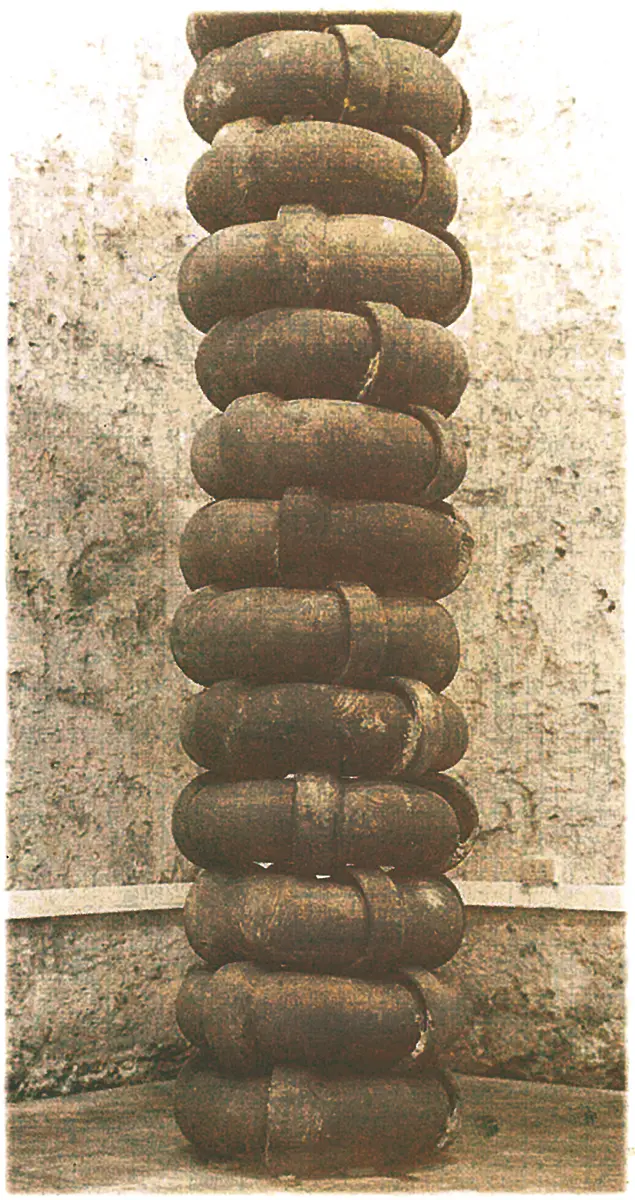
The sense of observation (vigilance?), of (self-) watching, of action/reaction, was present in other works in the show (what the artist calls his “columns” in metaphoric allusion to that architectural form, built not with bricks but with clay pipes.) Nevertheless, these components are equally pre-fabricated, and superimposed on each other. They reach different heights, creating different levels of access, offering different possibilities to appreciate their background, the “water mirror” that flickers and reflects those who peek over it.
These are abstractions of columns that, in their potential for growth, remind us of Brancusi’s Infinite Column. But at the same time, they are closed shapes that compel us to experience them in a circular fashion. A sense of movement appears again, through the circle, the shape of the eternal return. The serpent bites its own tail in these “columns” that, in isolation, could be taken for sculptures. Yet they are, at the same time, units in an installation group, well integrated in terms of space and dialogical relationships.
Like some artists who graduated from ISA, Humberto Díaz exploits the plastic/expressive possibilities of ceramics, using it as a resource in his installations and generating a kind of “ceramic installationism” on the basis of the relative dominance of semantic intentions. The practitioners of this art show an inclusive attitude toward ceramics, blurring disciplinary borders and returning to the craft (of pottery) in order to discourse from a revisited tradition.
Yet unlike the rest of them, Díaz does not elaborate on his ceramic pieces. The artists, who had taught ceramics workshops even before entering ISA, use prefabricated, standard units, so that the parameter, the mold (industrial or manufactured) is a support for his creations, to which he tends to incorporate a performative component.
This is not by chance, either. Performance is another of Díaz’s modes of expression, as a member of the DIP group (Public Interventions Department), a collective of ISA students that will be among the official selections to the Eighth Havana Biennial.
ISRAEL CASTELLANOS LEÓN