This exhibition of works by Fernando Aceves Humana (Mexico City, 1969), titled En Riesgo (At Risk), grabbed our attention not only with its pictorial and iconographic quality but also because this young artist is better known for his prints than for his paintings. The exhibition presented at the University of Paris gallery (25 large-format canvases) is impressive above all for its pictorial, narrative, and iconographic coherence. Polychromy reduced to an intense range of dark colors, a significant discourse about the violence that is contained but nevertheless present, radiates from the work’s inner depths to create an environment of somber, strange singularity. The artist’s seemingly smiling and relaxed attitude generates questions about the probable duality of his personality, inducing the subtlety of visual discourse, intellectual as much as sensible, whose first vision provokes nonetheless a noticeable shock to the viewer.
Conflicted and fused relationships between men and animals have marked the history of mythology, giving origin to symbols, metaphors, and allegories, building ancient and modern myths, and structuring the secret thinking of the universe. There was also doubt fueling an imagination where the issues of the dual, of fantastic anthropomorphism, and of rejection or fear, betrayed man’s fascination before an untamed power, before an incomprehensible beauty, before the element of invincibility possessed by a triumphant and threatening animal.
In the apprehension of the world this show evokes, the title chosen by the artist induces a preparation, an immediate attitude of self-defense in those who come to observe it. It appears as a warning, indicating a danger that surrounds us and of which we are not always aware. The selection of animals as archetypes to represent the deep layer of the subconscious and of instinct, be it, as it is here, similar to the fox or the hyena, the wolf, the ape, or the deer, imposes itself in this line of reflection that, from literature (Jean-Jacques Rousseau) to psychoanalysis (Jung in Man and His Symbols), or Lévy-Strauss’ anthropology —to cite only a handful of authors— has shown that “man feels prim ally identical to all its peers (among which we should include animals) and that is why he will acquire the capacity to distinguish among himself as he distinguishes among them; that is, to take the diversity among species as the conceptual basis for social diversity.” (Du miel aux cendres [From Honey to Ashes].
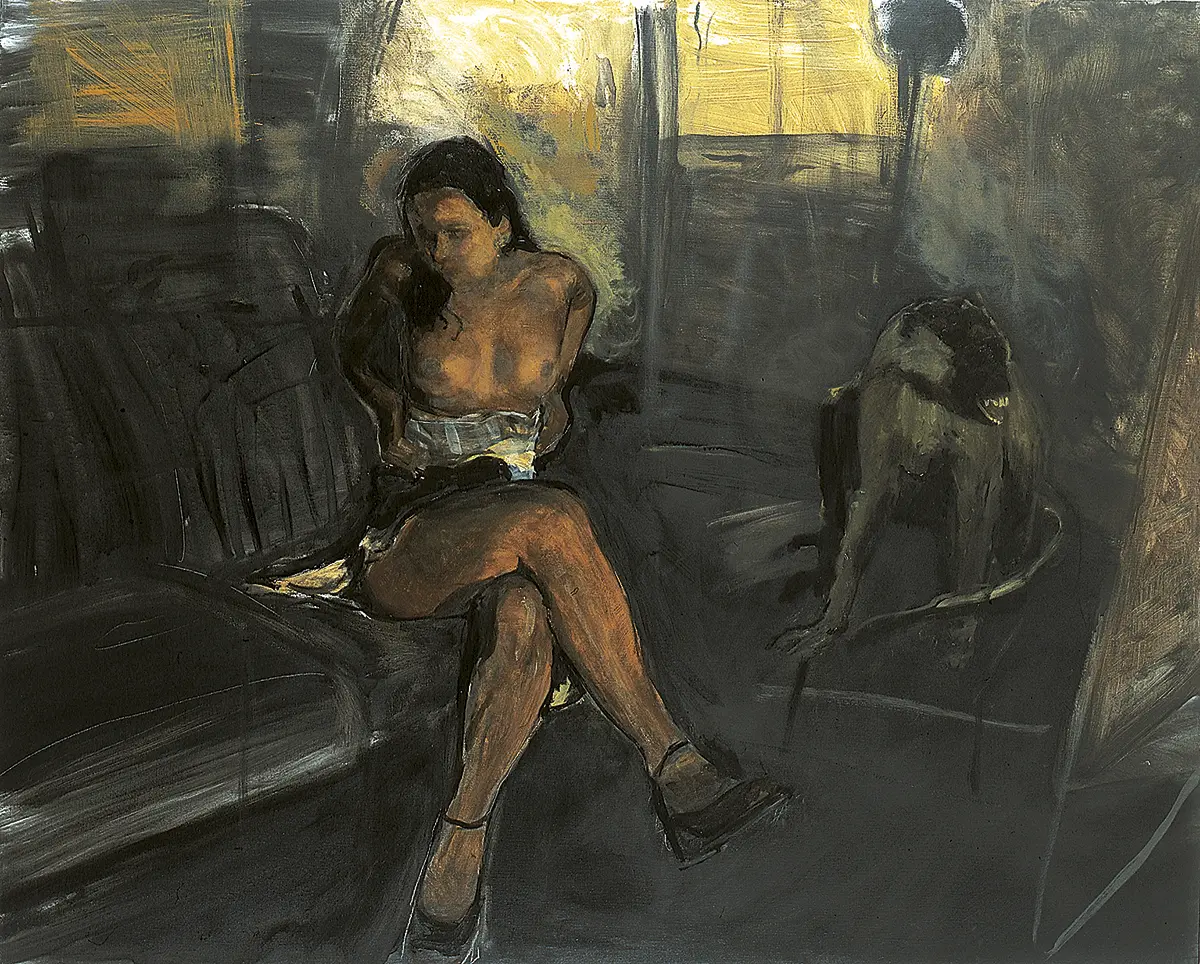
In Aceves Humana, animals do not replace men (nor, in truth, those women sometimes present). The artist’s provocation resides in the proximity between those two assimilable species. The choice of darkness for his canvases, the recurrence of those black and somber holes, like openings or immeasurable abysses, the lights that shine on a distance that seems inaccessible, the waiting, aggression, or self-defensive postures, are but fictional codes within a pictorial language and a strong, condensed expressiveness that seeks, through the creation of oppressive atmospheres, to provoke and contain us in order to make us more aware of the fragility of our certitudes.
Aceves belongs to that category of artists who are unafraid of painting, unlike so many of his contemporaries. Perhaps, as some claim, everything has already been said —yet nothing is ever said in exactly the same way, and it is never too late to say it. This series about the furor of life and the feeling of a threat that stalks us like death does is inscribed, through successive metaphors, in a virtual discourse that strengthens the painting’s inexhaustible expressive, pictorial, and conceptual dimension. The painter is not insensitive to a certain figurative tradition in Mexico, but his assimilation of this tradition is traversed by the evocative strength of the image and by a specific work on materials and textures, on those shades of black that are so extremely complex and difficult to stratify in transparency.
In Túnel 2003, the gaze of a stalking animal ready to pounce on an invisible prey responds to the lights of a train advancing in the dark. The deep-blue sky emphasizes, even more, the mystery of a scene that is, like many of the stagings in this exhibition, theatrical. Another version of Porfeo/Por su fealdad, 2003, shows a cave on whose depth we can distinguish the white light coming from the outside. We also see an ape in the animal pose, with the look of a frightened, disoriented being, incapable perhaps of finding the escape from the cave in which it is being kept prisoner. Fear and imprisonment are reaffirmed in another scene Sin título, 2003, where an animal, half hyena, half wolf, seems to be stalked and hunted by humans. Lamps shine directly on it and the animal, blinded by the light, seems paralyzed with fear, unable to confront his persecutors.
Where is the future of man in these somber propositions, filled with loneliness and despair? Aceves is a skeptic, a doubter, and his animals crystallize an assured agony. We are overtaken by confusion when faced with Damiselas, 2003, where the foreground is dominated by a hybrid being, half-human, half-animal, adrift in a pitch-black space in which fragile female figures, finely drawn in white with some red-ochre touches, appear to speak more of an alignment than of possible humanity (the woman seen from behind leans on a car; the driver seems to be offering his services in the manner of an urban prostitute.) The central character is a kind of archetype, at once a thinker and an interrogator of those women’s, men’s, or animals’ destinies. This image, a sort of immobile sphinx in its orphaned meditation about time, ends the series with its gaze trained upon us as if inviting us to never stop questioning ourselves, and to never forget who we are. As anthropologist Gilbert Durand has written: “Platon himself knows it: We must return to the cave, we must take into account the very act of our mortal condition, and we must, as much as it is possible, make good use of time.”
CHRISTINE FRÉROT