In the summer of 1995, I was asked by Juan García de Oteyza, who was then the director of the Mexican Cultural Center in New York, to organize an exhibition of work by young Mexican artists living in New York. In the end, the show became an introductory examination of the relationship of Mexican artists to New York City. After a long series of obstacles were overcome, Mexico/New York: A Vital Dialogue opened in October of 2000. The premise of the exhibition and catalog essay was that since the very early years of the twentieth century, with the arrival in New York of Marius De Zayas, there has been a rich stream of intellectual and cultural exchange between Mexico and New York City.
During the organization and planning of the show, it was a great pleasure both to revisit the work of artists that I had known for some time and to see fresh, new work. Although I was somewhat familiar with Fernanda Brunet’s early, extremely sexual images, it was her paintings of erupting volcanoes that I found extraordinary. St. Helen became the introductory piece for the exhibit as well as the cover of the catalog.
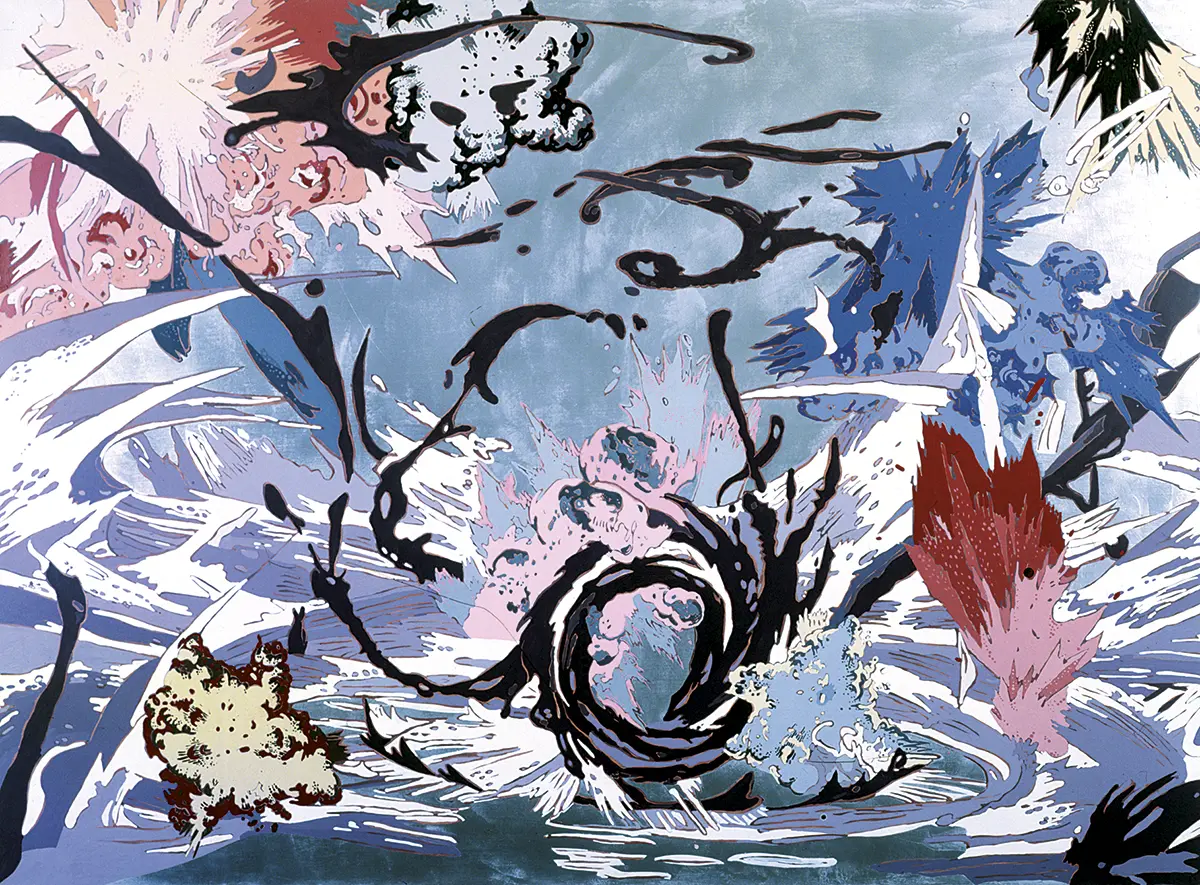
In the spirit of dialogue and exchange, therefore, it is very interesting to consider how this rapidly developing artist got from her pretty, pink, sexually-oriented oils of the 1990s to St. Helen, 1999, and to Rrooom!, 2003, which are included in the current exhibition. Her move from sexual imagery to erupting volcanoes is not difficult to understand. There is something fundamentally potent and sexual about her volcano pictures—if not with active volcanoes. An analogy can easily be drawn between the spectacle of power and the forceful emission of molten rock, and ejaculation during sexual climax. Brunet’s earlier paintings and the volcano series shared a limited color palette and a “juicy” style that made one think of wedding cakes and creamy desserts. By contrast, the late work appears less “pretty” and harder, flatter, and noisier. It is clear that a fairly dramatic shift has taken place.
While the process was undoubtedly much more complex, two factors are notable: a change from oil to acrylic and an attraction to Japanese comics or manga imagery. Her use of acrylic paints was motivated by a desire to work with a less toxic medium. The influence of Japanese manga, the hugely popular genre of Japanese comics, which is wide—some would say obsessively—read in Japan and within Japanese populations worldwide, is less apparent. In the context of this exhibit, there is a natural tendency to compare these to the pulp novellas that are so popular in Mexico. I suspect, however, that the connection has more to do with the images themselves, rather than any familiarity or conscious comparison of the novella to manga.
Printed cheaply, these comics are typically hard-edged, black-and-white illustrated pulp fiction. They often depict superheroes, or super beings melodramatically struggling to fight evil and defend good. The exaggerated drama of manga is popular with all age groups, but those published for older readers can be hyper-sexualized and relentlessly violent. All are peppered with graphic depictions of fights, gun battles, and explosions, and all of these are accompanied by the Japanese characters for the sounds associated with the action, for example, Kraash!, Splop!, Rrooom!. Manga has been influential in the work of other artists—both in and out of Japan. Perhaps the most notable of these is Takashi Murakami, whose work has revolved around manga characters in both two and three dimensions. Murakami’s work, likewise, virtually celebrates the overt sexual aspects of the subjects and their action-packed fiction.
Brunet’s fascination with sexual imagery and sexual innuendo would naturally be engaged by the adult manga and its related popular culture. Her isolation of the explosions, noises, and bombast of the comics follows logically from both her pornography and volcano-inspired works. Her two-dimensional interpretations of sounds result in pictures that could be seen as details of larger actions. On another level, they can be viewed as ciphers or characters, not unlike Japanese calligraphic painting, in which a single character can become the central image or subject.
The exhibition at the Galería Ramis Barquet, New York, was a stimulating installation. Given the imagery and its inspiration it could be described as “noisy.” Regardless of the size of the paintings, their implied volume is generally loud. Brunet’s use of a limited palette of pastel colors has been augmented recently by the addition of metallic silver. The most successful paintings are those painted this year in acrylic on linen. The fine texture of the linen fabric lends a hard surface to the finished piece that is much more reminiscent of the sharply printed manga. Although the nearly “delicious” use of oil paint is gone, her work now seems to point in a direction that could lead the artist to the production of pictures as exciting and visually stimulating as St. Helen.
CLAYTON KIRKING