As the second half of the twentieth century began, the visual arts scene in Mexico witnessed the rise of a group of young artists who sought to free themselves from the imperatives of realism and nationalism dictated by the then-dominant muralist school. Among these explorers of creative new paths was Enrique Echeverría, who, despite having been among the most important members of the so-called Generación de la Ruptura, is perhaps today the least known of that group due to his untimely death at the age of 49.
Thus the relevance of and the interest generated by Tiempo suspendido: retrospectiva de Enrique Echeverría, 1923–1972, a retrospective exhibition presented over the course of two months, in the Diego Rivera, Justino Fernández and Paul Westheim galleries of the Museo del Palacio de Bellas Artes, and curated by Ana Isabel Pérez-Gavilán, the museum’s assistant technical director.
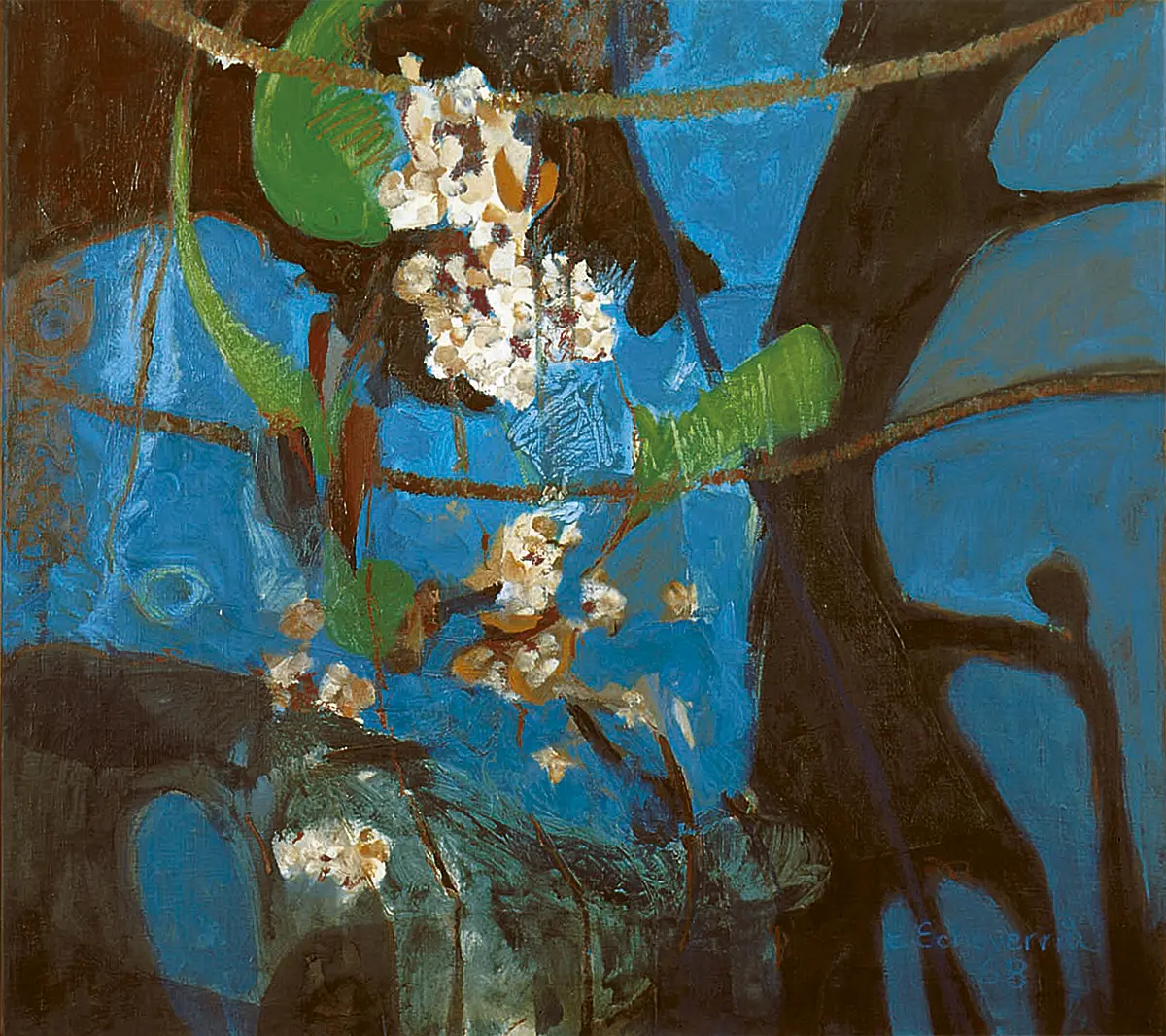
This anthology exhibition was the most exhaustive ever to be devoted to the work of a painter who was characterized by a vocation for the utmost freedom and incessant experimentation in terms of expressive forms. It included some 100 oil-on-canvas pieces in different formats; around 50 works on paper—watercolor, ink, gouache, mixed technique, and charcoal and pencil drawings; and six “acetographs,” a technique invented by the artist that involved applying diluted ink to acetate. There was also a collection of letters and photographs that provided a context for Echeverría’s work.
Organized chronologically, the exhibition illustrated Echeverría’s stylistic and thematic development, a process that made manifest the artist’s spirit of openness with regard to the achievements of international art; his interest in gaining a deep knowledge of several directions followed by modern visual arts; and his skill and sensitivity in building a vigorous personal language.
With the intention of accounting for the artist’s trajectory, significantly marked as it was by influences experienced during his sojourns in Europe and the United States, the expositive discourse outlined five fundamental periods: "Formative Years," 1943–1954; "Searches," 1954–1959; "Interior Landscapes," 1959–1967; "Imaginary Flowers," 1967–1970; and "Return to the Origins," 1970–1972.
This journey included everything from early figurative works (La silla, 1943) to late works that express Echeverría’s peculiar abstract proposition (El fin no se vislumbra, 1966), and those pieces in between that reflect the influence of Goya’s black paintings (La joven y las viejas and Eclipse, 1955); the geometric conception of landscape painting, so indebted to Cézanne (Ávila and Catedral de Burgos, 1952); cubist explorations (Maternidad, 1958); and the powerful inspiration derived from abstract expressionism (Niños bajo el puente, 1959), discovered during Echeverría’s stay in New York City as a recipient of a Guggenheim Fellowship.
During Echeverría’s development, the figure’s outline became fragmented, blurred, and transformed into blotches and color fields, ending in eloquent compositions of great plasticity that were dominated by the play of light, movement, rhythm, and the vibrancy of shapes that are impastoed by a stroke of the palette knife. Canvases like Mirando al cielo (1959), Marinero y Cabeza (1961), Muchacha güera and Futbolistas (1962), Pescado verde (1963), and Paisajes interiores (1964) belong to this period of maximum expressive richness and maturity.
The artist’s singular abstract language—a language that doesn’t entirely renounce the representation of objective reality—is evident in such oils. Positioning himself beyond the strict opposition of figuration and abstraction, Echeverría offers a kind of synthetic proposal in which the figure does not appear as an add-on but as an element that emerges naturally from the chromatic surface.
Similarly, it was possible to trace Echeverría’s evolution in the “imaginary flowers” cycle, a fertile terrain for the explosion of color and spontaneity of gesture, as well as to foreshadow the suggestiveness of his later works (Altea, 1972), some of them unfinished (Mujer II, 1972), in which he revisited some of his early themes—landscape, portraiture, and the female image—with great expressive intensity.
Presented three decades after the artist’s death, this retrospective allowed us to reevaluate Echeverría’s work of undeniable importance in the transition from modern to contemporary art in Mexico.
ARGELIA CASTILLO