As I write this review, the aesthetic debate in Buenos Aires turns again on an anachronistic dichotomy: light art against committed art. After an entire decade, the 1990s, in which “Art for Art’s sake” —in a rather abstract and formalist line— dominated the city’s main exhibition spaces, the beginning of the new century has revived in Argentina, in correspondence with international trends, conceptual, ideological, and politicized expressions. During the difficult year of 2002, following on the heels of the December 2001 crisis, many artists turned toward expressing their opinions and intuitions, leaving aside the discursive emptiness that proved to be such a good reaction to the heavily rhetoricized environment of the 1980s. Today, the polemic spirit is firmly in place: it seems that artists feel obliged to opt between formalism and commitment, and positions are increasingly polarized. Indeed, attendance at a recent debate on these issues at MALBA —Museo de Arte Latinoamericano de Buenos Aires— was massive, and in the debate, curators were even accused of forcing artists to politicize their work, while artists themselves were accused of opportunism attuned to the winds of the day. From the side of the “political,” denunciations were equally forthcoming: the country’s situation demands commitment, and it is not the time for the mildness of expression.
In this context, Elba Bairon’s show at Luisa Pedrouzo gallery represents a clear option for one of the two sides in the confrontation; Bairon rejects all fashions and pressures and limits herself to the development of the same line she has followed and shown in places such as the Rojas Cultural Center (emblem of light art in the 1990s) and the Diana Lowenstein Gallery, now relocated to Miami. Her work does not display interpretive resources, nor does it attempt to document any aspect of the real or the social; her interest seems to be the materialization of entirely subjective thoughts that do not add any commentary to the realm of reflection —or in any case the kind of reflection they propose is unrelated to a preoccupation with the social environment.
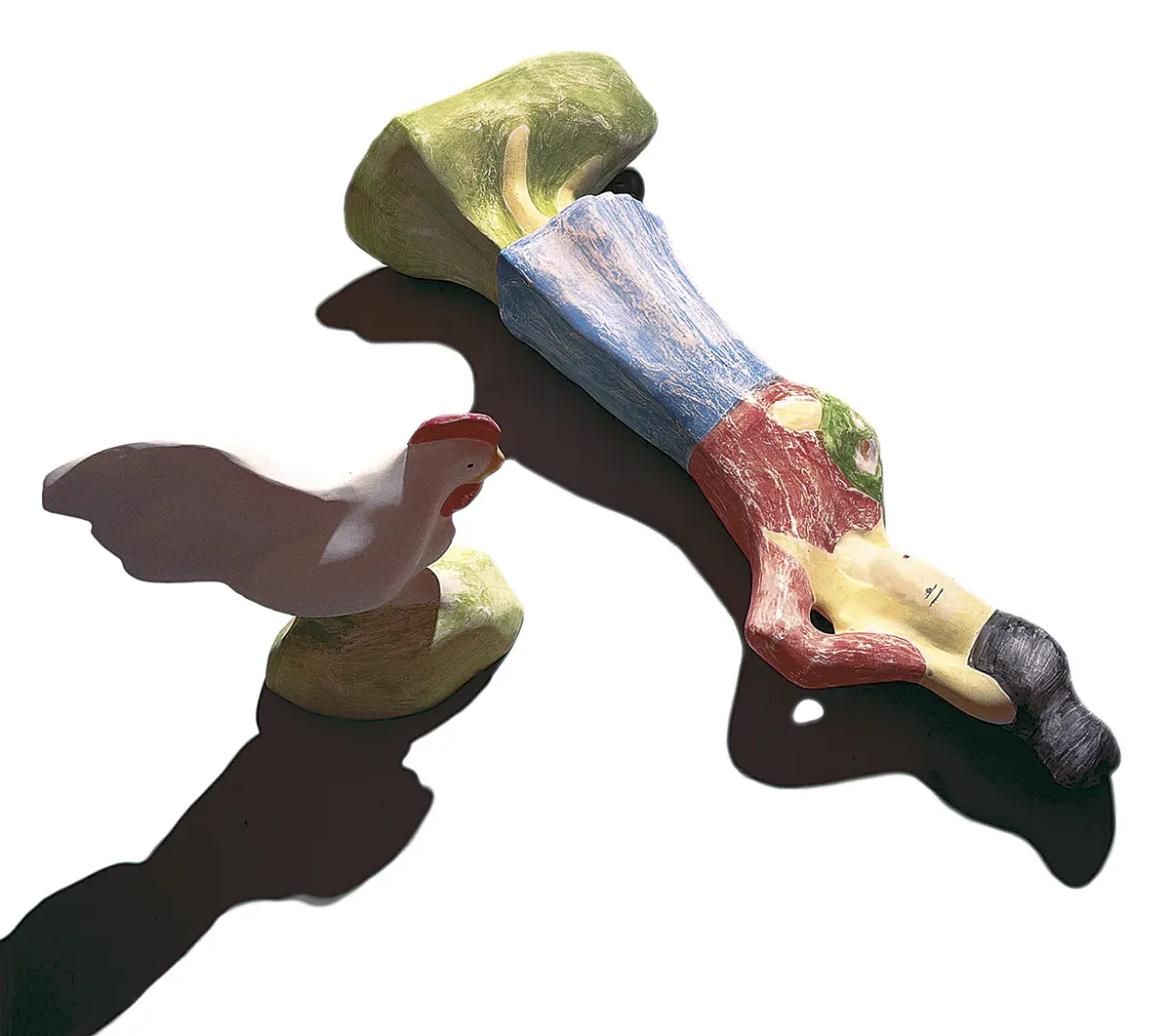
In the gallery space, Bairon displays a series of figures that dialogue with their own textures, with their edges, with the sober colors the artist chooses to paint objects created in the paper paste. Against the dominant trend, what we see entering the world are not the artist’s political ideas, but the honest images of her plastic investigation. We see imperfections on rectangular bars that could have been perfect; mysterious open —or not— holes inside semi-circular, flat shapes; the unbearable brightness of a pseudo-stone painted in black acrylic. On the floor alongside these pieces, and perhaps intended to disallow any attempt to give the show a concrete meaning, Bairon places two large figures representing a rooster and a human female. Are these hyperbolic reproductions of small decorative ceramic pieces? Is there any relation between the abstract forms and these disconcerting figurative apparitions? The show will not reveal the answer to these questions. None of the works has a title. There aren’t any signs or texts in the gallery. No didacticism is possible for this explosion of desires that have become visible. The meaning of these works escapes us, and all that’s left is the pure, inescapable effect of their elegance.
EVA GRINSTEIN