n the history of the twentieth century, the decade of the 1960s constitutes an undoubtedly special moment. A number of cultural, social, and political events in the international scene—the Vietnam War, the rise of the Berlin Wall, hippie culture, sexual liberation, the Civil Rights and pro-minority movements, to name just a few —can be cited to illustrate the decade’s characteristic spirit of rebellion and liberation.
Inscribed in a Latin American context that is equally marked by profound political changes and increased awareness of its position vis-à-vis hegemonic nations, Venezuela was not exempt from a climate of effervescence. The 1950s had already actualized the national longing for modernization in a socio-economic context characterized by the growth of urban centers. This expansion on the basis of riches generated by oil production was also due to the massive displacement of peasants in search of a better life, pursuing the dream that the country’s large metropolis represented. In the 1960s, this progressive euphoria was beginning to crumble. The urban explosion revealed not only the dehumanizing, alienating nature of city life but also the drastic deterioration of the population’s quality of life, which translated into the emergence of wide belts of poverty and marginality.
At the same time, in 1959 Rómulo Betancourt was elected President of the Republic. Many political factions representing an array of ideologies, had worked together to bring down the dictatorial regime of Marcos Pérez Jiménez (1958); however, when the dictator fell it was the right-wing parties who signed the “Punto Fijo Pact,” agreeing to carry forward a National Unity government. Betancourt had the historical responsibility of restoring the country’s political institutions and of reinforcing democracy and political freedom, but the Punto Fijo Pact pushed the leftist groups that had been involved in the fight against the dictatorship to the sidelines. Adding to this tension were frictions between democratic groups and the remnants of the old regime, along with the imminent crisis in the national economy.
It was in this context that Venezuela’s guerrilla movement first appeared. Many analysts think that the cornering and repression of the Left by the Betancourt government contributed to the guerrillas’ emergence. However, we should not underestimate the impetus that the Cuban Revolution provided to the formation of armed groups and, in general, to the rising insurrectionary tide felt throughout Latin America.
At any rate, it was in this climate of intense political restlessness that disillusionment with the democratic dream grew. Several insurrections—the Barcelonazo (1961), the Carupanazo (1962), and the Porteñazo (1962)—attempted to bring down the government through guerrilla actions and civilian/military coalitions, but ended up driving the regime to intensify the repression, resulting in thousands of deaths and disappearances; the use of torture, searches, and seizures; suspension of constitutional rights at several junctions; outlawing of left-wing parties; and political imprisonments.
The next administration (1964–1969), presided over by Raúl Leoni, saw a continuation of these political conflicts. The insurrectionary movement controlled some towns in the country’s interior, as well as some neighborhoods in the capital, under a strategy of “long war” and the use of rural guerrilla tactics. However, the strengthening of the country’s democratic institutions and an upturn in the economy, along with the successes in the anti-guerrilla repression, forced the insurrection into retreat. In April 1967, the Seventh Plenary Central Committee of the Communist Party of Venezuela acknowledged the defeat of the guerrilla movement and opted for a legal democratic process. Towards the end of the decade, the guerrilla movement had been mollified and placed entirely under control.
El Techo de la Ballena, an artistic/literary group with non-conformist and heterodox poetics, emerged in the context of Venezuela’s convulsive climate of political instability and subversive tendencies in the 1960s. The group adopted a critical position that completely rejected the establishment and employed a radical irreverence.
As a way to approach the diverse and complex aspects involved in the formation of El Techo de la Ballena and its production, on 10 November 2002, the National Art Gallery inaugurated a show titled El Techo de la Ballena (1961-1968). Curated by Marian Caballero and Félix Suazo, the exhibition analyzed the group’s poetics by following the historical thread of its more important exhibitions and editorial actions and displayed important documents relating to the Ballenero spirit in artwork, poetry recordings, books, photographs, catalogs, and videos.
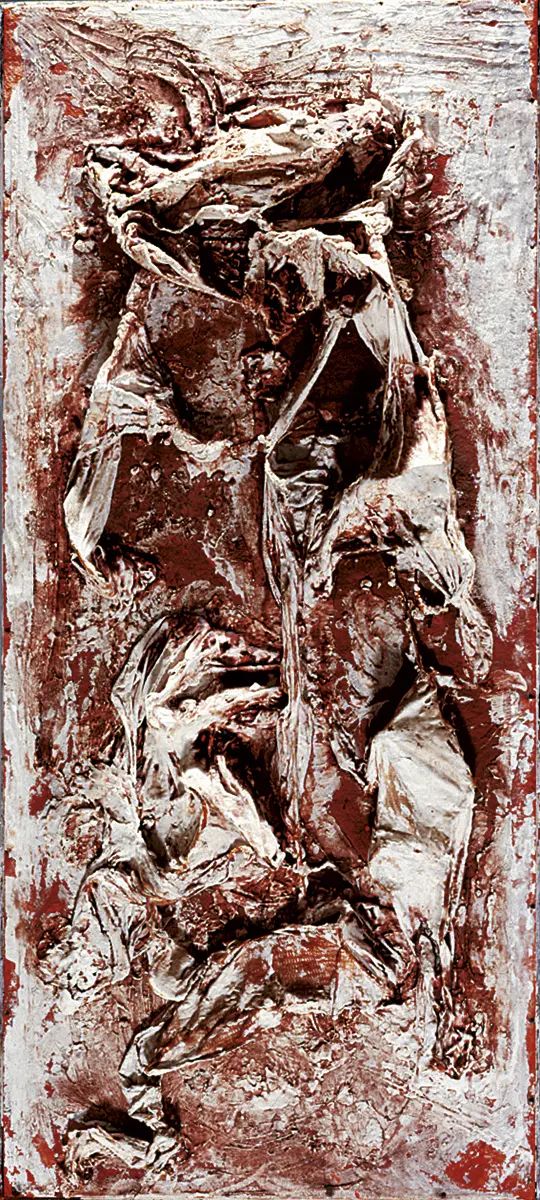
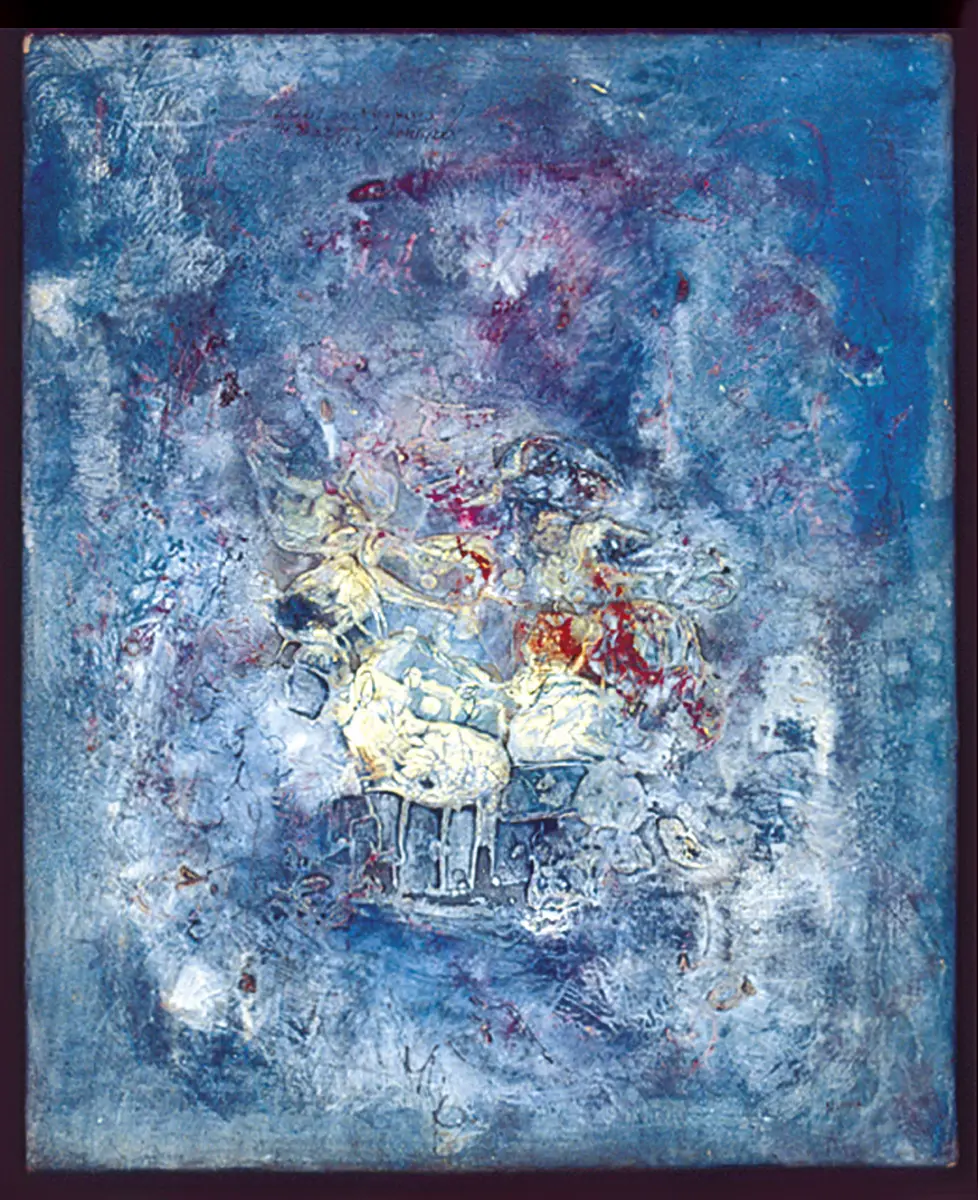
The show was divided into five sections. The first section titled “Magma,” relates to the group’s origins and its rejection of constructivism in favor of adherence to informal aesthetics. In fact, the group’s very first show in 1961 was titled Para la restitución del magma (For the restitution of magma). It coincided with the first ballenero manifesto, Rayado sobre el techo (Scratched on the Roof), which expounded the supporting ideas of the informalism then in vogue, and were full of an interior charge they called “magma.” For the group members, it was “necessary to reconstitute Magma... matter in ebullition... the lushness of lava... to place the canvas at the volcano’s foot... to give the lushness of lava back to the world... to demonstrate that matter is more lucid than color..."1 as a way of creating “a metaphor of the rot represented by a decadent society it rejects radically; an allegory of a consumer society constantly needing to discard; a denunciation of the excrescence represented by generalized official violence; or a parable of a technocratic society, whose dehumanization is reflected by the misery of population centers.2 This spontaneous, ebullient, primary, chaotic spirit, where art and life configured a single whole, was reflected in very material and textured works of a marked and rabid gesturalism, such as Materia III (1961) by Fernando Irazábal, Cabeza filosófica (1961-1962) by Gabriel Morera, Homenaje a la alfarería (undated) by Ángel Luque, or Aucun mortel n’a jamais été capable de découvrir ce qu’il y a sous moun voile by José María Cruxent. Another path followed by the group’s informalism, one with a lesser material charge and a greater attachment to splotching and to change is seen in a disquieting painting by Alberto Brandt, Imágenes transiberianas del califato de Irán (undated), or in Hugo Baptista’s and Manuel Quintana Castillo’s pieces.
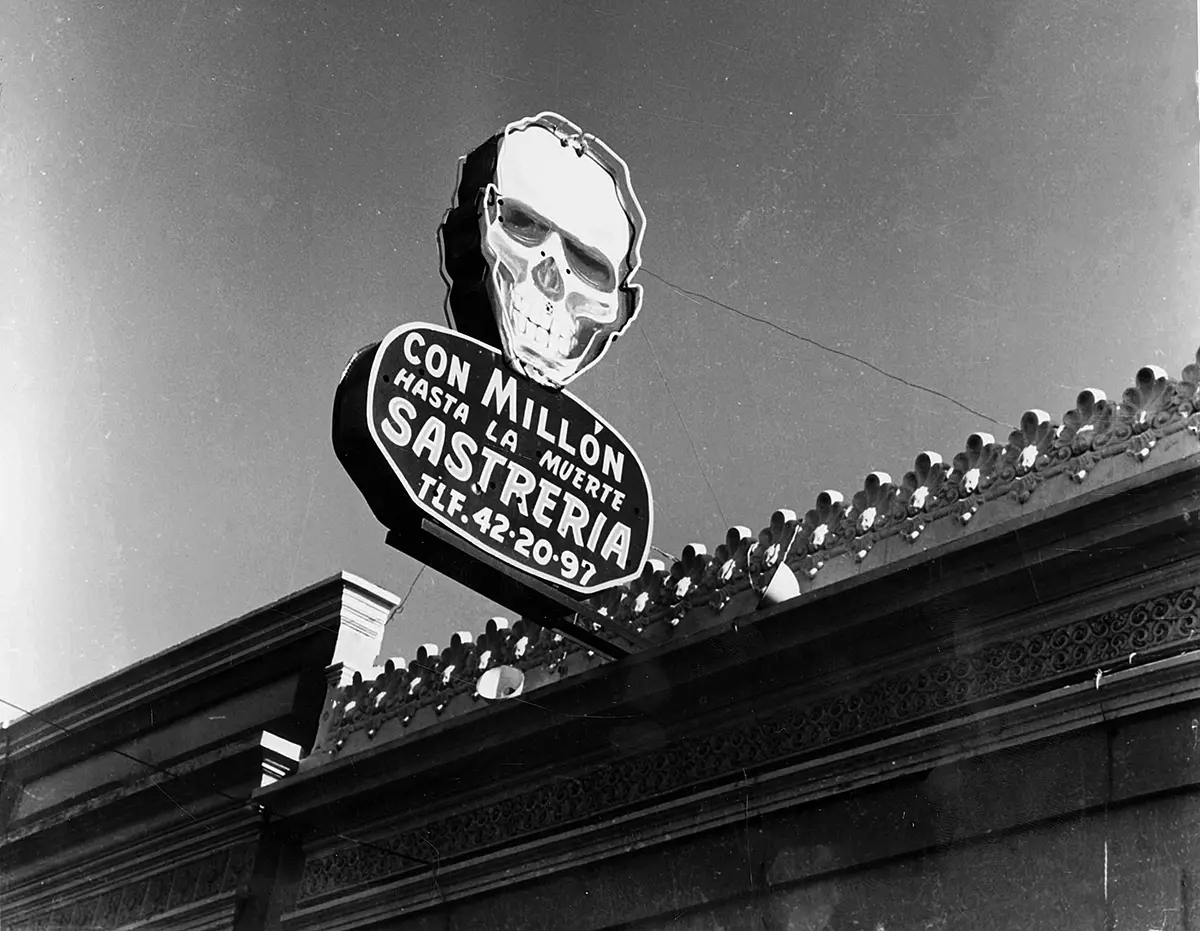
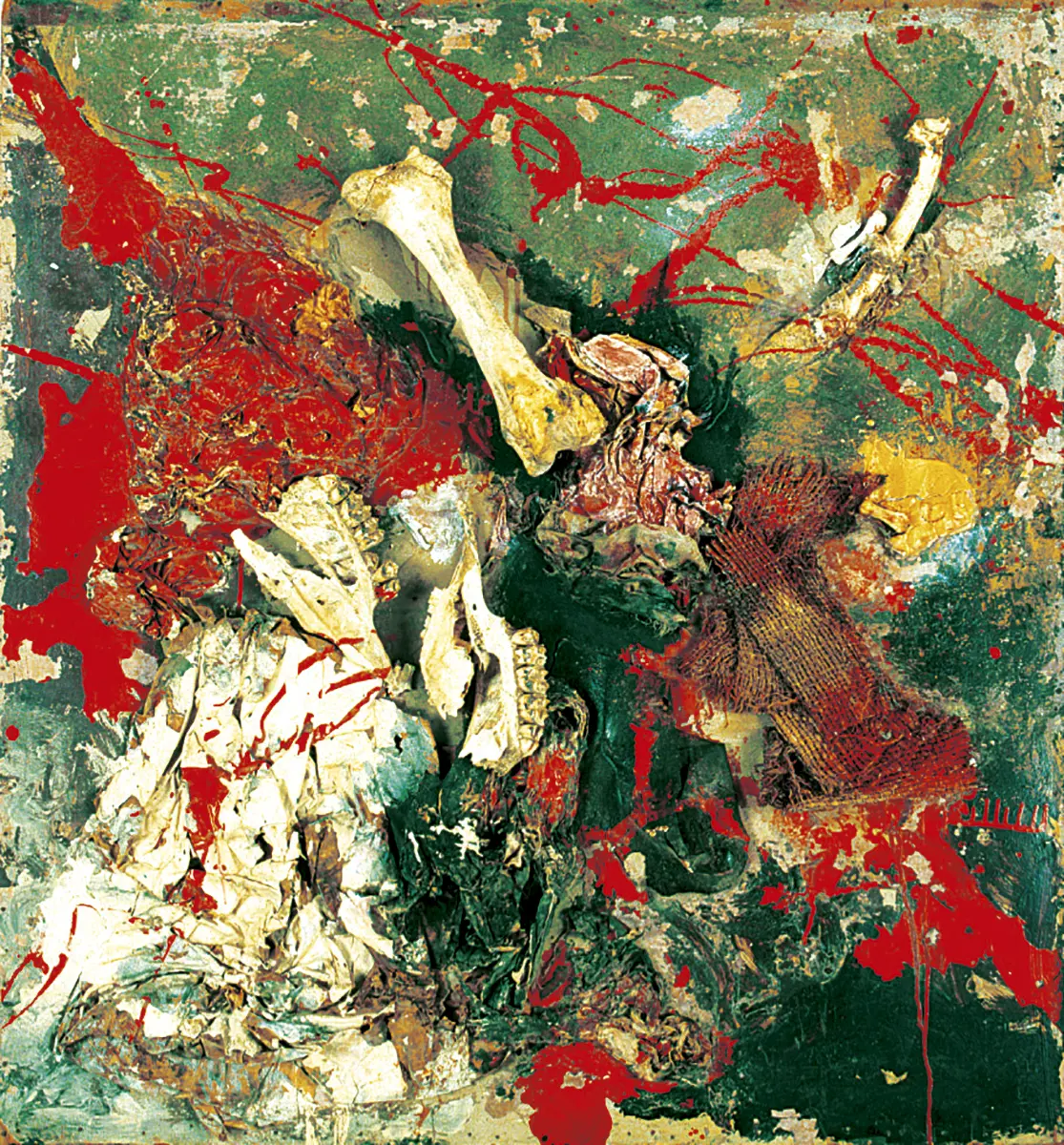
The show’s second section was titled “Muerte” (Death) and it referred to the group’s use of the theme of death, not only as a means to critique political violence and repression but also as an ironic gibe at certain funerary rituals and situations. The highlights of this section are the references to Fernando Irazábal’s exhibition Occisos (1962) and Carlos Contramaestre’s Homenaje a la necrofilia (1962), as well as Daniel González’s photographs. In Occisos, Irazábal presented a series of pictorial reliefs made with paper, canvas, and various non-pictorial materials representing decomposing bodies or fragments of skeletons, like old corpses partially disinterred. This brutal aggregation was transferred by Irazábal to ink drawings—as in Bestia (1963), which showed the ferocity of violent death by the use of very expressive strokes and drippings. Homenaje a la necrofilia is perhaps the most radical event in the history of Venezuelan art. Carlos Contramaestre, with an irreverent attitude unprecedented in Venezuela until then, used animal bones, flesh, and viscera to paint and compose his pieces; when the materials began to decompose, the Health authorities closed the show. The exhibition, accompanied by a mordant catalog, was the object of protests, denunciations, and harsh criticisms—a true success for the group exposing, as it did, the reactive character of official culture. Both exhibitions sought to alter the meaning of putrefaction and decomposition and to make it a metaphor for the violence in Venezuela’s political environment, as well as for the social decay and dehumanization that characterize consumer society. At the new show at the National Art Gallery, we had the opportunity to see Contramaestre’s excellent 1962 collage Estudio para verdugo y perro, created with bones, jaws, paper, and crumpled fabric in red and sepia tones, and composed with raw drama. Daniel González presented a series of photographs in which death is an object of ridicule, as in the image of Christ hanging from the cross by one hand, or a conventional house in which corpses are dressed and prepared.
“Fragmentación” is the title of the exhibition’s third section, which opens up an understanding of the group’s use of new figurative aesthetics. The expressionist deformation of the human figure and the rearrangement, or fragmentation of its parts was the path many artists followed in order to express the anxiety, alienation, and isolation of the individual in this period of history. One important element in this trend was the representation of grotesque and repulsive images as a way to reveal society’s false morality and decadence. Carlos Contramaestre, Perán Erminy, Ángel Luque, Daniel González, and Dámaso Ogaz were some of those who followed this path of figurative expressionism. Juan Calzadilla was undeniably important, with his vocabulary of diminutive human forms that create calligraphic conglomerations. Equally significant was Jacobo Borges, with works like Tomadora de helado (1965) or La jugadora No.1 (1965), in which the same aggressive deformation is applied to female characters of otherwise refined manners and tastes.
Ir contra todo (To go against everything), the show’s next section, gathered several different moments in the group’s development, each marked by the desire to oppose official culture, societal norms, and the traditional circuits of art. These events—including Homenaje a la cursilería (1961), Exposición tubular. Homenaje a Caupolicán Ovalles (1963), and Alberto Brandt’s Falsarios eróticos (1966), as well as the publication of Caupolicán Ovalles’s poem ¿Duerme usted señor presidente? (1962)—were characterized by a radical use of criticism, mordant commentary, black humor, surprise, and scandal. In Homenaje a la cursilería, one of the first ambient installations ever seen in Venezuela, the balleneros assembled under their severely critical gaze, kitsch and other generally ridiculous objects that are part of the nation’s popular culture, with the intention of vindicating the true strength of human inner life and distancing themselves from the sentimentality and melodrama promoted by traditional venues. The Exposición tubular was a collective exhibit of poems printed as posters and arranged in tubes. Falsarios eróticos presented a series of collages created by Alberto Brandt, in which, through altered, pseudo-pornographic photographs, the artist attempted to unmask hypocrisy and false morality. The show was scandalous. Ovalles’s book ¿Duerme usted señor presidente? was also a radical gesture. With extremely harsh language it painted a portrait of Rómulo Betancourt as an “elegant traitor,” the “generous part of whose heart is being eaten away by an ulcer."3 The scandal following the book’s publication resulted in its author’s prosecution and the imprisonment of Adriano González León, who wrote the prologue. Photographs of other actions by the group, such as their protests at the Salón Pegaso (1995), were also shown in this section.
Finally, the section titled “Ciudad” presented some performances around the recurring theme of the city as the site of dehumanization. Images of the street, the neighborhood, urban expressions, people, and traffic—all were used by the artists in their attempt to criticize uncontrolled urban growth and its consequent impoverishment of the quality of life. This last section is comprised of Adriano González León’s 1963 book Asfalto-Infierno, with photographs by Daniel González, in which image and text seek to form a semantic unit that allows us a glimpse of the “intimacy” of Caracas; Edmundo Aray’s book Sube para bajar, also from 1963, which explores the changes in everyday behavior brought about by the city’s hectic rhythm; and Pablo Gasparini’s photographic exhibition Cómo son los héroes (1965), with images of socialist Cuba, presented as the ideal society.
The exhibition also included a series of performances, projections, forums, and lectures, contributing to the consideration of this important and radical moment in Venezuela’s cultural history.
El Techo de la Ballena (1961-1968) was a well-conceived, well-curated exhibition that allowed us to revisit this period of the country’s history and by exploring the group’s avant-garde radicalism, to study and understand those convulsive years whose social, political, and cultural implications still possess currency.
NOTES
1. From Rayado sobre el techo No.1, Caracas, March 24, 1961. Quoted by Félix Hernández in El Techo de la Ballena, (Caracas: Galería de Arte Nacional, 2002) p. 6.
2. Ibid., p. 8.
3. Caupolicán Ovalles, ¿Duerme usted señor presidente?, in Hernández, El Techo de la Ballena, jacket copy.
KATHERINE CHACÓN