Courtney Smith’s Copacabana series is vertigo and an observation of beauties and singularities. Vertigo because of the variety of readings it promotes in the viewer. Beauties and singularities by virtue of each piece being a unique construction that includes a variety of moments in the history of society and presents the simile of harmonies and disarticulations by means of its pastel tones and uncolored wood, its moldings, its cuts and assemblages, its softness and its rigor.
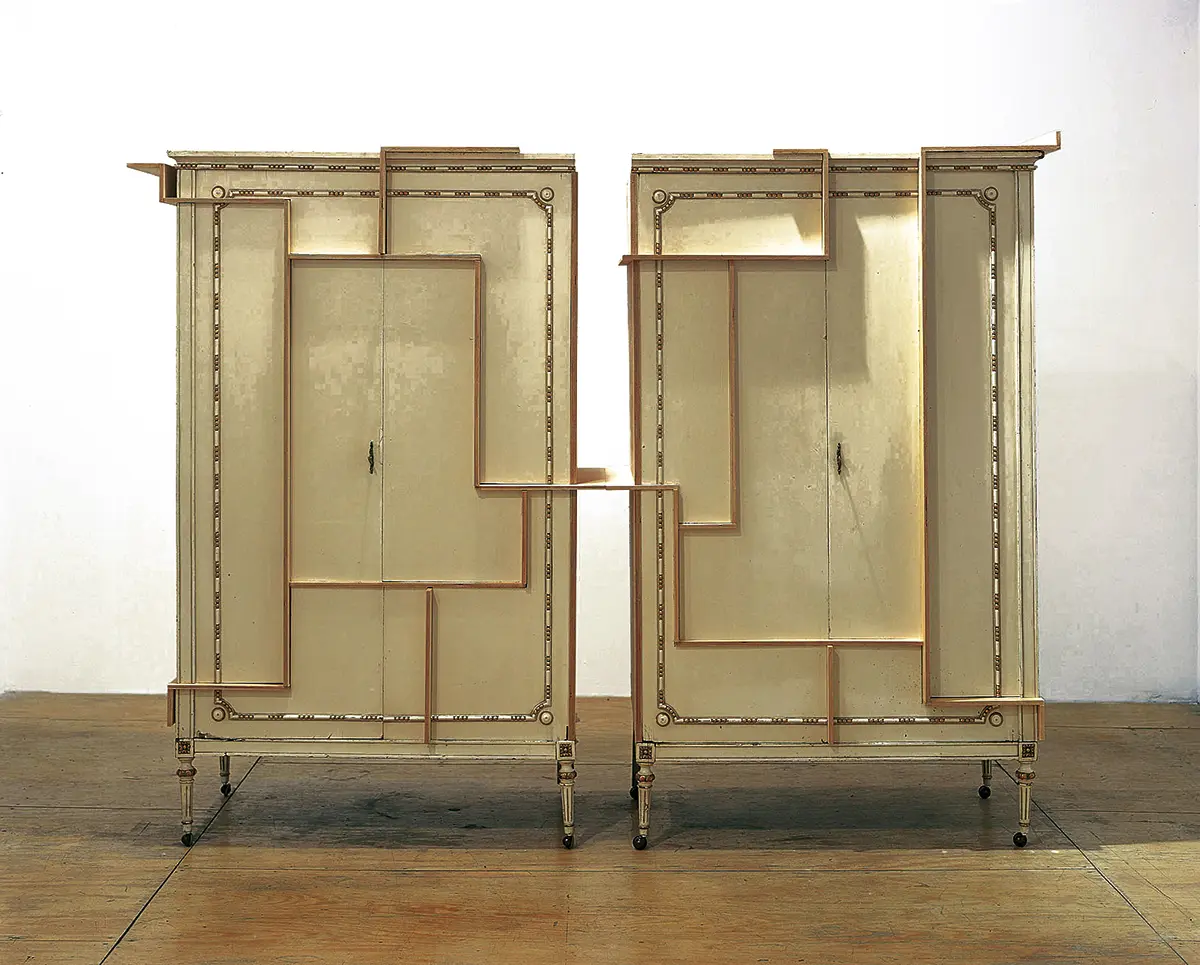
We could imagine the artist helping us to change the scene as we blink. In the past, the furniture item is inside a house; it is locked up, closed, opened up, touched, mistreated, caressed, exchanged for another, lost in a financial debacle, sold. It goes through one or several hands until Courtney Smith discovers and actualizes it. We may be in a period furniture museum —even if the period is the 50s; then we blink and we are faced with a peculiar situation: alien entities have been grafted onto this furniture, articulated, stackable, functional, and dysfunctional entities referring to one or several anomalies. Regarding this, the artist commented in a conversation in New York: “I’d find and buy this old furniture in Copacabana, and that is where the title for this exhibition comes from. I invaded these pieces with plywood constructions that I worked on in studies here and there, with understandable difficulty, given the fact that I’d never worked on carpentry before. This exhibition is a metaphor for the city and the body, like metastasis. For me, drawing is extremely important, it is very elaborate and could go on infinitely.” Looking at the drawings presented in this show —which generated some sections of the previous furniture and, to a degree, of this one— it is not difficult to understand their obsessive and passionate side, loaded with baroque shapes. In the current show’s “furniture,” the artist exercises free association between drawing and the items. Curves and curls are to be found in her drawings but not in her wooden constructions; on the latter, the artist draws a two-dimensional curved elongation which on wood becomes a three-dimensional right angle. ‘In the past I worked on canvas, drawing in large formats. Wood is different because it is more rigid and becomes a sculptural metaphor.” Depending on where and when an item is intervened —carved— its sections cut out, new elements grafted on, it can grow and grow, or it can begin to see its mass diminish until it disappears.
The previous paragraphs integrate the concepts I proposed at the beginning of this article: “... vertigo and an observation of beauties and singularities.” One shape generates the next, and one module generates its offspring, “one is one and his circumstance.” On the other hand, Tell me no lies, Seen/Unseen, y El Siglo de las Mujeres are some titles of exhibitions in which Courtney Smith has taken part; it is understood that her subtle aesthetic reflection deals at once with the complexities of life as a woman, mother, wife and professional person, without forgetting the importance assigned to the social and political context.
Already in the year 2000 Smith was creating furniture on the basis of personal aesthetics. Her solutions have been varied. Some of these objects corroborate the need to be familiar with the history of art. In her previous works, Smith makes explicit the broken of two-headed frontispiece characteristic of baroque churches in Europe and in Latin American portals and altarpieces. The use of hinges and the “tonal climate” helped create more direct and stronger pieces than the 2003 ones. In the latter, the subtlety of the veil created by the pastel tones in the elaborations of wooden contrast promotes an ambiguous, softly penetrating aesthetics. Surrealism, dreamlike states, and the past all navigate in the furniturés pastel tones. While that other tone of the plywood, industrially assembled from a thousand different kinds of trees, constitutes the area of the work done now, closer to the utilitarian and the constructive, which becomes a drawer, section, a body full of singularities. It is a copula. They are like emanations from the original furniture, although what prevails, visually, is the form. If this furniture had dared dream, it might have chosen to reincarnate in this that the artist has made of them, so strong are the allusions to the human despite the complete absence of human figures. Each piece shares its “being” with invisible gnomes that debate its possible use and express their admiration for the balance achieved. Each object had a history —or many— new histories have been added now. The addition of parts generates infinite conceptual and visual options. The sections inserted into each group create outlines that are like the steps of fantastic stairs, alien to the literary. The results are polysemic, they generate shapes and codes of visual union in the world of interior architecture, in its visions of the useful and the useless. The stair-like outlines enhance our ascent into nothingness, this is to say, into the Great Fall.
GRACIELA KARTOFEL