Consuelo Manrique’s work has hesitated since its beginnings between two inclinations: on the one hand, it makes explicit an interest in those values of abstract painting that privilege color, form, composition, brushstroke, and blotching; on the other hand, each one of Manrique’s shows expresses the desire to name a reality beyond those values, which are of an entirely pictorial nature. As the artist puts it, she experiences painting as “a boundary tension between the pure act of painting and the need to say things that go beyond the purely pictorial.” This duality was already visible in her first show, Nichos de vida, which explored the problems affecting Bogotá’s wetlands; it was later expressed in “Mapas de no territorio,” dealing with the ravages of violence in the Alto Magdalena region, and it is again explicit in Hálitos, Manrique’s most recent show, also related to the theme of violence, presented at Galería Diners.
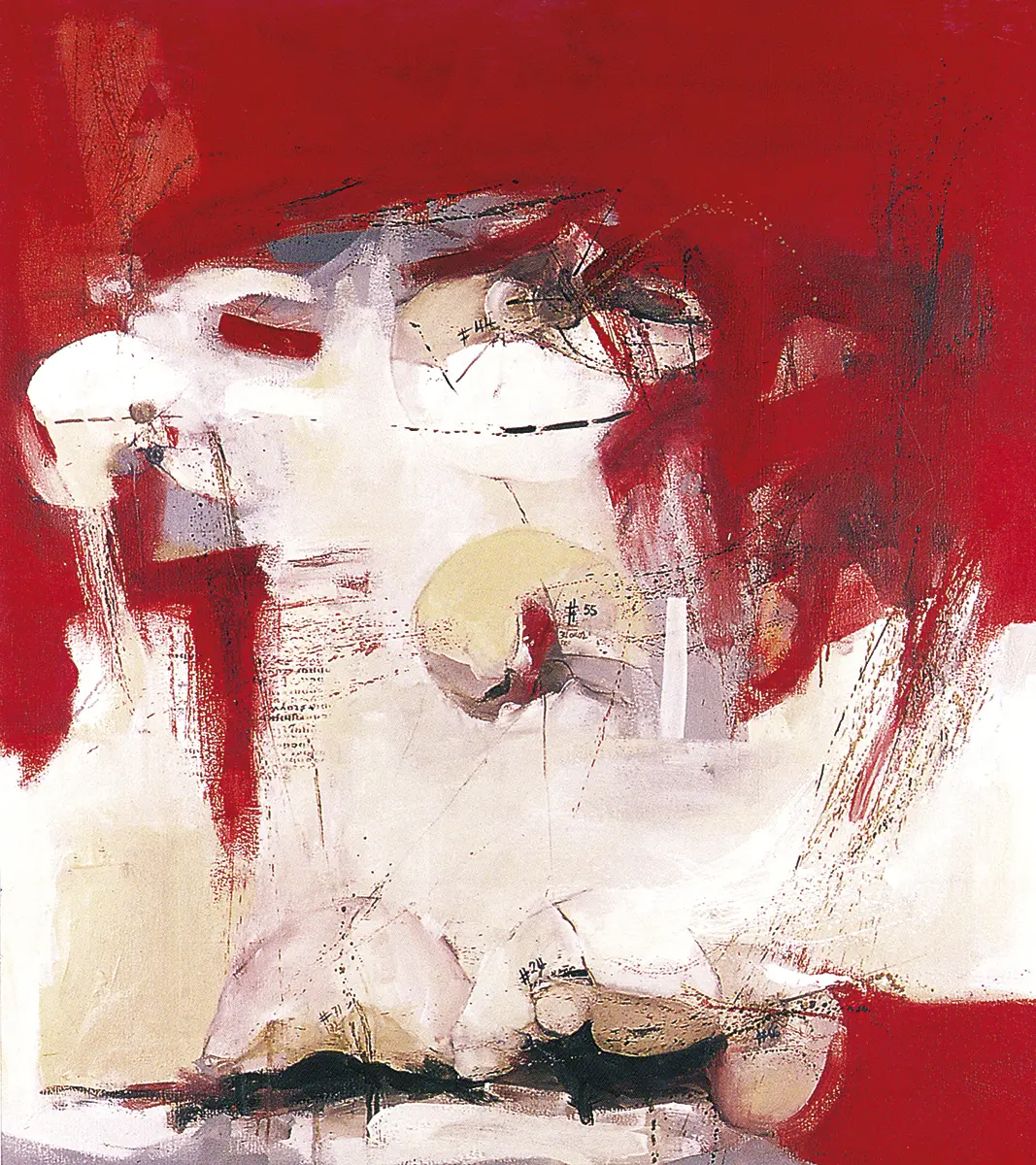
This show confirms that the space “beyond painting” Manrique refers to is related to a question about human behavior and its relation to life and death, to extinction and violence, issues that become evident in a manner of painting with expressionist overtones: gestural blotches, wide fields of color (dominated by reds and yellows), agile brushstrokes traversing the canvas and accounting for a force intent on expressing a certain drive through this pictorial language. On this occasion, Consuelo Manrique has most definitely focused her attention on violent behavior, on what psychologists interpret as “the mask of fear.”
The Judicial Palace holocaust was a decisive event in the country’s history. That difficult experience resulted, along with many dead and wounded, in a large number of “disappeared,” who were buried anonymously and left their relatives and friends trapped in uncertainty. In recent years, doctors and anthropologists have carried out investigations intended to identify these remains through the specialized analysis of their skulls, virtual “black boxes” containing valuable information about the individual’s identity and important aspects of their lives. These and other studies of human skulls have also revealed that behind violent behavior there are traumatic, fear-inducing experiences, such as abuse, so that violence can indeed be understood as “the mask of fear.”
Consuelo Manrique is a careful and attentive reader of the literature produced around these topics. For her, those skulls have become “white boxes” that keep a link to the past, so that they possess an aura and signal the presence of a being who has left traces of itself, a trace of life, turning into hálitos (breaths), breaths of life amidst the scenery of death. These whitened bodies encased in mystery, filled with the potential to “speak,” to recount past events, float on the pictorial surface, becoming at times nothing but diffuse blotches barely resembling their anatomy and are presented at times in much greater detail, perfectly recognizable; in both cases they inhabit the canvas like triggering elements, allowing the viewer to relate in a different way to those pieces of cloth covered with paint. Their presence brings forth something that questions us, something that moves us to reflection and drives other readings.
Manrique’s canvases, some dominated by the color red and some by yellow, were carefully arranged in the exhibition space. The show was preceded by a painting in elongated format, placed atop a box that, in the empty entrance hall, resembled a column; it depicted a straight line of skulls, indicating the exhibition’s theme. Also included were two sketches of skulls, which revealed a gaze that interrogated their anatomy and resolved it by means of a formal language that reveled in the drawing’s tonal values and the brushstroke’s expressive qualities.
The gestural character of the show’s paintings and drawings reveals that in the act of painting Manrique expresses a tension between the painting itself and her theme; thus in the different pieces, in the pure language of painting her expressive capacity is brought together with violence, a negative presence that exercises its power on all who live in a country threatened by incessant conflict —on the face of which painting is affected, responds, and takes shape.
MARTA RODRÍGUEZ