Under the title El delito de la belleza, Carolina Antoniadis (Rosario, 1961) presented during the months of April and May her first anthological exhibition of works dated between 1986 and 2003. In this exhibition, the artist’s savoir faire is understood as a neo-mannerist option, where the logic of excess crystallizes into an intricate horror of empty spaces. Thus this individual show emphasized a revision of two intensely and prolifically productive decades, at the same time that it privileged a non-linear, deconstructive exhibition syntax, which established relations between different bodies of work, in different topological situations and dialogical interplays: large-format paintings, triptychs and polyptych with photographs and stoneware objects; plates and plaques in enameled and/or gold-painted porcelain, all with gold leaf frames, collages, decoupages, mixed techniques, in-situ mural installations, and assisted ready-mades. Through this de-limiting operation, the obsolete categorial boundaries separating the different languages of art were intentionally broken. In terms of the disposition of her works, a curatorial script articulated the pieces without recourse to the chronological/retrospective disposition that is traditionally found in exhibitions of these characteristics.
Intent on recovering a cipher of the beautiful/convulsive, Antoniadis presented the viewers with a physically and sensorially stimulating tour, which, a posteriori, at the level of aesthetic reception, activated a previously unsuspected range of associations and anchors of meaning.
Antoniadis’ ultra-baroque poetics is marked by the proliferation, juxtaposition, and superimposition of iconic, decorative, and geometric motifs. Alongside the trompe l’oeil of her sumptuous tapestries, brocades and silks, clothing designs, and textile weavings, whose different morphological and semantic densities culminate in an equalization of rigorously plane surfaces. Indeed, a madness of seeing and touching, camouflage, playful physicality, mimesis, hyper-simulation, multi-centeredness, concentration, dispersion, and fragmentation are the artist’s favored strategies. Her aesthetics could be interpreted as a cultural revisiting of the laws of complexity and diversity, present in the concept of the bel composto, which was born with classical Baroque. In this sense, Antoniadis paints, decorates, and makes her pieces baroque precisely to free herself from her own excesses. That is why the artist situates herself in a position that is at once of adhesion and of conflict, with the very pieces of the past she is constantly quoting, criticizing, or poking fun at, in the key of parody and satire, from the threshold of an uncertain, anxiety-inducing present.
Antoniadis behaves like a veritable Mnemorisne for the late twentieth century and the newly minted third millennium. Her hybridizing poetics is testimony to a frantic iconological memory where, as though in a stylistic patchwork quilt, a myriad of iconographic codes and repertoires intermingle, derived from various textual encyclopedias. If the artist quotes, however, she also breathes and keeps her distance. And if she carries out mimetic gestures, she later disguises, extrapolates, and masks them in an operation of estrangement of her referents which, in turn, amplifies and resignifies them in a new context.
In El delito de la belleza the dimension of pure aesthesis, id est, of that aesthetic fruition that is achieved through a recognizing gaze and a gazing recognition, becomes the ideal starting point for a trajectory of the senses, where the ambiguity and the rebelliousness of beauty that verges on criminality work as the counterpart of an absence —an absence of being. This hiatus, this gap, is located at the deepest level, acting from behind the beauty of the ornament, and corresponds to the un-being of beauty posed by Lacan. A substratum of melancholy and perversity coincides with the splendor and stasis of form, becoming a leitmotif in Antoniadis’ work. Such a somber background is nothing other than the fuscum sub nigrum that Leibniz identified with the Baroque monad, a kind of cell or sacristy without openings to communicate it with the outside, but strongly autonomous.
Antoniadis’ most recent works present both monadic configurations that weave parallel micro-narratives in a single painting and beautiful, dark radial vortices, in tracings dominated by rhythm, redundancy, and serial repetitions that are irregularly and regularly programmed.
Antoniadis’ site-specific installation Juego de niños (2002) is a clear example of coded homage to the Baroque and to the famous Keplerian orbit. It comprises nine porcelain plates painted in gold leaf, arranged around the perimeter of a long, monochrome corridor in Crete red that reproduces a horizontal ellipse: the Baroque curve par excellence, attained by means of anamorphosis and deformation of the circle. Here, the profuse decoration of each module’s surface, with its golden acanthus leaves, is not enough to mitigate the cold furor and restrained pathos of the small and innocent black outlines at the center, which are nothing more than enigmatic specters —somber backgrounds— engaged with the element of the naïf in a perverse game of torsion and falsification.
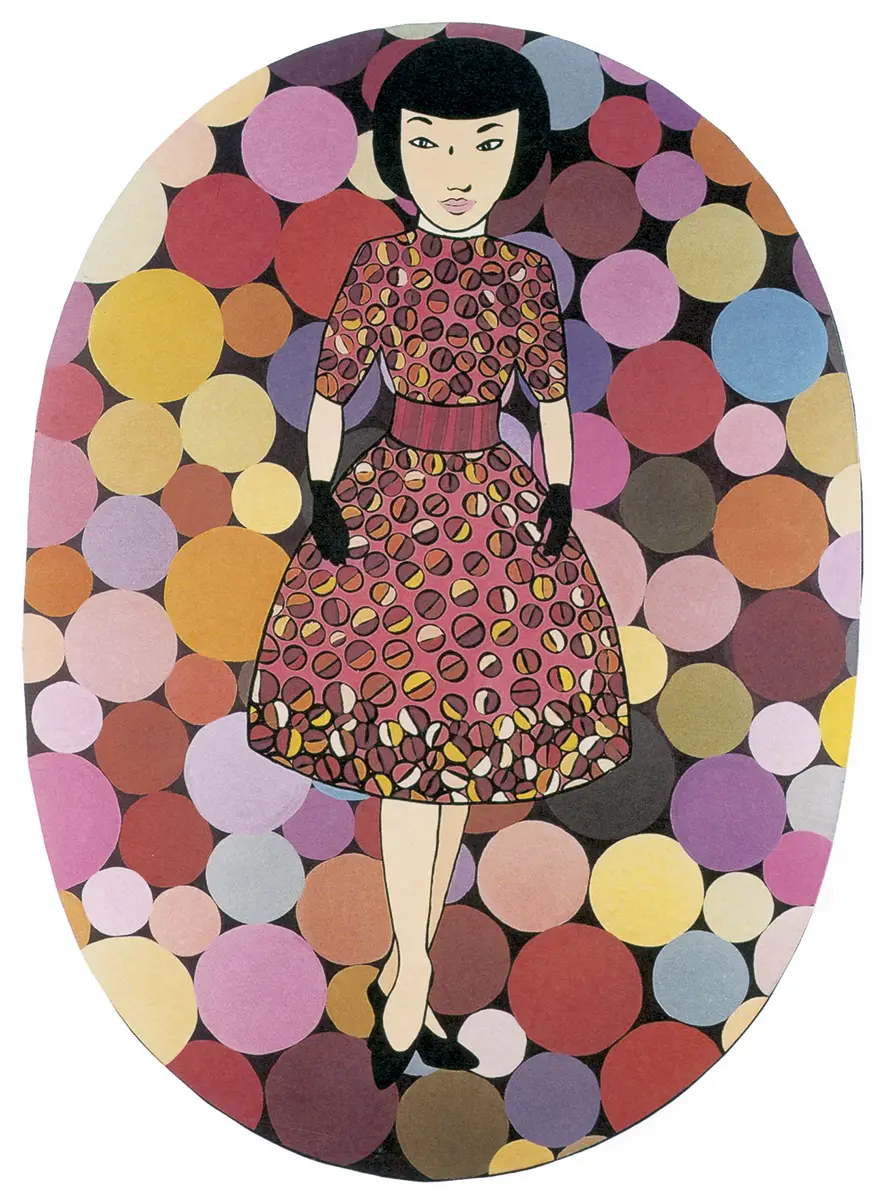
Híbrida (2002), a monumental 200 x 150 cm oval-shaped canvas, features an attractive, excessive, monstrous female icon that mimics the programmed chaos of a geometric background. This background reproduces the beauty of certain fractal configurations in rhythmic progressions with irregular variants. Here, the figure is seen by the artist as a cliché or stereotype of Gender Art annexed to a striped background with which it attempts to coordinate, by turning itself into a stripe. It is a hyper-body, a clone prototype, completely out of measure and scale, concocted on the basis of Antoniadis’ post-re-reading of some procedures characteristic of Pop and Op Art. Híbrida is an impossible woman and it works as an authentic magnet for the eye. The ellipse of the shaped canvas is duplicated, in a redundancy effect, by the figure’s head, locked in a close-up. The inclusion of a minor oval within a larger one is a symptom of the Baroque OmniVision’s reflex or specular retombée, and it acts as a metaphor for the loss of an axis, instability, and the chaos that dominates our frantic and turbulent times. Híbrida and its companion, Ambigua —another 2002 oval-shaped canvas with similar dimensions— are the result of a syncretic mix of several female models: exotic, standard, Oriental, Western, modern, postmodern, functional, accessorized, child, adult, and so forth. Thus, they are more feminine than femininity itself, and they have no other option but to hide in an embrace of the multicolored circles and ellipses that cover their backgrounds. Similar to one another but not identical, these circles are painted in flat inks, generating a kaleidoscopic weaving that moves vertiginously towards the foreground to compete with the magnificence of the Woman-fetish object.
To summarize, the point/counterpoint of order and disorder in a growing entropy comes across in this large body of works, where luxury presents itself as voluptuous falsity while the artifice of ornamentation is posed as art and effect of montage.
CLAUDIA LAUDANNO