Carlos Vega’s recent paintings mediate between the past and the future. Most of the eight large-scale canvases recently exhibited at Jack Shainman Gallery portray open roads and suggest a sense of transit and the possibility of future experiences. However, Vega’s collage technique, through reliance on old documents that are either superimposed on or used as a support for painting, evokes the past. Although the canvases themselves are devoid of human presence, the viewer becomes a kind of presence and animates the experience of these works. Our attention constantly moves between the painted subjects and the collaged surfaces, alternating between a metaphorical past and future, and thus grounding the work in the present.
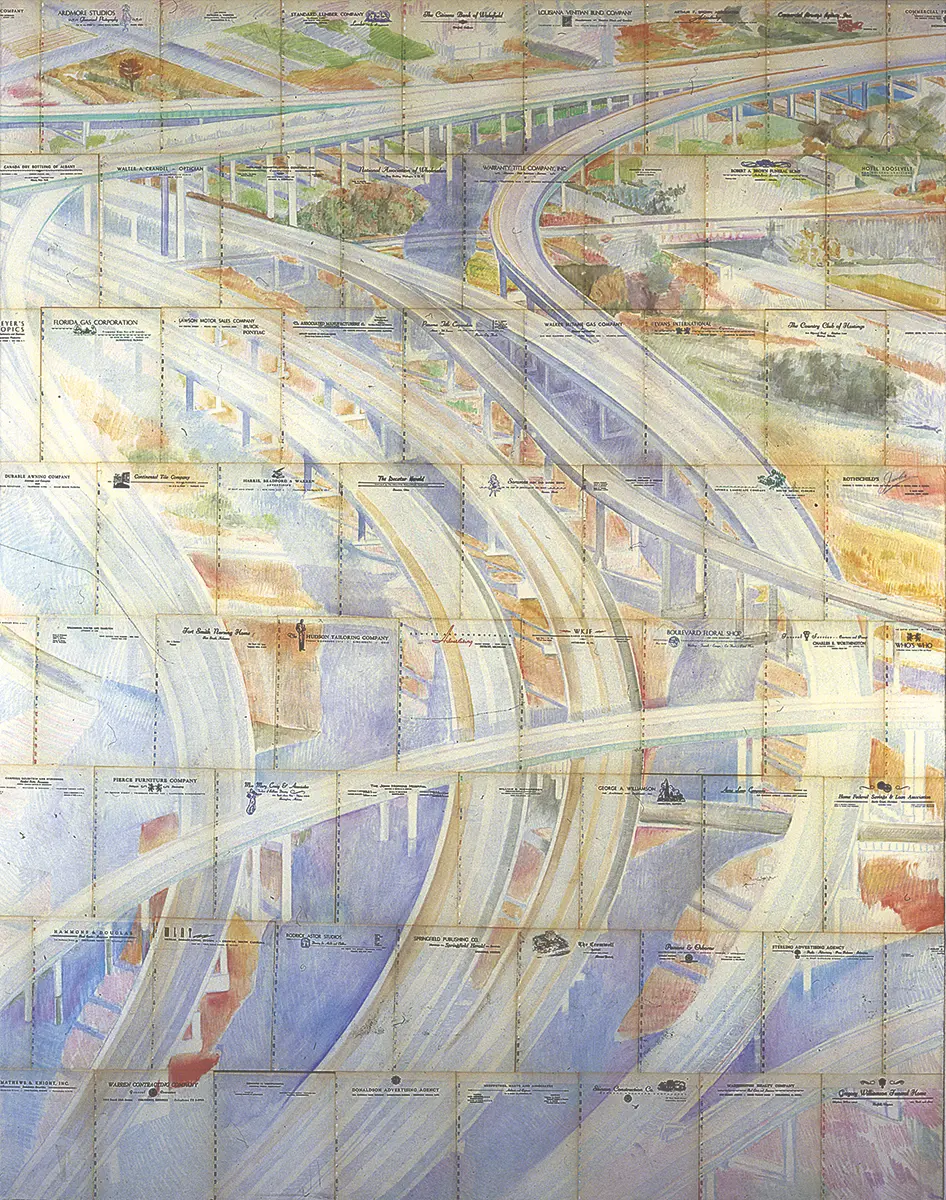
Vega’s technique has shifted significantly since the earlier work he exhibited at Jack Shainman in 2001. At that time, he employed vibrant colors and gave greater prominence to collage elements to create a dramatic discourse, whereas his recent paintings are muted and understated. Now, he favors a palette of yellows, light grays, and whites, and the collaged elements are more discreet. In Who’s Who, a canvas depicting an empty network of highways, Vega employs blank stationary samples from a printing company. By superimposing the sheets in a brick-like layering over the painting, he creates a veil through which we view the subject. The two layers vie for the viewer’s attention without the heightened drama of his earlier work. Stage Coach Road, a work on paper, inverts the technique, placing the collage elements in the background and the painting on top. Because the subject here is more prominent than the collage, this work becomes the boldest of the entire selection. It depicts signatures carved into trees that marked the boundary of an old stagecoach road in the mountains of New Mexico. In the background are pages from an illustrated nineteenth-century Spanish dictionary. The regular print of the pages contrasts with the cursive markings on the trees, which signal a tangible human presence. In reproducing the tree carvings, the artist puts himself in the place of the traveler. The art of painting becomes a metaphor for the journey.
Vega has also shifted from his earlier style in the formal development of this series. In those paintings, he positioned the viewer either below or above the scene, but his recent works depict expansive level views with a high horizon line. The vastness this portrays is most pronounced in the depiction of a railway yard in The Total of Circumstances. The train tracks appear to extend to infinity, yet the viewer’s voyage into space is constantly interrupted by the collaged surface, in this instance a court transcript describing a border dispute between New Hampshire and Vermont that was heard by the U.S. Supreme Court. Similarly, in Avenue Cárdenas, he extends the major Mexico City thoroughfare far into the background by means of a raked perspective with no horizon line. However, perhaps as a metaphor for the chaotic nature of Mexico City, this canvas is almost impossible to traverse visually. The superimposed documents, pages with burnt edges from a land grant made by the king of Spain to his brother’s secretary executed in a flowery cursive, impede access to the painted subject. Both works offer an ironic commentary on the arbitrary nature of boundaries over the course of time.
The experience of continually alternating between the surface and the illusion of depth in Vega’s work recalls early theories on the nature of modernist painting as evoking medium specificity through an emphasis on surfaces and flatness. Vega evokes high modernism through the grid-like arrangements of his collages. Hybrid, which depicts a modern city, has a collage component of lined notebook paper arranged to describe a series of progressively smaller squares and is similar to the early paintings of Frank Stella. Camino Real depicts trees similar to those of Stage Coach Road and is superimposed with white stationery with a blue border, forming a block-like arrangement that dominates the viewer’s attention. The ghostly trees of the background painted in faint grays are diminished by the dominance of the grid. By using photographs as the basis for his subjects, the artist brings together separate systems of meaning, such as abstraction and figuration, or text and image. Vega chooses not to suppress narrative, and thereby distances himself from theories of modernism and presents the viewer with old stories, as well as new ones waiting to be told.
TATIANA FLORES