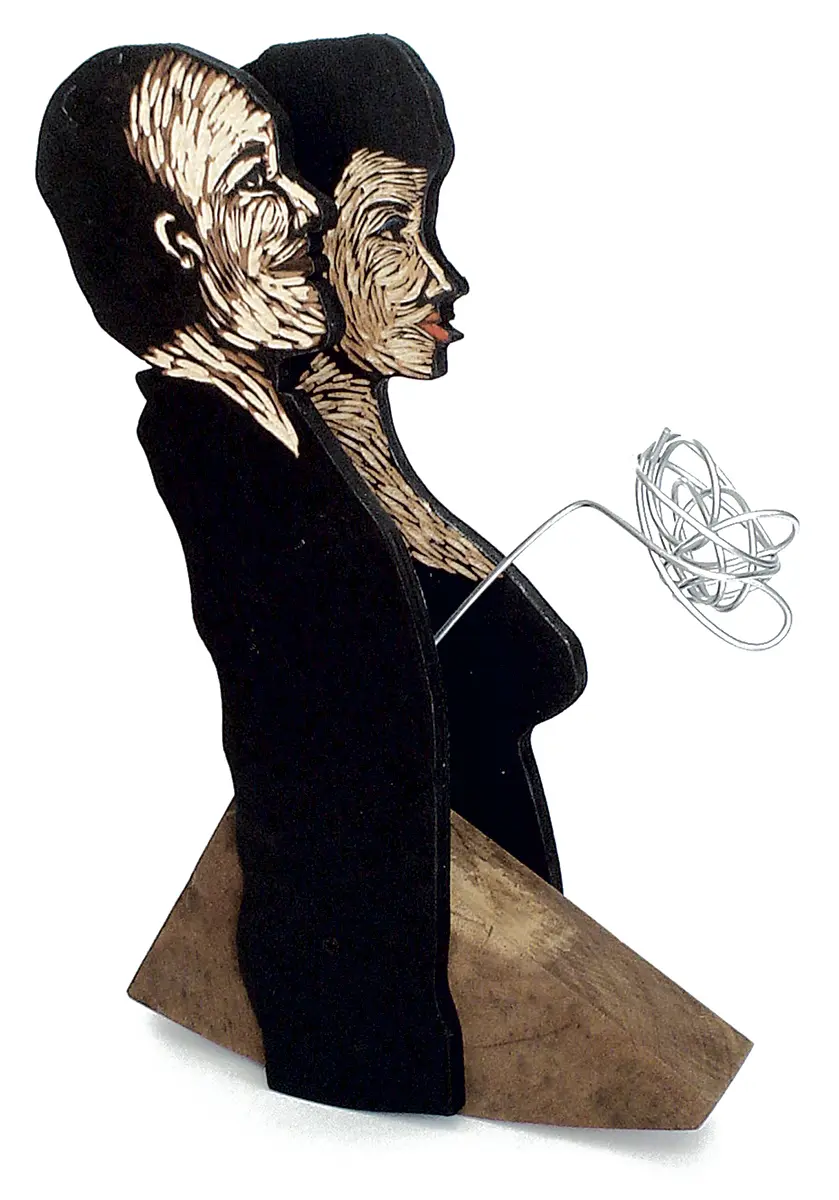
The true protagonist of Belkis Ramírez’s most recent exhibition, Portables, presented at Santo Domingo’s El Espacio gallery, is the format itself. It is Ramírez’s very aesthetic —an aesthetic in which the xylographic sheet goes from being an instrument in the service of the work of art’s material formalization to being an artistic object in itself, an intervened object, halfway between relief, bulk sculpture, and sculptor painting. The most salient fact is that the small format has given the work of art an intimate and portable character, a process akin to what happened with the transit from the predominance of murals to easel painting towards the end of the Middle Ages, and with the same sociological and market connotations, by expanding the work’s range of accessibility, but also with an individualistic component.
Even that portability can be assimilated to contents that recur in Ramírez’s personal mythology, with all that plotting of illegal journeys and forced prostitution, imbricated into an even wider and deeper plot, one that signals the ambiguity and the traps in a game of seduction that incessantly involves us all —but especially women.
All of this places Belkis Ramírez’s work among the most intelligent to be found in the context of contemporary Dominican art, within what can be considered an art that is dedicated, in large measure, to clarify the matter of gender identities in our culture, although it would be gross reductionism to label it exclusively as “feminist,” since its proposal, like that of an artist like Raquel Paienowsky, goes beyond those parameters. And not only because they see reality in terms of an “eco-feminist” worldview, close to that of activists like Petra Kelly or Vandana Shiva, but in an even wider sense than that, as a denunciation of all forms of oppression from power, and as a deconstruction of the mechanisms of patriarchal repression.
Ramírez’s vision of the role of women seems close to that of Simone de Beauvoir; women are “half victims, half executioners,” and to be trapped and lured alienates men and women from themselves and from reality. In that sense, the phenomenon of prostitution comes to occupy the core of established institutions, such as marriage.
All of this is in a distilled plastic language through which, by virtue of the formats used, Ramírez leaves behind her tendency towards stenography. Drama, always present, is not all-enveloping now; we carry it with us, like the traveler who cannot outrun her obsessions. Clever use of the rhetoric of chiaroscuro and artificial lighting, natural and industrial materials, plus some historic/visual quotation —Munch’s The Scream— completes the character and rounds up the expression of the current moment’s most suggestive artistic propositions.
LAURA GIL