“A point is the result of the tool’s first clash with the material plane, the base plane. Paper, wood, canvas, stucco, metal, etc., can build that material plane. The tool can be a pencil, chisel, brush, quill, needle, etc. Through this first clash, the plane is fecundated…” This is how Kandinsky describes the origin of artistic creation in his classic text Point and Line to Plane. The elements of composition come one after the other following that initial clash: line, shape, volume, figure, background, plane, and their successive juxtapositions, structurations, perspectives, plottings, veilings, and transparencies, all of it ending in the final composition that emerges from the artist’s imagination. Kandinsky pointed out that the point is akin to “the union between silence and speech,” thus defining the fragile border between creation and nothingness in an attempt to reveal the short distance from the invisible to the visible, from the immaterial to the material, from the eidetic to form.
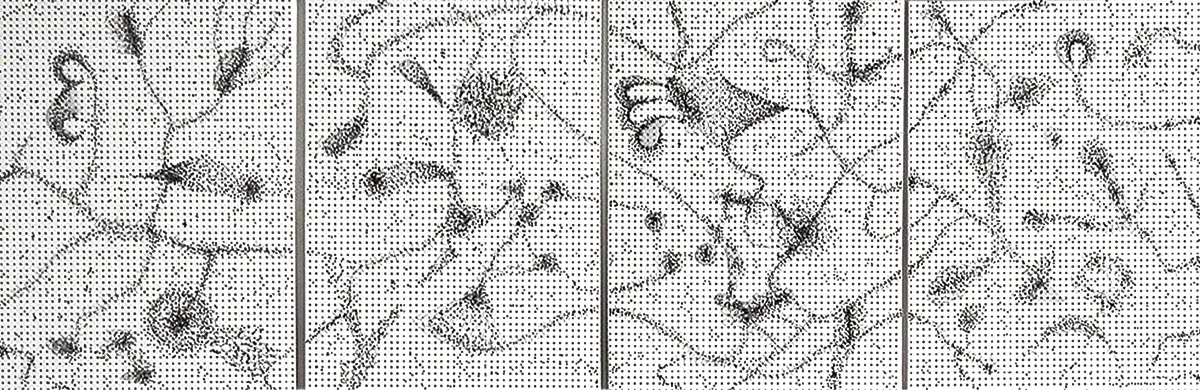
With his show PUNTO ALÍ DADES, Alí González refers us back to that first encounter, to that initial clash, to that first blotch —the genesis of creation— that reveals the possibilities of a primordial image. González keeps the selection of materials to a minimum and does the same with the compositive elements: color, line, and shape. Yet he is able to multiply his visual effects by using plain or perforated papier-mâché, and by the combination of materials. The symmetric perforation on the papier-mâché becomes indistinguishable from the points added by the artist. To these agglutinations, which tend to sink in the plane, González adds twisted wires, metallic mesh, and iron grids, arranged so that they acquire qualities similar to drawing, painting, or relief. Our gaze is captivated by this swarm of inert shapes, and attempts, in a futile effort, to discern between the material fragment, the painted outline, and the projected shadow, against a pristine white. The artist plays with order and chaos, with regularity and irregularity, designing a new cosmos that seems to dilate and contract. The show is divided into four series: Territorio de trampas, Cabezas tejidas, El agua and Nebulosas, and in a way it alludes to that order of ideas. In the series Territorio de trampas, 2002, mixed on perforated cardboard, 120 x 120 cm, the distribution of points activates the plane’s surface and builds a panorama of pictorial constellations that make the whole format dynamic. The concentric shapes grab our attention thanks to the incorporation of materials that accentuate the visual clash and augment the ambiguity between figure and background and between flatness and relief. In the same discourse, the series El agua and Nebulosas carry forward this search in which the meeting of opposites propitiates a dialogue with profound visual resonance. In Cabezas tejidas, 2002, mixed on perforated cardboard, 50 x 40 cm, however, the artist attempts, despite the abstract nature of the elements, an approach to the human figure. The shades between the white and black blotches create volumes, and these volumes sketch the portrait’s essential features. Anonymous and undefined, these faces express a new way of feeling and thinking about human existence.
With this recent proposal, González reaffirms his faith in the pictorial tradition, assuming the square or rectangular format and incorporating everyday elements to which he assigns a plastic value. With this, the artist builds a visual world that is full of real and virtual variations. Representation acquires a dual meaning through its form as well as its content, and at the same time, it explores the relationship between the two- and the three-dimensional. The viewer’s displacement becomes then imminent since progressively the viewer perceives different visions as she comes close to or moves away from the piece. A self-taught artist who declares himself a researcher in art, González has touched upon the fundamental problem of space in the history of art. Points, lines, and plots make the format he delineates extremely eloquent. Just like in physics “space is nothing without the things that occupy it,” in the visual arts space is activated on the basis of the proposal the artist achieves as far as technique, format, a discipline are imposed, be it in installations, engravings, sculptures, happenings, or body art. This artist’s work was already pointing in that direction, clearly signaled by the 2001 show Usted, el espacio, oriented towards the exploration of space in its oneiric, material, political, and representational aspects. What was left then was to inquire on the plenitude of pictorial space as pure creation, free of references and connotations; this is why González reminds us, from a contemporary perspective, that in placing a point on the plane we are creating anew —and recreating— space itself.
GLADYS YUNES