Alain Pino is seduced by contemporary life’s mechanisms of simulation. And (despite having graduated with a degree in painting from the Instituto Superior de Arte) he has chosen photography as his expressive medium in order to comment on phenomena and situations whose common denominator is ambiguity. He focuses, basically, on the way in which the media and institutions involved in the production of consumer goods surreptitiously manipulate people.
Interested since the early 1990s by the power of manipulation over our everyday life, the artist applied this concept to an artistic proposal that “played” with Cuban revolutionary photography. Around those years he discovered the work of Cindy Sherman, who opened his eyes by approaching the creative act as a “theater” of splittings in which characters lose their uniqueness by becoming multiple and unstable.
Androgyny is among the phenomena that have interested Pino more intensely, and the artist has achieved his most convincing work by exploiting it as a subject. Early in his career, the artist created pornographic play-doh scenes starring characters from the world of comics represented in an androgynous fashion. Some from the Disney gallery of animated cartoons, some invented, they all shared the lasciviousness and the abjection that the mass media can transmit subliminally. The point of these “hot” scenes was that by being resolved in a malleable and innocuous material, and by being staged using cartoon figures, they did not astound anyone. After creating the scenes, Pino registered them in cytochrome photography.
Pino’s female characters painted on large-format canvases through photo-emulsion and worked with oils in order to create androgynous beings becoming a destabilizing practice with respect to the notion of serialized work (a notion traditionally associated with photography.) Pino suggests mustaches and sideburns in the originals, hardens their faces, and takes away their long hair, emphasizing a certain overall drama. Their “weirdness” suggests the indeterminate character sex can assume when it is subjected to the criteria of fashion, material pleasure, advertising, etc.
Pino’s more recent work, seen at La Casona, has taken a turn towards an impressively cold discourse, among other things thanks to its minimal character. These installations and photographs titled De lado a lado connect with the artist’s previous work above all by their willingness to experiment, something that has always characterized him.
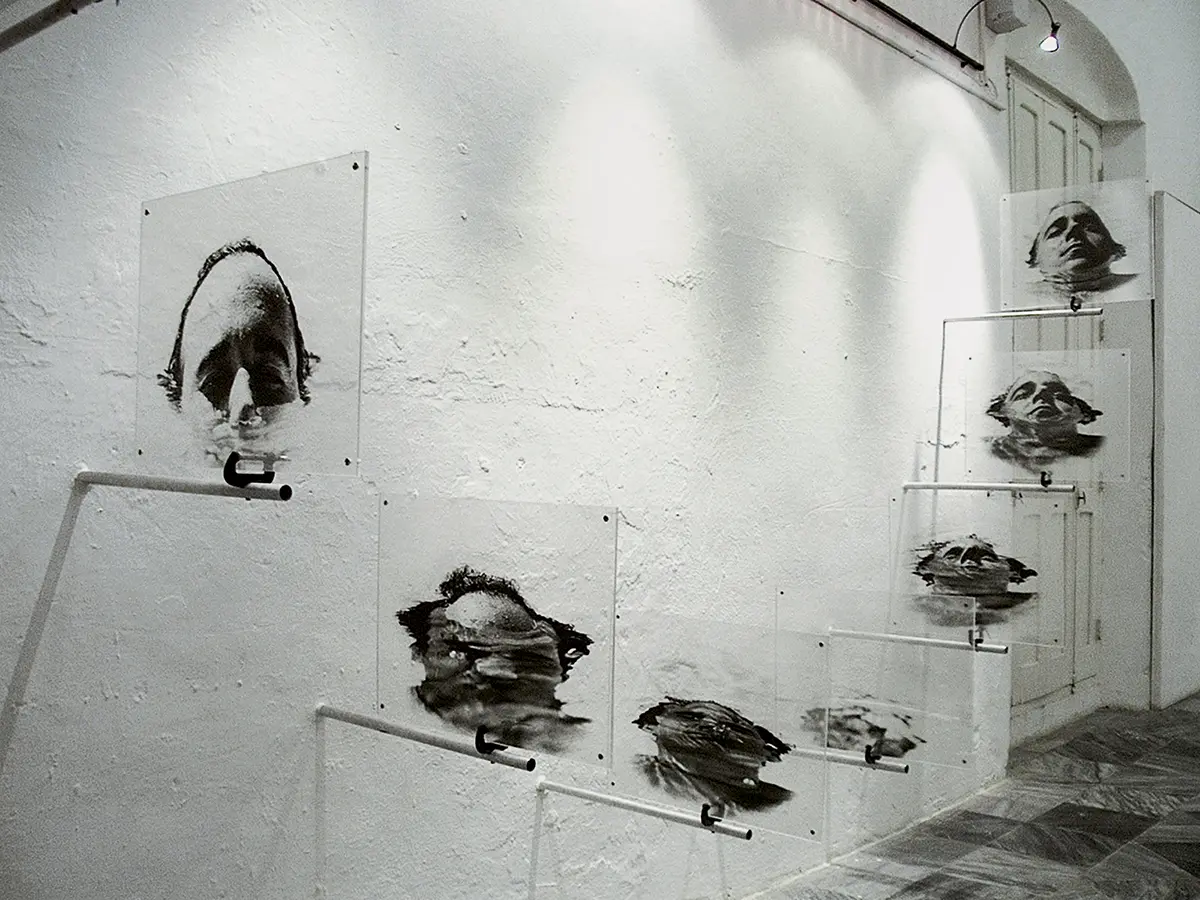
For the first time, Pino incorporates sound into his work, now to have us listen to the ineffectual broadcast by a Cuban station in the midst of a high tide (marea alta). The piece possesses the sobriety of the minimalist “white box,” resolved as it is with large acrylic sheets assembled using aluminum tubes, which replicate the movement of the ocean. Along with the radio sounds we hear an imprecise noise, signifying strangeness. For those who jump into the waters intent on reaching Miami, the high tide is not auspicious. In this sense, the piece interacts with another one, placed next to it and titled Sólo se ve en sueños, where a face appears and gives the impression of being submerged, as if drowning.
The topic of migration has been a recurring element in Pino’s discourse, and he touches upon it once again in this piece. Through four aluminum structures supporting a mesh of the same material and embedded on the wall, the artist has painted in melted varnish a male face that becomes blurrier as the sequence, organized in four subsequent levels, moves forward. In the last level, it has almost disappeared. The adventure of crossing the Strait of Florida in order to emigrate is something that only the strongest, both in physical and spiritual terms, can survive. Similarly, the possibility of frustration is always present, regardless of whether one reaches one’s destination. Some die in the attempt, others “die” of longing and homesickness after shedding their identity. Also, those who try to travel by legal means to the same destination (or any other), must go through a fiscal “filter” that often becomes a source of unresolved anxiety, as many are not allowed to go.
Once again Pino manipulates portraits, a traditional genre, now with male characters worked with liquid emulsion on which he has applied oil in order to achieve a greater expressiveness. Atmospheric pressure curves and the possible movement of the ocean appear drawn in this context, framing these subjects (who are not thought of as individuals) in an atmosphere in which tension is presupposed. There are three canvases, and in each one, the artist has painted a different youth; the subjects show their teeth and display different states: sadness, despair, and disdain. Check up is the title, and with this piece, Pino is telling us about the mediations (race, gender, social status, etc.) that impact the result when it comes to selecting possible immigrants. In his discourse, the “chosen ones” could be the survivors.
In a different gallery, we find the show’s most suggestive piece, El grito. An aluminum tube traverses serially the mouths of several characters, who scream in despair. The image has been printed on acrylic sheets and suspended from the ceiling. One possible interpretation is the cathartic scream of a whole generation, of several generations, of a whole people even. The piece is interactive: it is designed for the viewer to scream as well if desired. Yet at no point does Pino’s work overflow with emotion; everything occurs in a neutral tone, and it refers to vital issues without falling into melodrama.
This show of Alain Pino’s work surprises us with its cerebral distance, but it also provokes thought. Its aloof atmosphere is underpinned by a strong psychological charge. With its minimal saga and its formal rudiments, indebted to industrialism, this proposal is not any less impressive by being so self-constrained.
AMALINA BOMIN