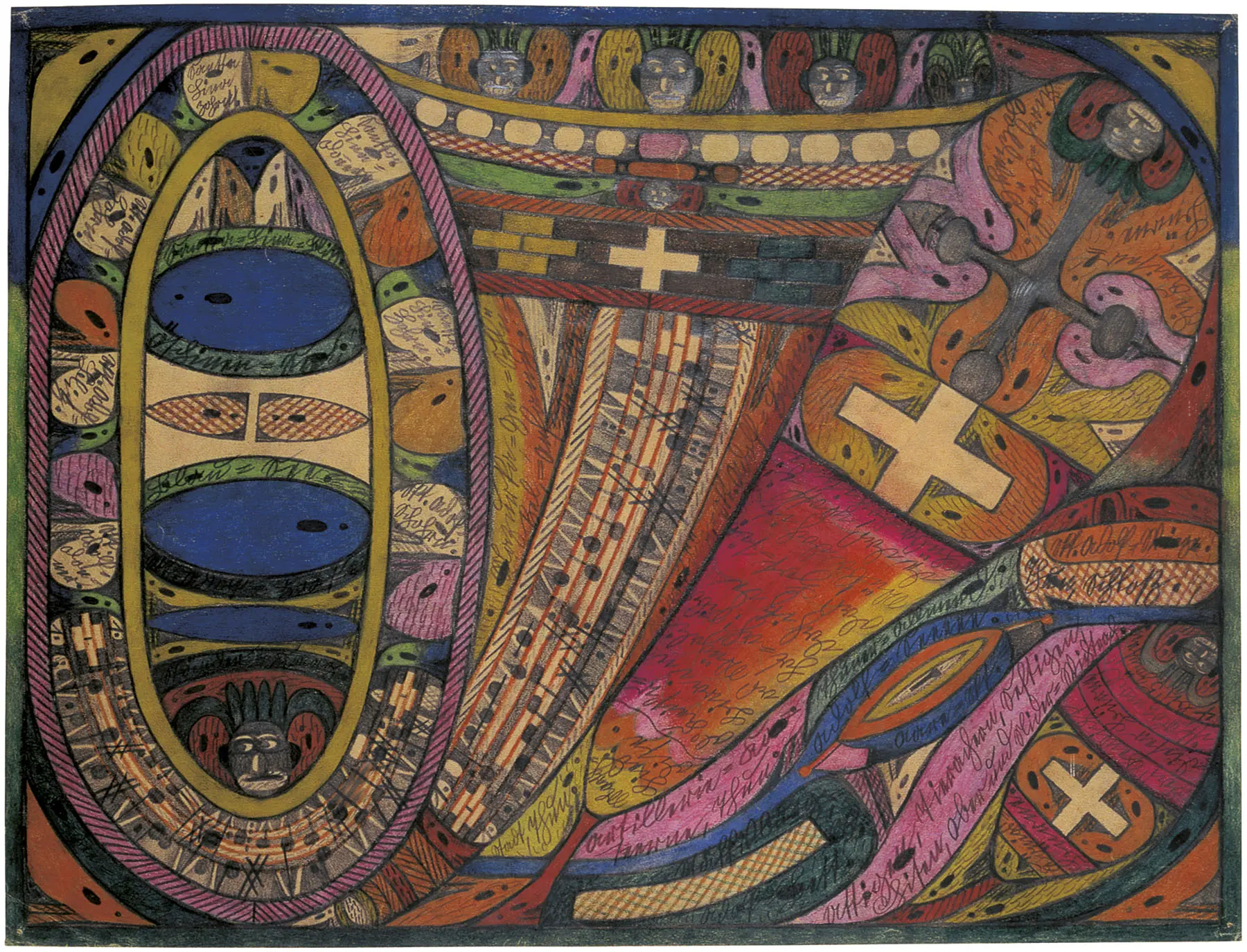
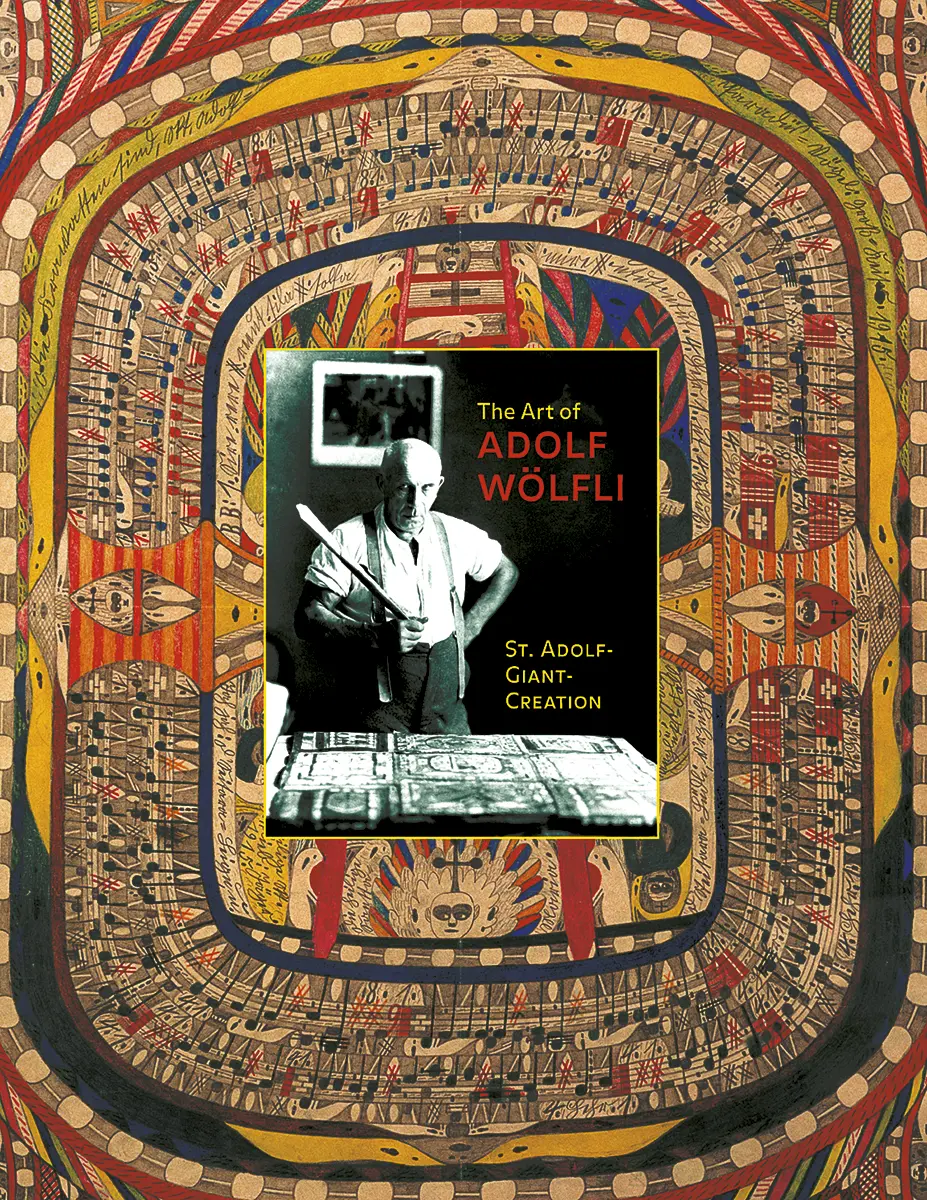
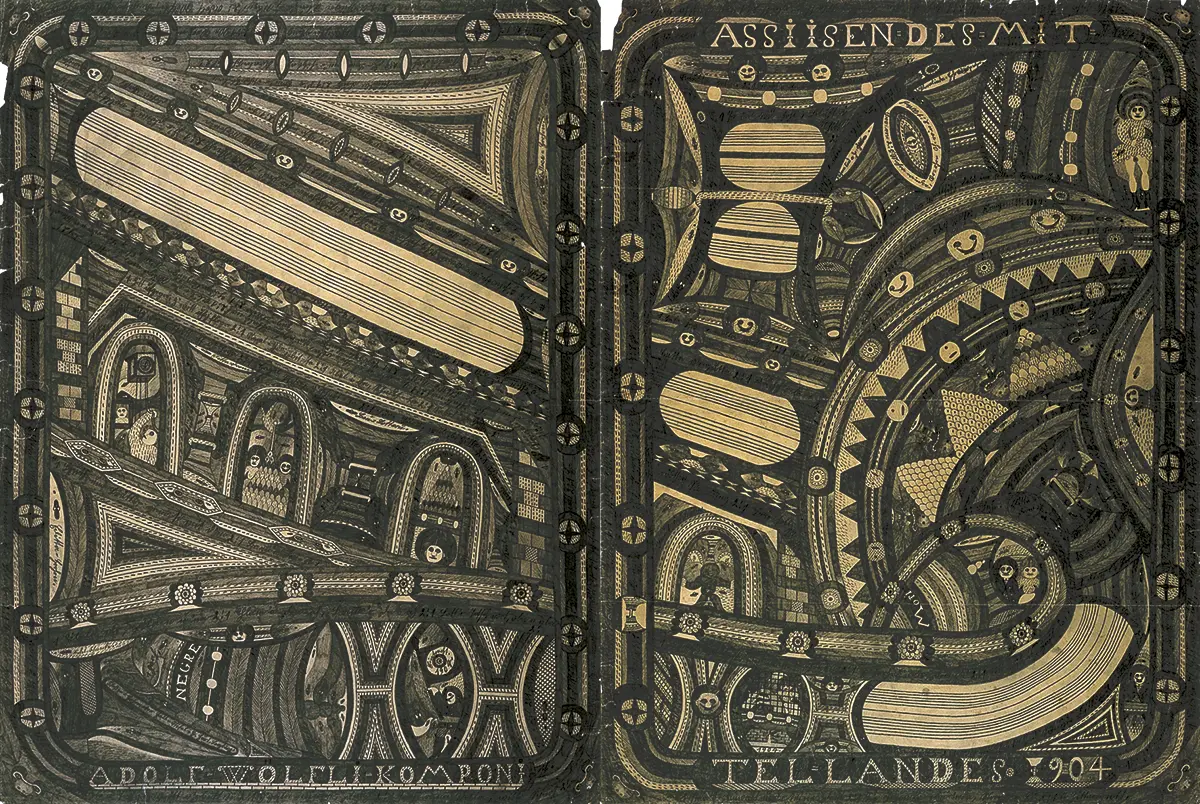
In these times, it is surely no coincidence that the most interesting exhibition taking place in New York is about the work of a person diagnosed as an incurable madman. Adolf Wölfli (1864–1930) was incarcerated in the famed Wartau clinic in Switzerland for thirty-five years, from 1895 until his death in 1930. During this period, he produced nearly 30,000 pages for a set of profusely illustrated books that included more than 3,000 drawings and collages. Somewhat less than 200 of these are exhibited at the American Folk Art Museum. It is the biggest exhibition of Wölfli’s work ever presented in the United States.
Wölfli, a manual laborer, was diagnosed with schizophrenia after several encounters with the law, occasionally for theft, but most critically for the attempted rapes of girls of increasingly younger ages. After having been abandoned by an alcoholic father at the age of five, losing his mother at nine, and being prevented at eighteen from pursuing a girl he loved because of her parents’ class prejudice, Wölfli used the second half of his life to construct a delirious but extremely organized universe to which he could escape and live. His first drawings (from 1899 to 1903) were unappreciated and lost. A doctor’s note of the time describes them as “very stupid stuff, a chaotic jumble of notes, words, figures..."1 Soon, though, Wölfli began receiving encouragement from his psychiatrist, who eventually wrote a book about him,2 and in time his art attracted considerable attention. His work was included in the renowned Prinzhorn Collection; André Breton and the surrealists revered him; Jean Dubuffet used him as a paradigm in his art brut collection; Harald Szeeman exhibited his work in Documenta V in 1972. There is also much evidence that Wölfli, himself, saw an audience for his work. Though he worked on cheap newsprint and kraft paper, he fretted about the presentation, carefully binding his pages into enormous volumes, and he was concerned with the publication and exhibition of his production. He made a distinction between his “books” and pieces he called “Bread Art” that he bartered for pencils and other personal items.
Wölfli’s biography and the recognition his work has achieved bring to the fore, once again, the issue of so-called outsider art. At one level it seems perfectly natural to classify Wölfli as an outsider artist; he was certified insane by experts, and his production occurred under conditions of social isolation. Add to this the fact that he never had any formal training in art and was never in communication with other artists, and a picture emerges of an almost perfect example of the outsider artist. A closer look is warranted.
Dubuffet, like many others, uses the outsider label affirmatively, to highlight qualities of freshness and ingenuousness perceived as lacking in the work of artists concerned with art trends and the art market. Dubuffet at some point dropped Gaston Chaissac, a friend and protégé, from his art brut collection because of his “insufficiently rigorous distance from cultural circles."3 In this sense the label seems to function as a lens, focusing attention on aesthetic deviations from the market.
Early interest in Wölfli’s work was undoubtedly motivated in part by a growing phenomenon among artists of longing for innocence, for a way of seeing that was uncontaminated by the prejudices and affectations of industrial capitalist society. Equally relevant to the attention Wölfli received was the fact that the traditional canon of academic art skills was coming under attack in his time and was being challenged as a prerequisite for “insider” status. These trends converged to open the door to consideration of the art of “other” cultures. African art was embraced by the Cubists, and the art of the South Seas by the expressionists. In this context, the art of the “other” within became another source of fascination. Klee, for instance, extolled the art of children (complaining of the way in which absorption of developed works “corrupted” them) and saw “the drawings of the mentally ill” as “parallel phenomena.” Rilke, in a letter to Lou Andreas-Salomé, wrote expressly about what he saw as the contributions of mental illness to creativity, using Wölfli as an example:
The case of Wölfli helps us to understand the origins of creativity... He brings us to the strange but growing realization that many symptoms of illness are to be supported because they bring out the rhythm with which Nature tries to recover things alienated from her.
Against this background, we can see that Walter Morgenthaler, the psychiatrist at the Wartau Clinic who dared to call Wölfli an artist, was acting in the context of his times, as was Hans Prinzhorn. Both men perceived a correspondence of formal resources between so-called pathological expression and the avant-garde art of their time. And it was not only those with open minds who saw the parallels. Others, such as Paul Schultze-Naumburg, used the parallels for opposite reasons, to denigrate the project of modern art. His most infamous work, Kunst und Rasse, 1928, provided the theoretical foundation for the Nazi concept of “degenerate art.”
Standing back, it’s possible to see a contradiction in the critical recognition accorded Wölfli and others similarly situated. On the one hand, the admiration of scholars, critics, museum directors, and collectors has redeemed the art of the insane, demonstrating that it is interesting, noteworthy, and marketable. But this appreciation has generally been coded as recognition of outsiders. Documenta V, directed by Swiss curator Harald Szeeman in 1972, was probably the first major art exhibition to give prominence to work produced by asylum inmates, Wölfli among them. Szeeman dedicated the exhibition to the theme of “questioning reality,” which suggested the possibility of genuine inclusiveness. And in an introductory essay for Documenta V, Theodore Spoerri, a Wartau psychiatrist (and husband of Elka Spoerri, curator of the current Wölfli exhibition) provided a theoretical basis for inclusiveness, if not an explicit argument for it, by pointing out how difficult it is to diagnose mental illness solely on the basis of a person’s artwork. In spite of all this, Documenta V ended up placing the art of asylum patients in a separate section of the exhibition. Therein we find the contradiction: if the artwork is worthy of consideration, why bother to put fences around it and treat it as outside? Klee was clearly alert to this problem when he declared that, in relation to art, “the word ‘insane’ must be rejected."4
To help understand the treatment of outsider art, it is worth noting how the mainstream tends to incorporate new realms as discrete bubbles, enjoying the effervescence without allowing for their dissolution. Not unlike what has happened with the fad of “multiculturalism,” outsider art has been used to refresh the mainstream from behind a subtle barrier. Often the appreciation has been shallow and opportunistic. Surrealists, for instance, for whom visual expression was a form of exhibitionism, found the “irresponsibility” of the insane extremely seductive, and hijacked ideas and processes from outsider art to more effectively engage the spectator as voyeur.
There are several practical reasons to be uncomfortable with consigning artists who happen to be insane to the niche of an outsider. Wölfli’s example is a case in point. Though socially isolated, Wölfli was not utterly separated from the notion of an audience for his work and showed great concern for the logistics of communication. His artwork was not considered by his clinic to be of major or only medical interest. If it had been, it would have had to be treated as clinical evidence and kept confidential like medical records in general. He was not unrecognized in his own time. And, as noted in the catalog for the current exhibition, his imagery was eerily anticipatory of later developments in modern art. Wölfli’s case shows how messy it is to fit the generic label of an outsider to a particular artist.
There are theoretical problems as well. For one thing, the boundary between normality and mental illness is porous. Peter Gorsen5 characterizes our achievement-driven society as, in itself, a pathogenic field, which makes it quite easy to project meaning into products generated under autism and other so-called illnesses of the mind. He points out, too, that fashionable mind-altering drugs bring the “insane experience” into the realm of normality, in effect expanding it. For Gorsen there is no “normal or sane individuality” that can be used as a referent against which to clearly measure abnormality. Spoerri notes that statistics are not very supportive of the idea that the art of the insane deserves separate treatment from “insider” art. The making of art is not an activity that inevitably accompanies insanity. Only two percent of asylum patients resort to art making, and the vast majority who do are, by medical diagnosis, schizophrenics. This in turn suggests a possible connection between artistic creativity and schizophrenia, which is not at all the same thing as saying that insane people make insane art. Spoerri goes on to speak of a triangle formed by the experience of a situation; the plastic result generated by that situation; and the interpretation of that result by the observer. And he notes that this model is valid regardless of the mental health of the artistic creator. Consistent with this, in discussing Wölfli’s work in relation to his condition, Spoerri avoids formal discussions and bases his analysis on correlations between his imagery and his biography.
It turns out to be difficult at any time to achieve precise definitions of normality, and this problem is made worse by the continual shifting of social values over time. Behavior that is pathological in one context becomes normal under changed circumstances and expectations. For example, resistance to killing, evident in studies of human behavior in war, has proved to be susceptible to erosion through formal training and education by mass media. A recent book on the subject has documented a marked increase in war efficiency among U.S. combat soldiers in the decades between World War I and the Gulf War of 1991. What seemed at one time to be a “normal” revulsion against killing among uniformed young men has been overcome by social engineering.6
When sociopath behavior —such as killing without hesitation or remorse— sets the standard for “normal” behavior, what we have is a form of collective madness, but one that is virtually impossible to diagnose from within. That humans are capable of collective madness is one of the lessons of the twentieth century, and when the collective is insane, it is the same one that is deemed mad. In the former Soviet Union, one approach to political dissent was to diagnose the dissident as mentally ill and confine him to an asylum. In China, under Mao, vast numbers of people were imprisoned for purposes of “reeducation” on the grounds that they suffered from mental deformations that required forcible intervention. Recently in the United States, critics of the wars of the Bush administration have been dismissed in some quarters as not only unpatriotic but lunatic. In Venezuela, the Psychiatry Society accused the government of Chávez of mentally abusing the people, and demanded that “the leadership of the nation... assume their historic duty to reverse this unprecedented situation [collective emotional disease], since otherwise, they will bear, forever, the responsibility for irreparable consequences in the emotional health of a generous and good people who do not deserve this."7
If the label outsider is so messy and suspects a classification, why then do we use it? Does the niche label intensify our interaction with the work? Or does it distance us? After all, is said, what value is there in the distinction?
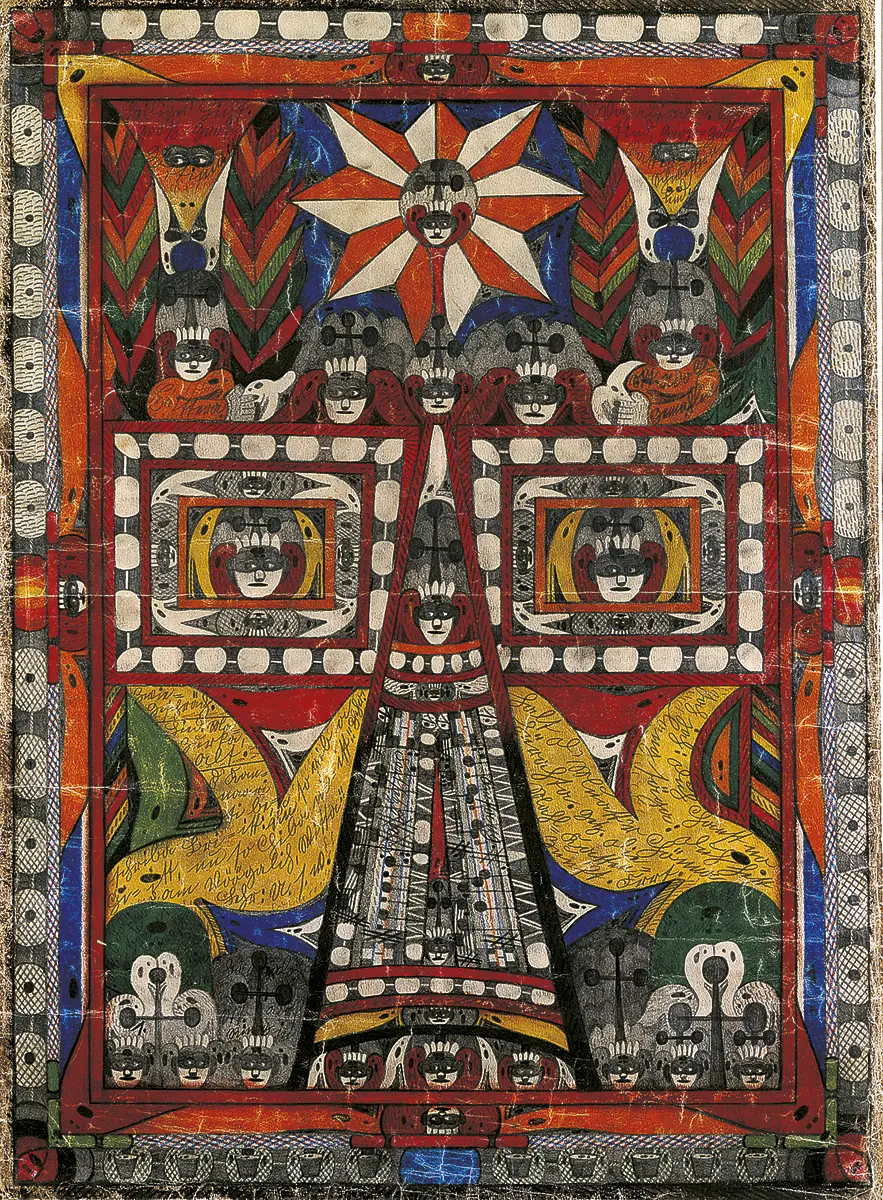
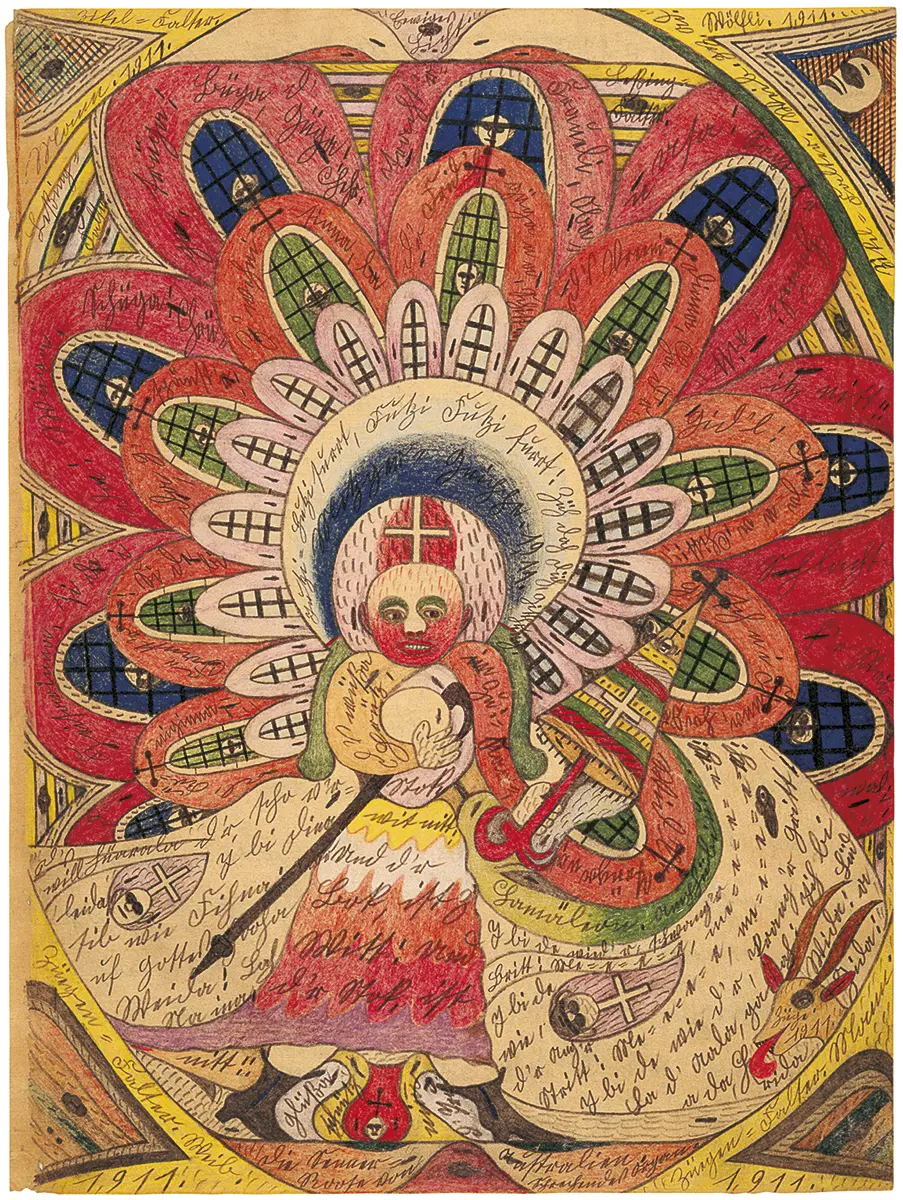
Looking at Wölfli’s work, one is struck, immediately, by its intricacy, thoroughness, and tact. Large pages of newsprint paper are completely filled with images and geometric shapes —monochromatic in the very early years, colored thereafter— that curve and swirl in patterns hinting at the possibility of symmetry without ever becoming mechanistic or predictable. Visually lush thanks to Wölfli’s obsessive desire for intricacy, the work incorporates narrative and decoration in ways that prompt the spectator to consider rough analogies —to Persian miniatures, for example, or Shaker illuminations. Given his remarkable productivity, it is noteworthy that Wölfli doesn’t repeat himself. On the one hand, there is the consistency of a life-long project, on the other hand, significant variations of texture and iconography, and movement over time. William Blake’s work comes to mind, for it, too, expressed inventiveness within a unified field spanning a lifetime.
A close scrutiny of Wölfli’s drawings can take the viewer down many different paths of the imagination. Where one spectator finds warmth and energy in the brilliance of design, another might sense a coldness in the long decorative loops of minute iconic faces with blackened circles for eyes. One might be fascinated by the allegorical significance of hundreds of different clock faces. For another, the elliptical shape that so frequently emerges in one guise or another at the center of Wölfli’s pages, suddenly comes into focus as a vagina, leading the viewer to a completely different set of reactions than a first viewing produces. Differences of this kind strongly suggest that the outsider label is at the very least unnecessary for an appreciation of Wölfli’s work and at worst, an interference with the imaginative freedom of the viewer to seek an independent reading.
It might be argued that there is an obsessive-compulsive quality to Wölfli’s work, for in addition to the remarkable quantity, there is the minuteness and exactness of the imagery that signals massive amounts of time and effort. But Wölfli is not unique in this respect; in fact, much of his production prefigures noteworthy contemporary work like that of Roman Opalka, Hanne Darboven, and others. It is not in these aspects that Wölfli’s work differs from most of the art we normally encounter.
The significant difference, and there is one, between Wölfli and most of the artists we generally see in exhibitions, has nothing to do with iconography, but rather with the fact that Wölfli over the course of his life built a much more ambitious, complex, and all-encompassing universe than any of the artists we normally see in galleries and museums. He conceived a nearly perfect structure within which to fit his work: more than forty-five bound volumes, so minutely planned that he was able to identify where each piece of information was located in the tens of thousands of sheets he produced, and was able to cross-reference them. The set of volumes starts with the series From the Cradle to the Grave, continues with Geographical Pads, recording imagined journeys on a multiplicity of levels (in the realms of earthly geography, intergalactic space, wealth, and time), and culminates in his last, unfinished work, Funeral March. Narrative, inventory, arithmetic, illustration, and musical notation —all are used. The ambition seems to have been to embrace and organize all aspects relevant to human life. This is not unfamiliar; James Joyce aimed for the same in Ulysses.
Wölfli’s narrative addresses issues of both memory and wishful thinking, the latter reflected in the purchase of stars in the universe and his canonization of himself as St. Adolph II. He presents long inventories of items that appear in his drawings, including tools, musical instruments, vegetables, mechanical objects, and buildings. He presents lists of inventions. His mathematical notations are mostly in the form of calculations of interest accruing on his hypothetical wealth and projected into astronomical sums. His illustrations are often accessories to text, and sometimes he makes collages with material clipped from magazines, hinting at connections between past and present. His profuse musical notations —the Funeral March covers 3,080 pages— often refer to images used in his collages. They are based on numerical systems, phonetic sounds, and quasi-traditional notes (on six lines instead of the traditional pentagram). The New Zealand musician Graeme Revell tried to interpret Wölfli’s music, and the compact disk he issued makes fascinating listening, even though, as Revell himself warns, nobody can vouch for its faithfulness to Wölfli’s intentions. Revell did make an effort to follow the artist’s instructions about instruments that appear as illustrations in the text, and he used a brass band for the performance so as to approximate the only instrument available to Wölfli in Wartau: a paper trumpet through which he would project sounds from his mouth. While it is understandable, given the lack of clarity about Wölfli’s intentions, that no music accompanies this exhibition, one misses a soundtrack, for which Revell’s recording would have served well. The biggest risk in a Wölfli exhibition is that the individual drawings can be mistaken for postcards alluding to a trip, distracting attention from the fact that this is a once-in-a-lifetime, amazingly rich voyage with Wölfli. It is one that none of us would ever have been able to conceive or take without him. A more explicit musicality could have served as a constant reminder of the ambitions of this amazing epic.
We all may be, in an unhealthy centrifugal dynamic, in the process of being thrown towards the outside as a new form of normality. The fact is that, at least for the moment, the outsider label in art, as a lens for art viewing and as an inspiration for art making, seems anachronistic, clumsy, and self-defeating. If we let go of it, we probably wouldn’t miss it unless, of course, our interest is narrowly focused on the art market, where labels are essential for the creation of profitable categories. Wölfli clearly helps us reach beyond this and regain a sane perspective.
Edited by Selby Hickey.
NOTES:
1. Elka Spoerri, “Adolf Wölfli, Artist/Builder,” in The Art of Adolf Wölfli: St. Adolf-Giant-Creation, (New York: American Folk Art Museum, 2003), p.16. The exhibition was shown at the American Folk Art Museum, New York, February 25–May 18, 2003, and is at the Milwaukee Art Museum, Wisconsin, September 18–December 12, 2004.
2. Walter Morgenthaler, Ein Geisteskranker als Künstler: Adolf Wölfli, (Bern/Berlin: E. Bircher, 1921); published in English as Madness and Art: The Life and Works of Adolf Wölfli, (Lincoln: University of Nebraska Press, 1992).
3. Henry-Claude Cousseau, “Origins and Deviations: A Short History of Art Brut,” Art & Text no. 27, p. 20. In fact, the mental state of Chaissac is not clear; he was a self-taught artist and the time he spent in confinement was to have his tuberculosis treated. The art brut collection included naïf artists as well, so Chaissac’s health probably wasn’t necessarily an issue. It is interesting that the exhibition Parallel Visions, a comparative study of modern and outsider artists, purposefully left out Van Gogh because, as curator Maurice Tuchman states in the introduction to the exhibition, he never was inspired by the work of outsiders. On the other hand, the 1940s work of Antonin Artaud was included because it was then that he “fell outside.”
4. Cited by Reinhold Heller in a review of an exhibition of Der Blaue Reiter, “Expressionism’s Ancients,” Parallel Visions, (Los Angeles: Los Angeles County Museum of Art, 1992), p.78.
5. Peter Gorsen, Kunst und Krankheit, (Frankfurt: Europäische Verlagsanstalt, 1980), pp. 103–104.
6. In his book On Killing, Lt. Col. Dave Grossman points out that during World War II, the firing rate by individual soldiers was only 15 to 20%, during the Korean War it rose to 55%, and in the Vietnam War it reached 90% to 95%. Drilling and Pavlovian conditioning bypass all the rational and irrational filters that normally keep the individual away from all-out violent aggression.
7. “La Sociedad Venezolana de Psiquiatría y sus expresidentes, se dirigen a la nación,” a document read to the press in the Hotel Caracas Hilton, 7 April 2002.
LUIS CAMNITZER
Emeritus Professor at the SUNY College, Old Westbury.