Using a metaphor about the Congo and Bravo rivers, Pablo Vargas Lugo (1968) recently presented a synthesis of his work over the last ten years at the Carrillo Gil Museum. Two white acrylic balls illuminated from the inside and joined together by hanging black chains could be interpreted as two enormous eyes with the nerves outside and their gaze dislocated. Around them, the artist wove-or unravelled-what I think was one of the most comprehensive solo exhibitions presented recently in Mexico City. The combination of curatorial concepts and the underlying theoretical and aesthetic proposals of the artist resulted in an exhibition full of different readings, a show which was ludic and above all. delightful in its irony and humor.
‘This luminous balls-one on the floor and the other hanging from the ceiling-greeted the visitor in a bantering manner, looking around in different directions. Integrated like pieces of pop furniture, though at the same time very introspective, they symbolized the subject matter of Congo Bravo: the complexity of the (dis)integration of our visual codes and their perceptive deconstruction by the artist. The frontier theme is an important reference in the work of this artist, who has devoted himself to constructing and questioning in sensitive terms a discourse on semiotic codes, distinct from the dissolution of boundaries between the aesthetic and the political, the public and the private, and from any kind of dominion. This posture, however far it may claim to be from politics, is itself indicative of a dislocation or rather a relocation of the creator vis-a-vis the global advance of an increasingly politicized art.
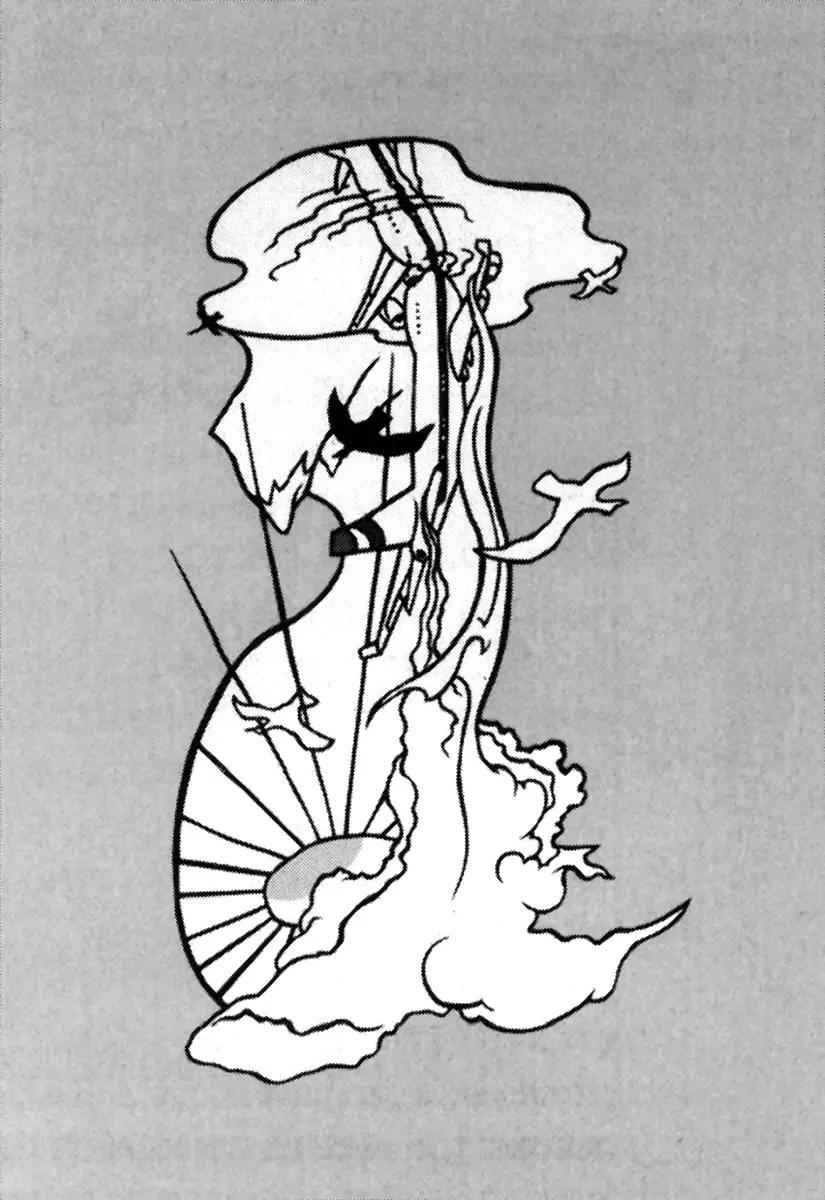
Cultural references are the pretext for a process of slippage. These enormous eyes which cannot see but are nevertheless omnipresent, persistently emphasize the arbitrary nature of the images and the impact of our cultural and perceptual conventions in reading them. Behind a white acrylic cross with a red stain from the Rorschach psychologic tests, are papers and photographs delicately cut with Chinese painting techniques or Tibetan tankas, but depicting eschatological scenes, and whitish-black stains on a surface of naturally colored wood, all of which recall Cow (1991) and Camouflage (1992). There is a deep process of investigation and research on the perceptual symbolism of the gaze and the desire to displace it and make it more explicit. Although Vargas Lugo insists that his aim is not to criticize, judge or convince, the solidity of his proposal places him in the avant-garde of a galaxy of young artists whose training and development have not allowed them to express the vital sense of their artistic activity in the same way as Lugo, who this year won an artistic residency in the city of Vienna, sponsored by the Austrian Ministry of Foreign Affairs.
In the exhibition at the Carrillo Gil Museum, the selection of works illustrated a discourse that encouraged dialogue with the artist through textual citations and incidental commentaries which sometimes established a form of debate with the artist. This was further enhanced by the museography, which abandoned the chronological arrangement of works in what might have been an ordinary retrospective in favor of parallel thematic and visual relationships that gave explicit and spatial clarification to the questions being raised in the works.
However, I wonder about the inclusion of three pieces which, instead of enhancing the discourse seemed to obstruct it. I am referring to the installation titled Deep Thoughts, Snowman (1993), and Pack of Cigarettes. In the first case, a series of cardboard boxes in a dark room surrounded the figures of a starfish, a conch, and a hare on the sand. The work was watched over by a candle, also in resin, and bathed in black light; the reference to the vanitas theme is so direct that the ironic and ludic exploration of life and death are canceled out, which is not the case with Crystal with luck, a small coffin in transparent acrylic which unfolds a subtle rainbow. The same is true of Snowman, which is made of polyurethane with splattered black paint, like dripping water. The enormous Pack of Cigarettes, on the other hand, raised another problem. The exhibition contained works. Which explicitly included signals, iconic images, and commercial logotypes that played with and manipulated the meaning of their effects on the mind. But with the cigarette pack these elements were absent, with the pack being increased to monumental size, its surface left in coffee-colored cardboard. I believe that this damaged this discursive axis on which the artist has been working since it omitted an element that seems indispensable to Lugo’s reflection on the handling of consumer hyper-imagery. Although this might give the work a pop reading, I believe that the problem could be resolved satisfactorily in other ways.
One final reflection on the context of the show. This exhibition confirmed the new image which the Carrillo Gil Museum hopes to project under the new direction of Osvaldo Sanchez, the former director of the Festival Internacional Cervantino, as a place for dialogue and exploration of contemporary art in Mexico. Although the target public is familiar with the theories underlying the cultural proposals of new art evident in the language of the exhibition space, which has a certain degree of the complexity-this show was one which seemed likely to attract a new kind of public, people who might simply come to enjoy the works and their presentation in a spontaneous and amusing manner.
ANA ISABEL PÉREZ