In this exhibition presented in the handsome eighteenth-century building of the Maison des Arts de Malakoff (officially classified as a historical monument thanks to the efforts of André Malraux), Pablo Reinoso confirmed and convinced us of the validity of the change. The change which he introduced into his work more than three years ago confirms the idea that though it includes an exploration of identification, it is also the cathartic liberation of the mental, physical and aesthetic edges of sensibility. It, therefore, appears clear that the radical and indispensable turning point which occurred in his art in 1995 has opened up, through a questioning of the unconscious, an infinite metaphorical field and the possibility of multiple combinations at both the conceptual and formal levels.
The gesturality induced by the canvas, which resembles a kind of artisanal work-cutting, cutting up, assembling, and sewing is transcended by the air, the material nature of an absent density, a volatile spirit that erases both gesture and time, a void that creates the space of sense. The adventure resulting from the choice of another material, coupled with an artificial movement (an electric motor) has created within Reinoso’s work fragile frontiers in the realms of the virtual and the real. But the experience of his former work as a sculptor taught him a long time ago how to define his relationship with space (body and matter). It also allows him to measure and evaluate the balances in an indeterminate area in which unquantifiable and indescribable elements are present—the air and emptiness.
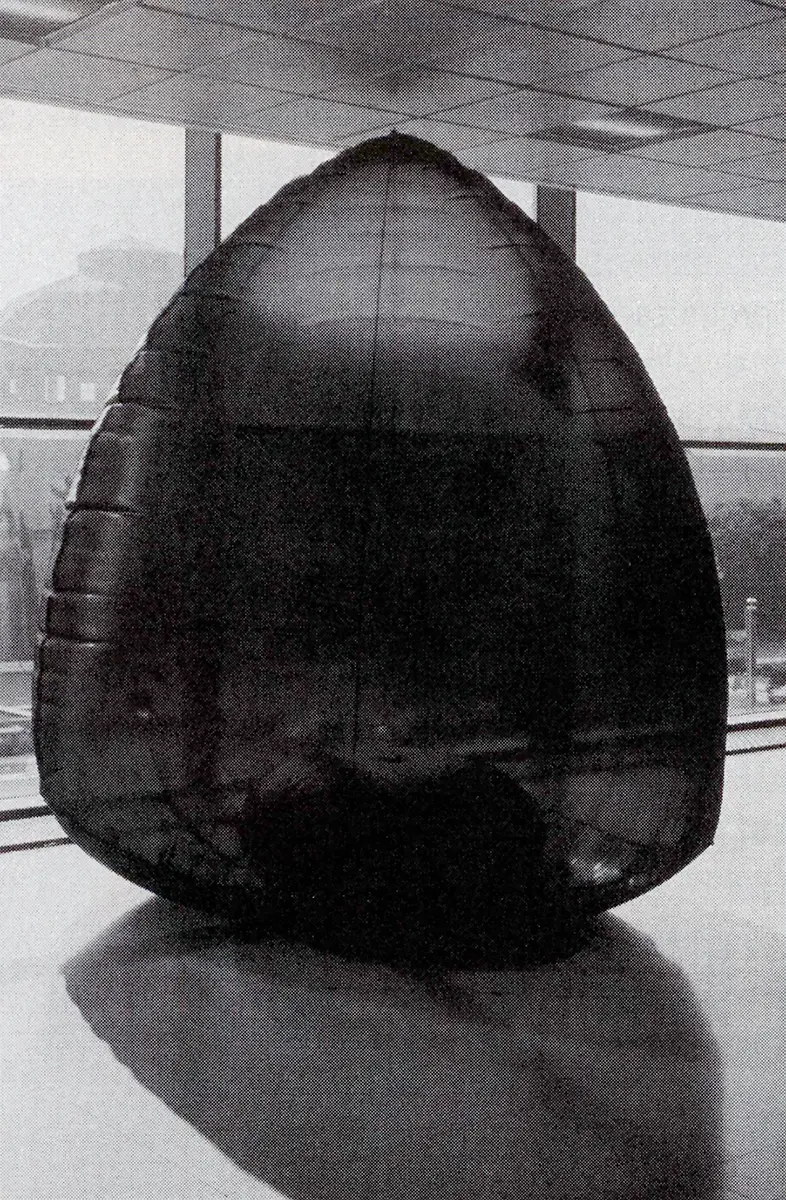
In an earlier text on the very first new works by Reinoso, I referred to a kind of humanized minimal component within a sensitive geometry. But beyond the clearly kinetic aspect, his art is above all kinesthetic, the materialization of the “mental body in a physical space.
The entry into the metaphor of life (breathing, the beating of the heart, respiration), which was like a kind of second birth in the first exhibition of his new works (at the Ruth Benzacar Gallery, Buenos Aires in 1996) is now reinforced and even exceeded by the emergence of a psychoanalytical dimension that raises, with increasing insistence, the questions of self and the other, the precarious identity within the problem of the double. The relative passivity of Sleeping, Breathing, and Persisting, where the timid movement created a still limited form, has now given way to a more active Reinoso, who intervenes in the possible dimensions of his reflection, eliminating step by step the formal and material constraints as he reflects on the time of living, fitting together present time, contemporaneity, and transience as challenges to some irreducible permanence.
The Word, The Other, It's Me, Pleasure, and Partner-Symptom are works that introduce another dimension in the artist’s involvement with forging the link between art and life. A new dialogue is created between the work and the spectator, but also between the work and its creator. In The Word (1998), spectators are invited to participate as a duo bypassing their heads through a kind of rocket-mold- uterus which allows them to speak to one another without seeing their bodies, in the erasure of differences and the anonymous intensity of an exchange. In The Other, It’s Me (1998), the visitor, whose head is slipped into a sterilized bubble-gut, is reflected In a mirror that takes the place of the other. This intervention of the spectator is a new element in Reinoso's work. This game of doubles reappears in Pleasure (1998), where the breathing apparatus is placed inside, like a heart, an organ, or a palpitating piece of fiber. A game of doubles can also be found in such works as Partner-Symptom (1998), where the canvases are superimposed in a mixture of forms, transparencies, and movements. In this work, the reference to the body is evident, and the breathing apparatus is masked. A body is twice inhabited, phastamagorized, and revisited. These forms reflect a growing interest by Reinoso in anthropomorphism, a desire to move towards something more organic, towards metaphor.
The installation as a mise en scéne in the work is also a new element. The Cabinet of Dr. Lacan presented in Barcelona in 1998, is an immaculately white and transparent environment, a closed place where the spectator can only look, unlike The Word, which is a place for experimenting and living. With this work, the visitor is transformed into a voyeur of himself by observing a bed and an armchair which are “breathing.” In this visual discourse which creates a virtual role game, the spectator can become two persons and penetrate mentally into the mise en abyme of the psychoanalytical concept proposed in The Cabinet of Dr. Lacan.
The viewer Is bewitched by the materials whose moire effects, reflections, transparency, brilliance, and iridescence are transformed into chromatic and tactile possibilities that Reinoso has been able to capture and transform, giving these industrial-looking materials a true nobility. In Reinoso’s work, new technologies —materials that do not let air through— are used to create a kind of mystical communion thanks to the use of a breathing movement. Without a doubt this exhibition linked the heart up to the soul and to the body: breathing in, breathing out, you are living.
CHRISTINE FRÉROT