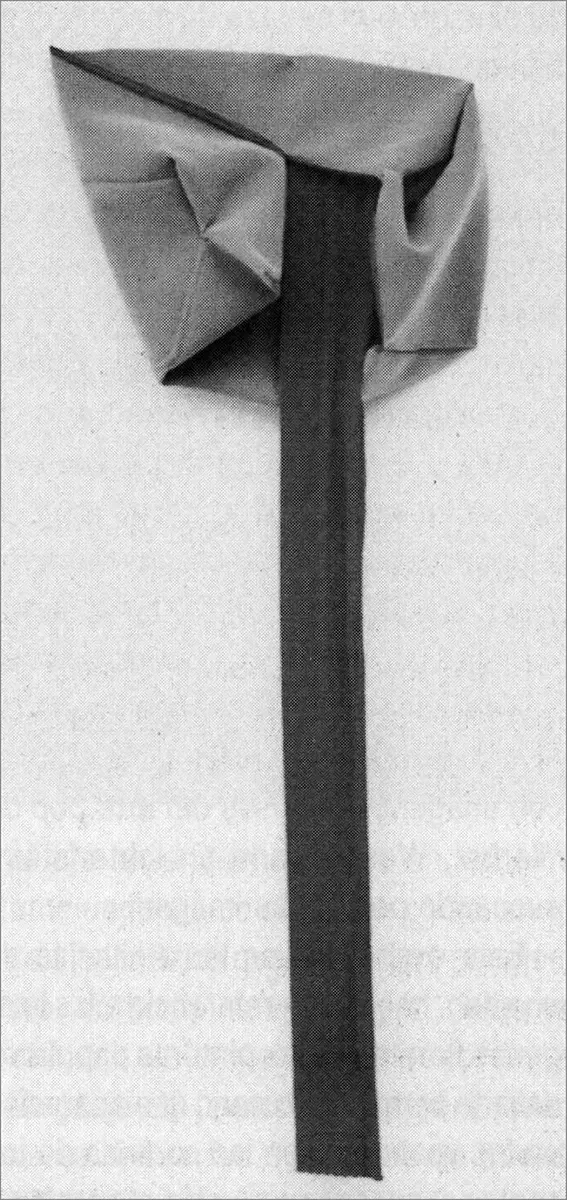
In the first wing of the Alliance Française Gallery in Buenos Aires, the wall was painted dark blue, with three elongated, whitish bulky objects hanging from it. The translucent fiber hung from the wall from a flexible wooden rod that acted like a hanger. The bulks supported their languid volumes, folds, and gatherings held together with pins and stitching. Their size was clearly anthropometric: looking at these pieces, it was not difficult to think of clothing, shrouds, or some representation of the human body. On the main wall of the gallery was a work made of cotton padding which appeared to be a more solid kind of object than the earlier ones. It was a white piece with patches of bright pink and a fringe in the same color and sewn in such a way as to suggest a deflated ball. The fringe did not correspond to any edge; it was like something left over from the design, the comic remnant of some scoffed-at functionality. These works were accompanied on the same wall by a bag of red leatherette and fabrics, supported by a prong. Its weight was concentrated at the lower end, as if the bag was filled with something, or had turned in on itself and become full of itself. It looked like one of those sparring bags used by boxers, and its concave form and fleshy brilliance suggested a hybrid sexual organ, half female, half male.
When we visit the first exhibition of an artist, we do not normally come out thinking that we have seen mature work. But in the case of Mónica van Asperen, something of the kind did occur. In this, her first show, there was a particularly strong relationship between the forms, the selection and handling of the materials, and the problems to which the pieces were preferred. Furthermore, there was something exquisite in the way in which she combined together in the same figure the maximum violence which can be brought to bear on the image of a body —that is, its dissolution, its collapse into shapelessness— and the soft form in which she constructed and composed this new state.
Van Asperen entered the art world recently. She had participated in the scholarship program directed by Guillermo Kuitca, where she worked in clothing design. This profession seems to have allowed her, on the one hand, to create a kind of precision-based sculpture with fragile materials and, on the other, to gain a very intimate understanding of the problems of the body in terms of volume, and of design as a system of bodily oppression.
Her decision, never made explicit, although it was clear enough, involved a critique of orthodox design as a mimesis of the body which lay outside the specificity of the discipline. The works of this show thus came together at the most fertile point of a transition at the biographical and theoretical levels, from the functional and regulated world of design towards the more elastic and potentially abstract realm of art. I am interested in showing the final stage of a codified body. "My premise was simply that of abstracting a body from a situation; afterward, the work itself took over this idea and made it into something more brutal, more categorical."
The idea of abstraction appears because these canvases, although related to the proportions of the human body in most cases, or reminiscent of bags or molds, seem to want to be seen as mutations or movements of an organism whose architecture is just emerging at the same time as it is destroying itself. I am thinking here of the white pieces in translucent cloth, which are not only literally “held up by pins" but are, as a result of their prolonged contact with the air. becoming yellowish, transforming themselves into the depiction of a slow disintegration of form. But in the other more solid works, such as those done with the reverse side of neoprene fabric, the opposite seems to occur: the form curls in on itself overflows, tightens, and consumes itself. The situation is abstract, pictorial, and expressionist, but it dissolves in volume, body, and in the movement of the fabric as a living organism, both serene and convulsive. The logic of design disappears: here there are no external parts to cover. The body is overflowing with inferiority.
All these features place the work of van Asperen on a different plane from that of other Buenos Aires artists in recent years, with their highly stylized and ironic formalism. This exhibition suggests that perhaps a new scene is emerging, one in which the critical effects of the work do not necessarily lie in the mocking betrayal of history, but in the uprooting of certain structures.
INÉS KATZENSTEIN