This provocative show of twenty-two female artists, many from Mexico, Cuba, and South America, examines the self-expressions of those associated with the Surrealists in the thirties and forties, and those who explore issues of identity, gender, and culture. The exhibition will travel to San Francisco's Museum of Modern Art in January 1999.
The show’s oldest and most unsettling works are the self-portraits of the French artist, Claude Cahun. Born Lucie Shwob, she changed her name at age twenty- three and as one of the first female Surrealists, she embraced the movement’s penchant for the masquerade. Through her tiny (3 5/8 x 2 5/8 inches) black and white photographs, she presents herself in various guises, often with a shaved head and in men’s clothing, deliberately fostering an illusive self-image. In Self Portrait: Standing Japanese Doll (1928), she eerily parodies female roles by disguising herself in a cape covered with masks, her face hidden behind an impenetrable Asian doll face.
Many of the Surrealists exhibited, particularly those from Latin America, paint themselves surrounded by extraordinary creatures within contrived settings typical of the movement. In Leonor Fini's At the Ends of the Earth (1949), the painter appears as an unearthly beauty immersed in her bare chest in murky waters littered with the heads of animals. Remedios Varo’s The Alchemist (1955), portrays the figure turning a stone wheel, her body swathed in a length of the black and white checkered floor covering that rises beneath her feet, enshrouding her bent body. Frida Kahlo’s Self Portrait with Thorn Necklace and Hummingbird (1940), demonstrates the artist’s propensity for dramatic, vividly expressed images of the self. The labyrinth of thorns that compose her necklace, piercing her skin evoke her pain, while the black cat and tiny monkey behind each shoulder intimate her lifelong emotional torment.
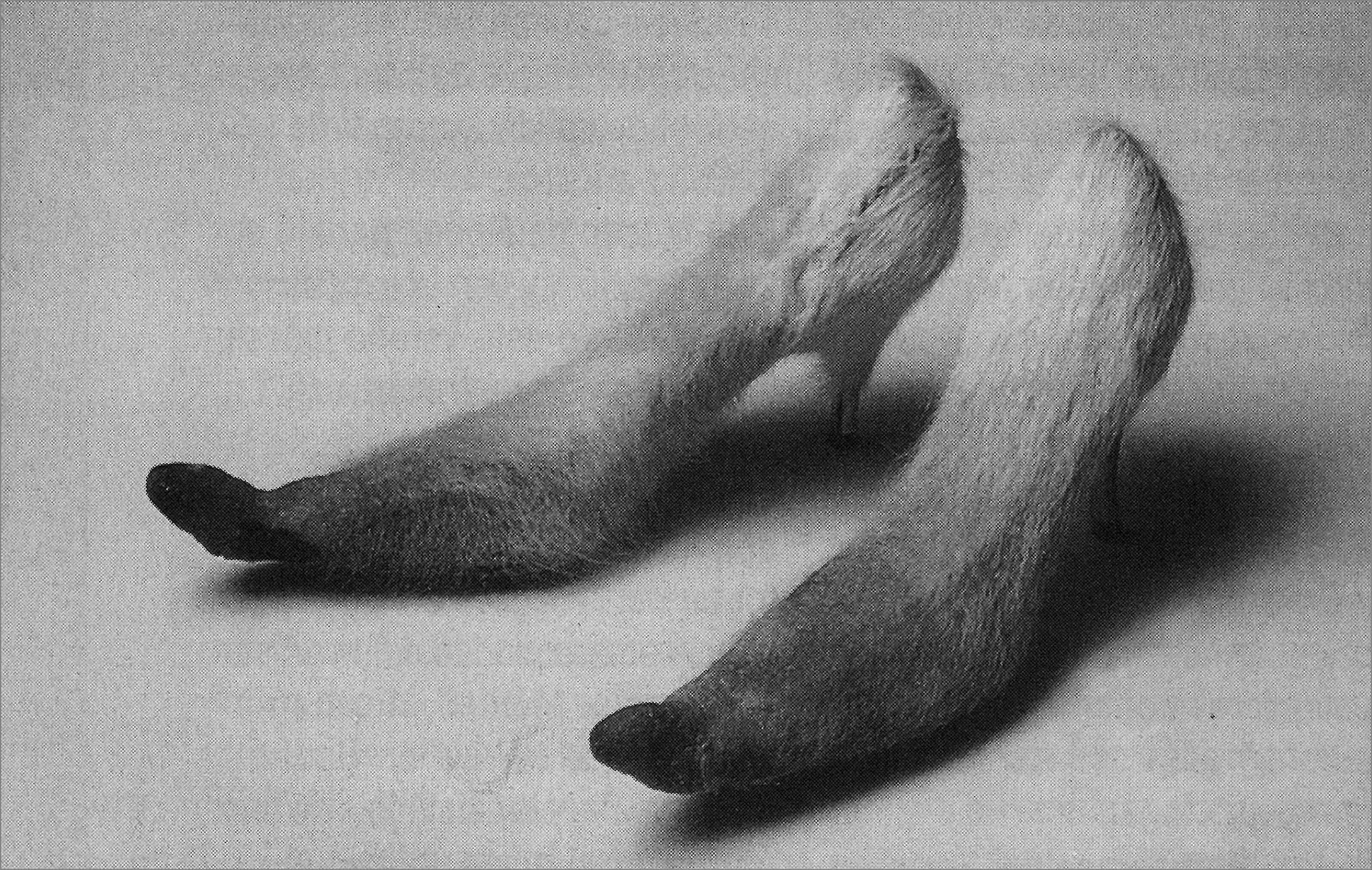
The exhibition's contemporary artists employ the body as the site for self-expression. In IV (1996), Mexican artist Paula Santiago sewed together with strands of her brown hair, a miniature, two-sided body armor of wax suspended from braided hairs within a plexi-box. It hangs as a haunting testament to a woman’s inner struggles. Stilettos (1994), by the Irish-born artist, Dorothy Cross, presents an unexpected pair of women's pumps, a kind of Surrealist transformation of the mundane. A cow’s teat covers the toes of each shoe, and the brown and blonde hide is stretched to fit over all but the spike heels.
Ana Mendieta’s photographs of her earth-body sculptures, employ the imprint and absence of her body as expression. In Untitled (from the Silueta Series) from 1976, the gentle silhouette of her body with arms raised is carved into the sand at the beach, the edges softened by a past ocean wave. Blood red pigment splattered within the hollowed shape lends a vivid resonance to her powerful, totemic form.
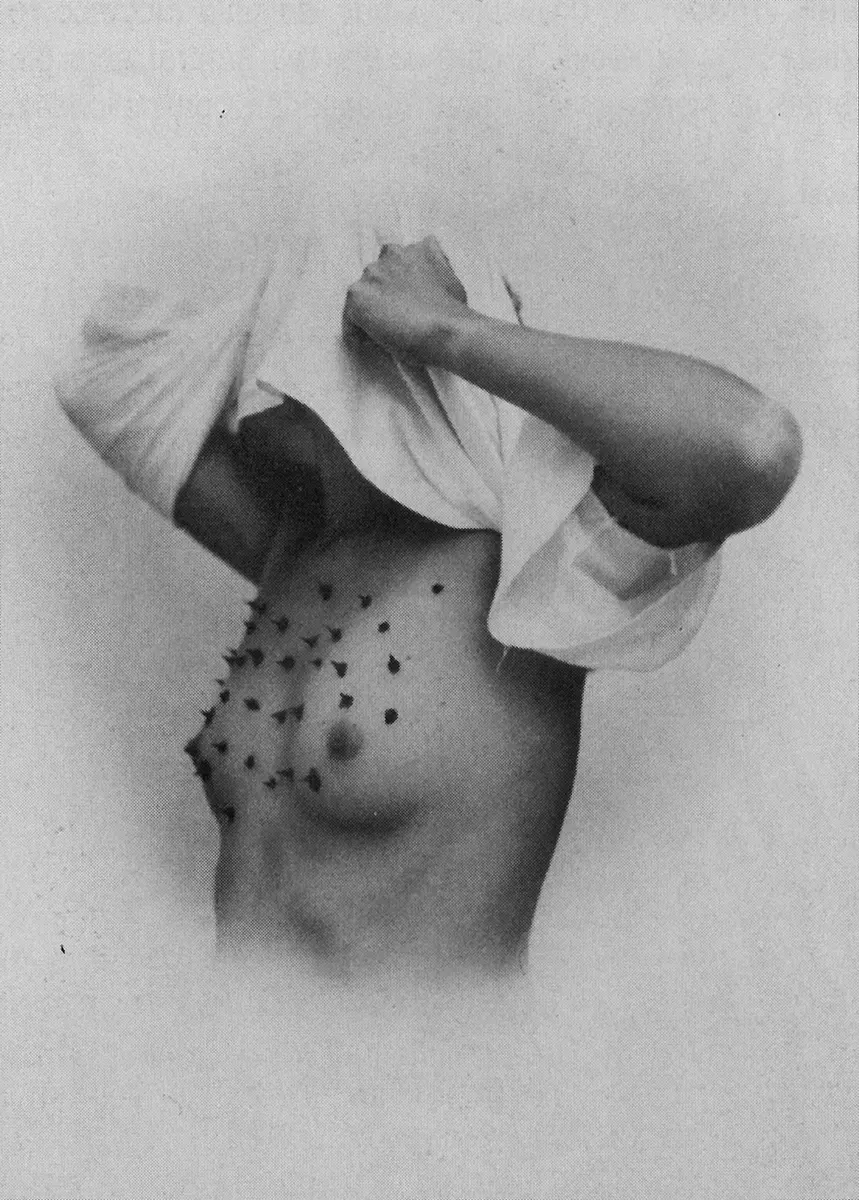
Finally, the photographs of Marta María Pérez Bravo and Francesca Woodman, present contrasting expressions of the self. Cuban-born Pérez Bravo seduces and unnerves with her black and white, nude self-portraits like Protection (1990). Bathed in light, she pulls her shirt over her head revealing the gentle curves of her chest, marred by an army of blackthorns.
Francesca Woodman’s self-portraits, such as House No. 3 (1975-1976), never capture her face. She sits in an abandoned house on a floor littered with plaster. Her surroundings are depicted clearly, but her body is a blur, as it twists in an ephemeral cloud before the camera. In each photo Woodman, like Cahun, negates her identity by hiding her face. Ultimately, this exhibition demonstrates that women’s struggle to address gender and its confines defies time and place.
MARY SCHNEIDER ENRÍQUEZ