This recent exhibition in Caracas by Miguel Borrelli, a young Venezuelan artist currently living in England, highlighted the consistency of his projects and at the same time revealed a new investigation of plastic space.
Unlike many contemporary artists who have abandoned sculpting in favor of installation, Borrelli has continued to explore the possibilities of sculpture, constantly trying to expand his formal limits, without his work ceasing to be a sculpture in the original sense of the term, i.e. the creation of solid and meaningful forms in space. This has allowed him to create powerful images, which differ from traditional sculpture, and simultaneously evoke the presence of objects and apparatus of strange and unknown technology and of forms of nature.
The representation of space in sculpture is always a difficult problem. Traditional sculpture does not depict space but fills it in a natural manner. Thus the introduction of space as a constituent part of the sculptural language (a matter of considerable interest to Borrelli) requires knowledge, imagination, and an authentic meditation on the actual meaning of sculpture.
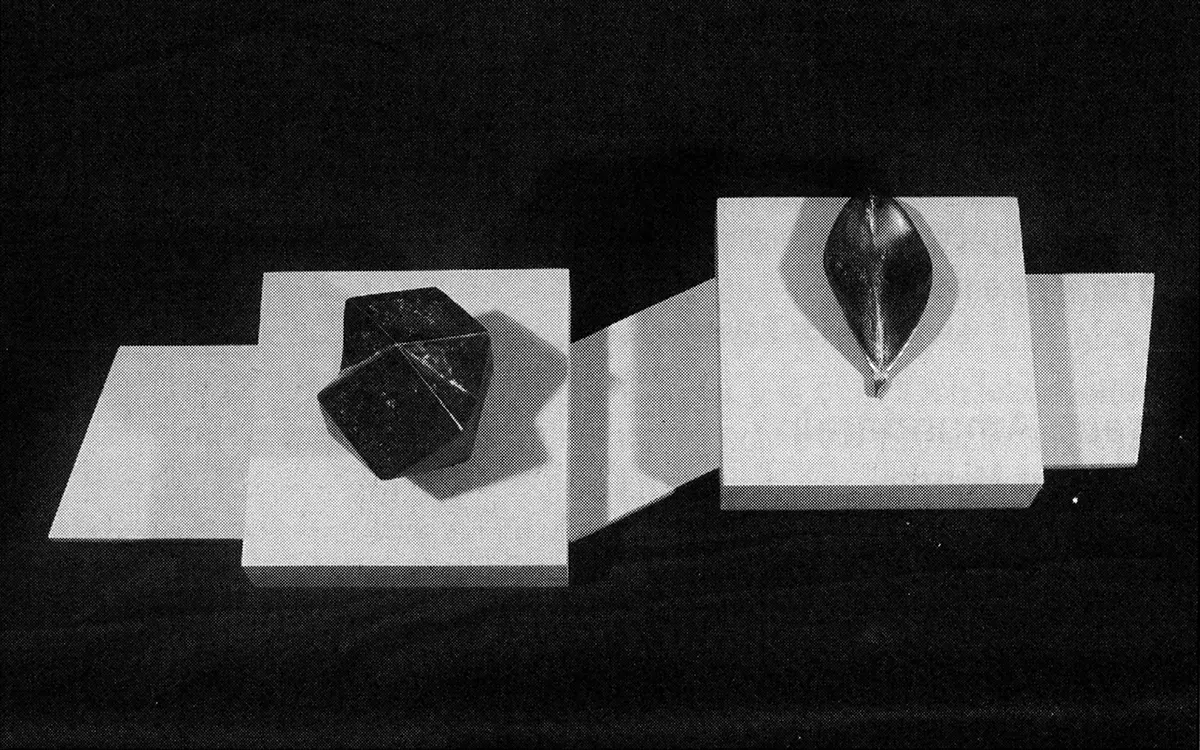
In Borrelli's previous exhibition at the Museum of Fine Arts of Caracas in 1993, he proposed the creation of natural spaces through abstract means and the perception of large silent forests in which the visitor's gaze was attracted by small natural objects: fruits, animal or vegetable remains, leaves. The artist alluded to these spaces through broad platforms which he placed directly on the floor (or, in the case of the smaller works, on little platforms placed on a museum pedestal), with the objects establishing an intimate dialogue with other objects or appearing silently in the immensity of space. The intention was to allow the spectator, through an exploration of real or imaginary space, to become part of the temporal dimension of the works. The black tints which covered the works neutralized their formal difference in size and emphasized the formal qualities of the materials, heightening their powers of suggestion. The works thus appeared as solitary places set within some profound silence.
This abstracted space nevertheless suggested a vision that was, in a sense, naturalistic. Now Borelli goes further, proposing a vision of space as an abstraction, which is materialized by means of square platforms of light wood, all painted in a uniform gray. In a way, this abstract depiction of space recalls the abstract spaces of medieval painting. With their gold backgrounds, these expressions could make a general reference to an extraterrestrial area, a heavenly space enclosing the figures of sacred beings. Borrelli's spaces seem to have the same intention. They do not refer to the heavenly realm, but to some indeterminate earthly sphere, some conceptual plane. Since they have been made abstract, there does not have to be any relationship of scale between the space and the forms depicted within it, but only a harmonization with the specific needs of the plastic object in itself.
There has been a more marked process of abstraction in the sculpted forms that appear in these spaces. Forms and objects which initially came from nature and which were therefore inspired by organic forms have been purified and transformed into symbols of themselves, although they continue to evoke natural forms. They reflect Borrelli's interest in the creation of sculpted forms resulting from his passionate observance of the natural world.
In this way, and using the full panoply of construction and sculpting techniques, Borrelli's work creates a relationship and fusion between elements that are conceptual, and constructive. abstract, sensorial, and organic. With their origins rooted in reflection and intuition, these works confirm that sculpture may be abstract without recourse to technological materials or forms: Borrelli's pieces are images that simultaneously appeal to the intellect and the senses and are capable of evoking, although in a distant kind of way, like an echo, the world of nature.
IRIS PERUGA