
In the first North American exhibition of the sculpture of Brazilian high priest and artist, Mestre Didi (Deoscóredes Maximiliano dos Santos), an extraordinary aesthetic combination of art and ritual reflects a genuine devotion to the Candomble religion. Didi descends from the west African Ketu Yoruba society and belongs specifically to a Candombld Nagô cult, distinguished by its heritage in the Yoruba society and Afro-Brazilian descendants. (Nagô is the name of African-Brazilians of Yoruba heritage). Intent on preserving the traditional African values and practices of the Yoruba society, Candomble Nagô maintains the continuance of religious rituals with devotion to a complex pantheon of sacred deities (orixá). Mestre Didi (now 82 years of age) was initiated at the age of eight into the Candomble Nagô religious society and dedicated to the cult of the orixá Obaluaiye, patron of the earth. He lived with African masters and developed spiritually and creatively in the Nagô community, where he learned to make ritual objects and appreciate the spiritual associations of natural materials. He has continued to construct images symbolic of the Nagô deities, who do not have figurative or anthropomorphic representations, as both ritual objects and non-consecrated art objects (obviously the objects in the exhibition are non-consecrated). Each deity has a symbolic attribute associated with its generative powers as spiritual forces associated with nature. Didi’s art forms of these symbols are as powerful as they are elegantly beautiful.
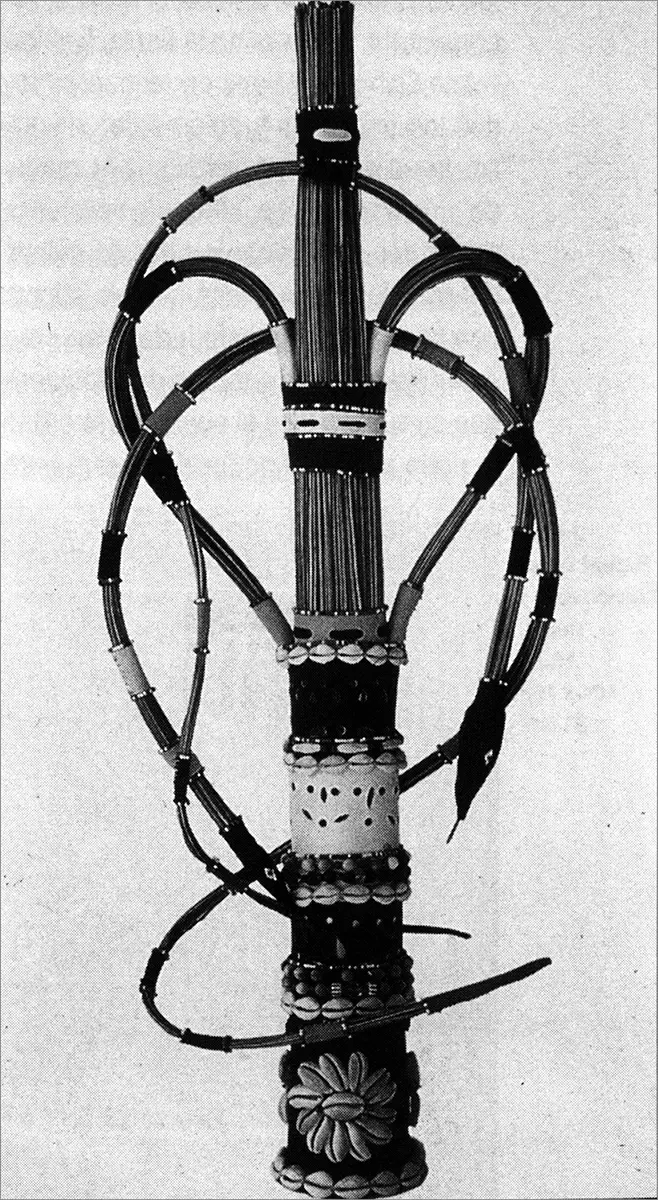
Through the use of appropriate materials, colors, and symbols, the majority of Didi’s objects are associated with the Earth Panthenon-Obaluaiye, Nana, and Oshumare. He constructs his sculptural objects as abstract concepts of the orixá in forms reminiscent of the scepters carried by the priests in ceremonies, in highly abstracted cloaked figures, majestic trees, snakes, and calabashes. He invents form and structure with materials laden with symbolism and tradition such as raffia, cowry shells, palm ribs, cloth, beads, and leather. The Great Scepter of a Spear (Òpa Esi Nilá) stands over 126 inches in height and dominates the entrance to the exhibition. Made of bundled palm ribs, beads, cowry shells, and leather, all of the materials are integrated to express a mystical symbolism, a wholeness that combines the microcosm of the religious and ethical system of the Nagô community. The scepter alludes to the continuous cycle of life; the birds at the top are symbols of fertility and progeny.
In the Scepter that Gathers the Symbols of the Earth’s Pantheon (Ejô Ori Waji) (1995), the Serpent with a Blue Head represents one of the symbols of Oshumare, a deity of the Earth, Pantheon. The large iridescent snake is associated with the mythical python that rose out of the earth, touched the sky, and returned to penetrate the earth. Because he carries all the principles and colors of the universe in his body, Oshumare is also symbolized by a rainbow. The winding multi-colored serpent represents the cyclical relationship of the world and beyond, is associated with wealth and wisdom, and is believed to leave valuable beads wherever his body touches the ground. Didi pays tribute to the serpent’s, and the orixá's power winding around bundled palm ribs (a material that is striped only at ritually appropriate times) in the tall elegant scepter with its bead and cowry designs.
Nothing is ever arbitrary in the choice of materials and designs for Didi’s objects. Imbued with a sense of the spiritual as well as the aesthetic, he carries on the Yoruba respect for artistry and innovation in remarkable and beautiful new ways. The appealing installation, with its background music of drums and chants, and excellent labels defining the orixás and their symbols, is a tribute to a master artist and a masterful tradition.
CAROL DAMIAN