During the month of November, the main room of the Centro Colombo Americano was the setting for a series of oil works by María Cristina Cortés, who belongs to a generation of artists that emerged in the 1970s and revitalized Colombian art in the field of drawing and graphic work. While many of her contemporaries turned towards a figuration that was indebted to pop art and hyperrealism, Cortés, in her charcoal drawings which at that time took interior settings as their themes, showed a particular interest in light—an interest that has become a constant feature of her work in her careful investigation of the genre throughout the history of art.
The work that finally established María Cristina Cortés was a series of landscapes in which she recreated the cold and strange atmosphere of the afternoons and dawns in the savannah of Bogota. Another feature of this work can be seen in its protagonists —cattle, cows in groups, or appearing individually, lying peacefully on the grass or moving slowly over the damp ground, almost always near puddles or streams of water surrounded by stakes. These elements of her images seemed to be the pretext for exploring the chromatic richness at certain moments of the day in the cold regions around the city of Bogota. This changing and fleeting landscape resulted in a memorable exhibition presented at the Garces Velasquez Gallery in 1988, where unusual chromatic possibilities reflected an ambivalent kind of light oscillating between orange, pink, and violet tones, the intensity of which made the landscape and the figures into an impressive and audacious symphony impossible to forget.
In the same gallery in 1996, María Cristina Cortés presented an extensive series of pastels entitled Cultures of Microbes, in which she abandoned the theme of cattle. Light continued to be important, particularly its reflections on watery surfaces. In some of these works, the memory of Monet’s waterlilies seems to be a direct one, particularly when the drawings show nothing other than reflections and little leaves or organic matter which, in complicity with the light, create a chromatic interplay that comes close to the kind of abstraction which filters through the late canvases of the French Impressionist. In other works, the image emphasizes the presence of a bowl placed on a tiled surface, which makes a direct reference to the world of objects and suggests the presence of a patio or some inner space, recalling some of the earlier still-lifes of the artist. The chromatic experience with which the spectator was left after this show was very different from that of the previous one, since this time the montage of the drawings followed a continuous line that went around the space of the room. The spectator was literally surrounded by low tones, predominantly blues and others, which spoke of another kind of light and other places.
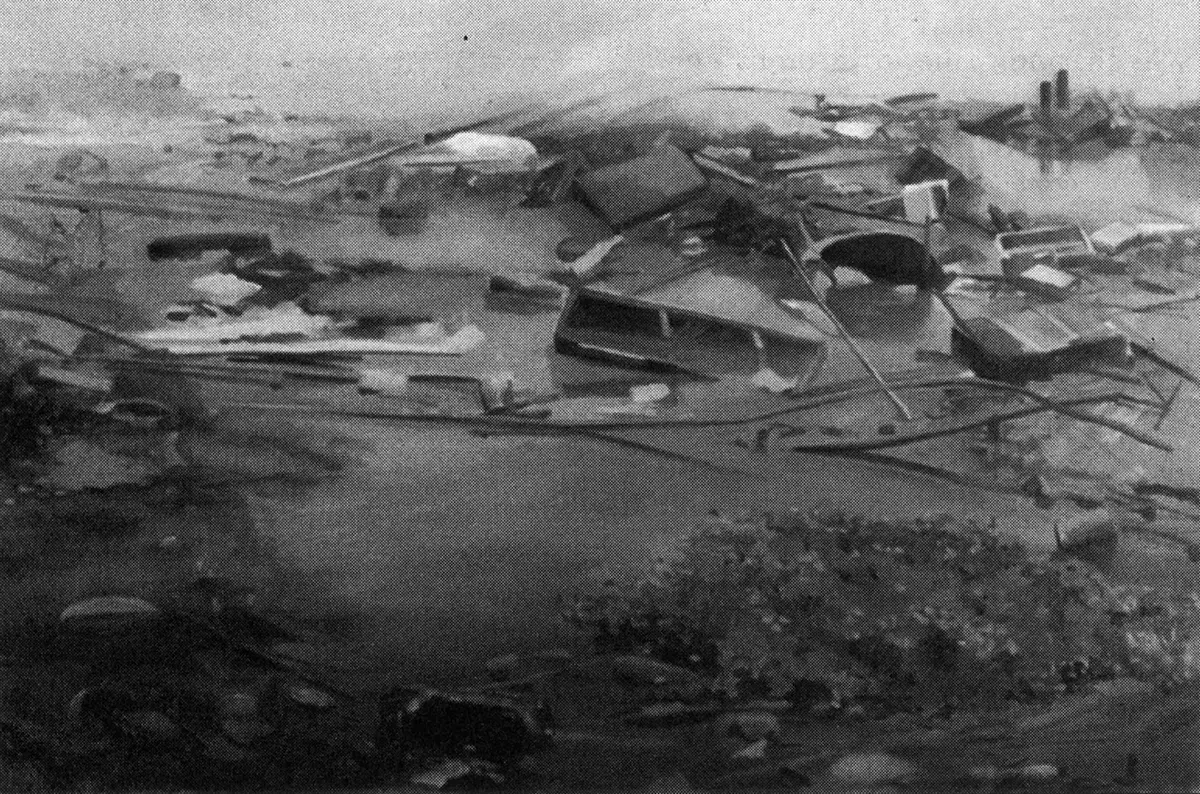
In her recent paintings, which make up the series titled Chambas, done over the last two years, there is a continuation of the angle adopted in the previous series which omits the horizon line and obliges the spectator to look at a surface that contains traces and reflections of the landscape. On these surfaces, in an almost radical way, the artist emphasizes her interest in exploring watery matter, a contaminated nature that offers another kind of textural density, with new chromatic tones dominated by greenish, bluish colors evoking a sense of inert, opaque and murky things with occasional splashes of pink and orange colors which indicate a specific time of the day. One of the most impressive images in the show is No. 12, a canvas measuring 116 x 163 cm. which depicts a pile of waste material, boxes, containers, and cans that have been worked in warm orange tones. The objects float on a watery surface that reflects the colors of the sky, with traces of life evoked through the presence of a few very green plants. In the upper part of the picture the image fades into greenish blue colors which seem strange and disturbing since as we draw close to the picture, it is impossible to say for sure, as a result of the treatment of the paint itself and its texture, whether the surface is a reflection or the image of an infinite sky. This painting seems to speak of the “catastrophe of a landscape", a theme that immediately evokes the work of the Romantic artist Caspar David Friedrich, whose paintings marked the definitive rift between man and nature.
Throughout this new show, the visitor was faced with two extreme situations, which seem to be the result of the paint: on the one hand, when the works are looked at from a distance, the eye perceives absolute realism, as in the case with the reflections contained in pictures No. 1, 2, 3, and 4. On the other hand, the visitor was reminded of the language of pure abstraction by one of the most interesting works in the show, picture No. 10, which can be seen as the true reflection of a dense forest in which the planes successively draw closer and more distant on a tranquil surface, or more simply as an interplay of colors in which the texture and tones are pleasing in terms of their own self-referential nature. This twofold perception has been a source of tension in all the work of Cortés who, as a painter of cows, landscapes, and still-lifes, is above all an artist who knows that her true subject is nothing other than painting itself with its history, with its high points and low points, its vicissitudes and language made up of texture and color. I would even go as far as to say that this figurative element predominates in her work because the existence of such an unusual kind of color necessarily requires the existence of a world bathed in light.
MARTA RODRÍGUEZ