
During October and November of last year, Margarita Gutiérrez, whose last show in Bogota was in 1996, presented an exhibition at the Diners Gallery. The artist already has an established career, which stretches back to the mid-1970s. After some initial semi-figurative stages which led to a recognized period of geometrical abstraction in the 1980s, her oeuvre can be seen as a rich adventure in a color that has been carried out with evident and enormous spontaneity. While at the end of the 1980s and early 1990s the rapid and mobile graphic elements and the abstract stains dominating her compositions were basically non-figurative, little by little a greater relationship with nature was established, with the emergence of elements reminiscent of circles and other curvilinear forms. Gradually, the paintings appeared more controlled and the viewer could begin to distinguish precise areas of color, some of which were well delineated. During the first half of the 1990s, Gutiérrez proved to be a daring colorist, an observer of a very varied biomorphic world, and a painter with a lot of ideas. With all these qualities, which I have mentioned only briefly, the artist recently presented this new show.
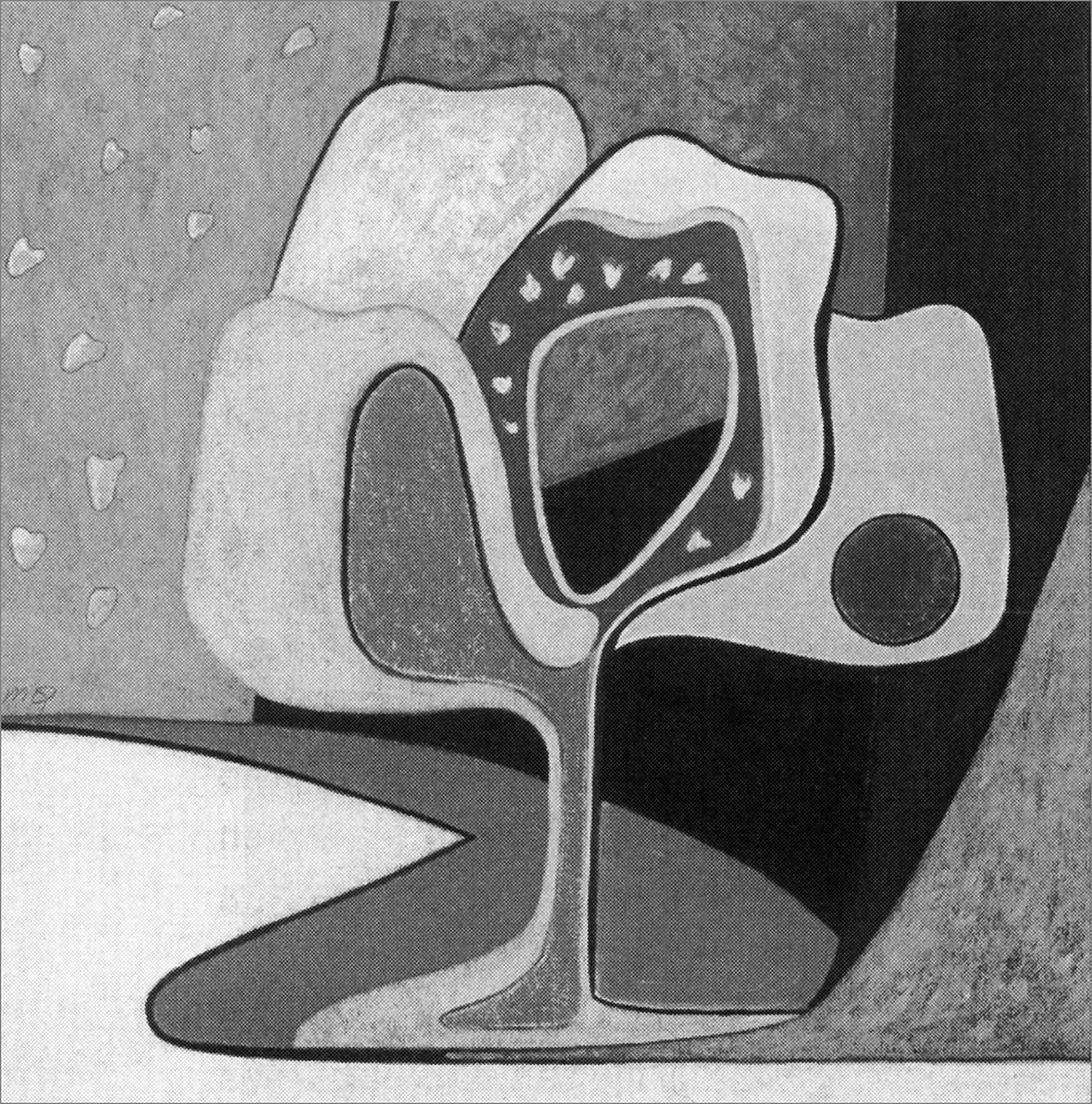
Through her study of abstract art and applied design from the period 1930-1950, she produced an excellent set of works that included oils, some ceramic pieces, and a tapestry. Whereas in her earlier free expression period, certain forms derived from biomorphic productions were in evidence, in her works from 1997 and 1998 Margarita Gutiérrez has openly acknowledged the art of such well-known figures as Miró, Calder, and Arp, among others, in a process that has given added strength to her art, with its well-balanced forms that seem full of vitality. Gutiérrez, who was born in Bogota, achieves a very personal effect by setting her experiences with form alongside those of the great masters, whom she follows deliberately and closely only when she pays them homage, as in such oils as Games with Arp and Games with Calder. But she does not merely propose splendid re-creations of some of the best Margama representatives of biomorphism, Gutiérrez has also studied the work of such designers as Charles Eames. Thus, as presented some utilitarian objects based on curvilinear design, beginning of course with two Eames’ chairs. She created an installation that not only enriched the exhibition but enabled the public to appreciate the many connections with organic and sinuous forms taken from nature that have contributed to the development of abstract art.
The exhibition, titled the Fifties, had a twofold effect: it helped to show that artistic revisions can be important, and demonstrated that the investigation is both intelligent and emotive; and second, it confirmed that in such difficult times as our own, it is essential to work with honesty and a lot of optimism.
GERMÁN RUBIANO CABALLERO