Within the search for a new social and political definition for the term "border," and a new attitude before the ethnic and cultural differences of social order, Manglano-Ovalle's work creates, through his installations, a structure within which the viewer has the opportunity to sensorial experience an atemporal space where all contradictions and paradoxes of this current issue live together1. As a critique of the social problems of multicultural centers where conflict and derogatory stereotypes reign, Manglano-Ovalle offers the viewer, through the artistic object, some basic instruments for reflection. The artist departs from conceptual and formal discursiveness in order to display and reevaluate a series of historical parameters and norms of social behavior. It is an inquiry into the tolerance among individuals —starting from the cultural and social context—, that also allows for a reevaluation of their power relationships with society and the State, thus liberating them from any association with free choice, as defined by Slavoj Zizek2.
Based in Chicago, Manglano-Ovalle's cultural context is a constant source of criticism and inspiration for his artistic output. His own process of adopting the American way —being of Spanish and Colombian descent, educated in America—, as well as the environment in which he lives, impel him to question specific sociopolitical themes of the large international cities. His experience also evokes displacement, exodus, exile, diaspora, and migration, reflecting the problems of that individual who sees himself forced —for one reason or another— to cross borders. This situation leads him toward survival within a new cultural system, a new universe, the possibility of change and regeneration, and, particularly, toward the possibility of confrontation. A reflection that unites art with the real experience, allowing an exchange of histories, language, a new identity, and a political sense of place and belonging that is spatially different.
In works like Bloom (1995-1996) or Subwoofer (1995), Manglano-Ovalle uses elements found in his urban surroundings; car sound systems, firearms, ballistic studies, high technology, and science in general, as a process of research and an instrument in producing the object of art. The artist first aestheticizes the social discourses of multiculturalism and postcolonialism and creates pieces that reflect upon the philosophical structures of knowledge and power derived from modernism. He questions the truthfulness of these principles by showing they are unable to provide adequate definitions for actual social problematics. Thus, the object is a response to formal factors of composition within its own structural milieu where opposites reign, and where the selected elements acquire a value foreign to their daily uses.
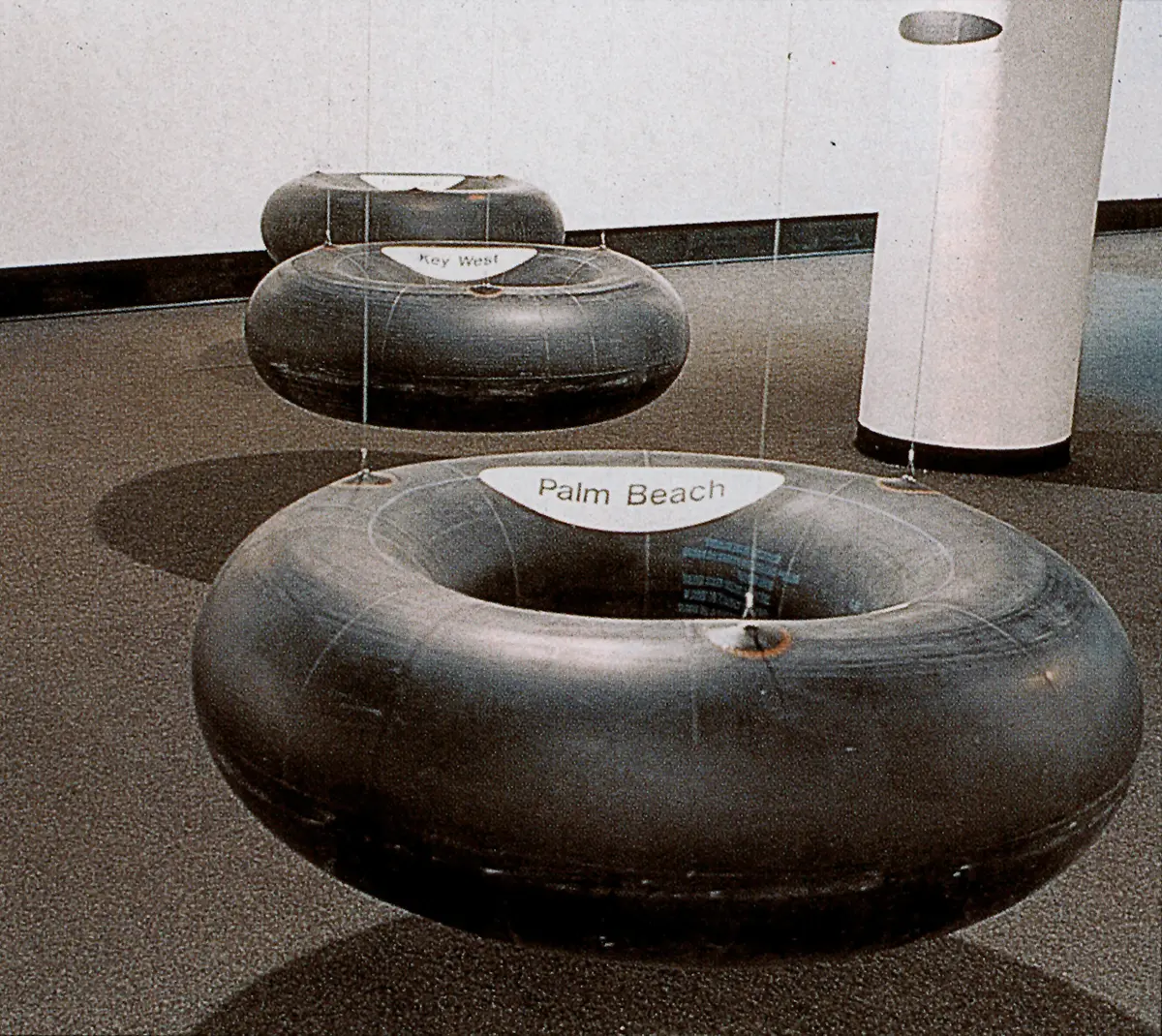
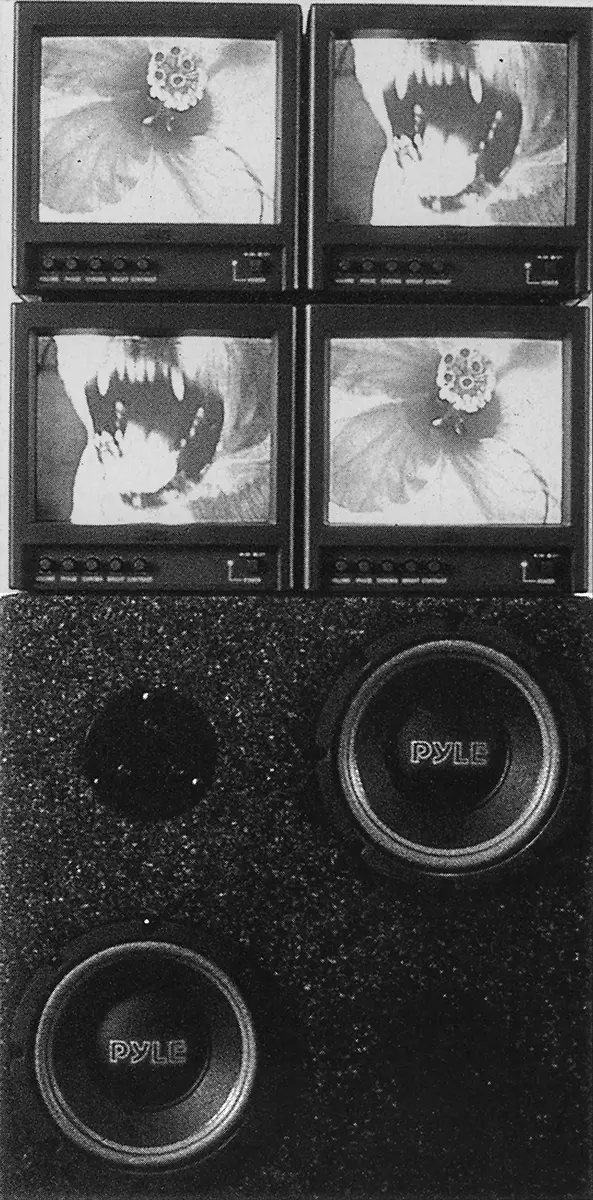
Manglano-Ovalle's compositions vibrate thanks to his presentation, which depicts imagery dependent upon the alienation of the person before his surroundings. In all the installations, the viewer is invited to move around the objects that occupy the space. Tires hung from the ceiling, in the case of Flotilla (1991); large speakers and video monitors of different sizes, amply distributed throughout the space, in the case of Flora and Fauna (1997), lead to a critical position on the viewer's part, as well as to a psychological articulation in a specific space and time. The objects obstruct the path of the visitor and oblige him to interact with the work in order to arrive at a more subjective interpretation of it.
A subjectivity is full of anxiety, provoked by the very alienation of the objects as they are displaced from their surroundings and daily function, in order to become charged with metaphors and convergent meanings.
His first works dealt directly with the subject of immigration to the United States. Two of them, Flotilla (1991) and Balsero (Raftsman, 1994) are a commentary on the entrance of illegals into the United States. Flotilla, whose installation includes three tires suspended from the ceiling, which float in a triangular position in space at the viewer's eye level, makes reference to three different border points; Key West and Palm Beach in Florida; and the Rio Grande on the Texas border, precisely those spots where the greatest number of illegals enter the United States. At first sight, the tires seem to sail through space with no bearings at all; however, each one represents the three cardinal points as well as the three caravels. The commentary is double; since Christopher Columbus's discovery of America, the continent has seen itself threatened by immigration. What has changed are the power relations and, so too, the role of immigrants before the State. Balsero, for its part, makes reference to four immigrants and their ocean voyage to arrive at American ports. Through the video —which appears in each corner of the space, showing the back of a man who finds himself sailing at sea—, the sound of the waves —digitally mastered to create an apparently monotonous melody—, as well as the very presence of the rafts, Manglano-Ovalle achieves an allegorization of difficult moments in personal histories, that lead to a new reflection upon immigration. The perception of reality is honed, alluding directly to themes like the displacement of individuals who seek a better world within a new culture and, with it, a new identity.
Within this same inquiry, Manglano-Ovalle has executed works in which he shows representative images of different ethnic groups that immigrate to the United States. With this, he seeks to break popular stereotypes of immigrants. In the piece Assigned Identities (1991), the artist presents some images of ID cards for different individuals, concealing part of the information about their identity. As he suppresses key information, he is able to contradict the created expectations about the true identity of these persons. In Self Portrait: Contemplating the Colors of my Chakra (1995), the artist also discovers his own identity by using color codes instead of the kind of information typically used by governments to identify citizens. In these cases, the political content of the work does not lie in the image as such, but rather on a level where the State's registration of the person's identity, for example, is questioned, where the relations created out of identity on a sociopolitical level are questioned, where the sense of membership to a specific social group is questioned, etc.
Furthermore, the existence of today's human beings is characterized by a brutal sense of survival, always in a state of limbo with respect to the present. The marginal areas of the great metropolises exert a flow of chaotic information where violence and hope come together. In the contemporary city, there is also a sense of rootedness in the country of origin, generally superimposed over a series of canons foreign to tradition, but determined by the social medium. Manglano-Ovalle incorporates this information derived from the daily experience, by working in video and music workshops with the residents of the most marginal areas, in order to create images and similes that achieve their meaning through the discordance of the music and culture of the street. Thus, the artist's work finds "something" that is not an immediate reading, a utopian space where no racial, territorial, or proprietary differences exist.
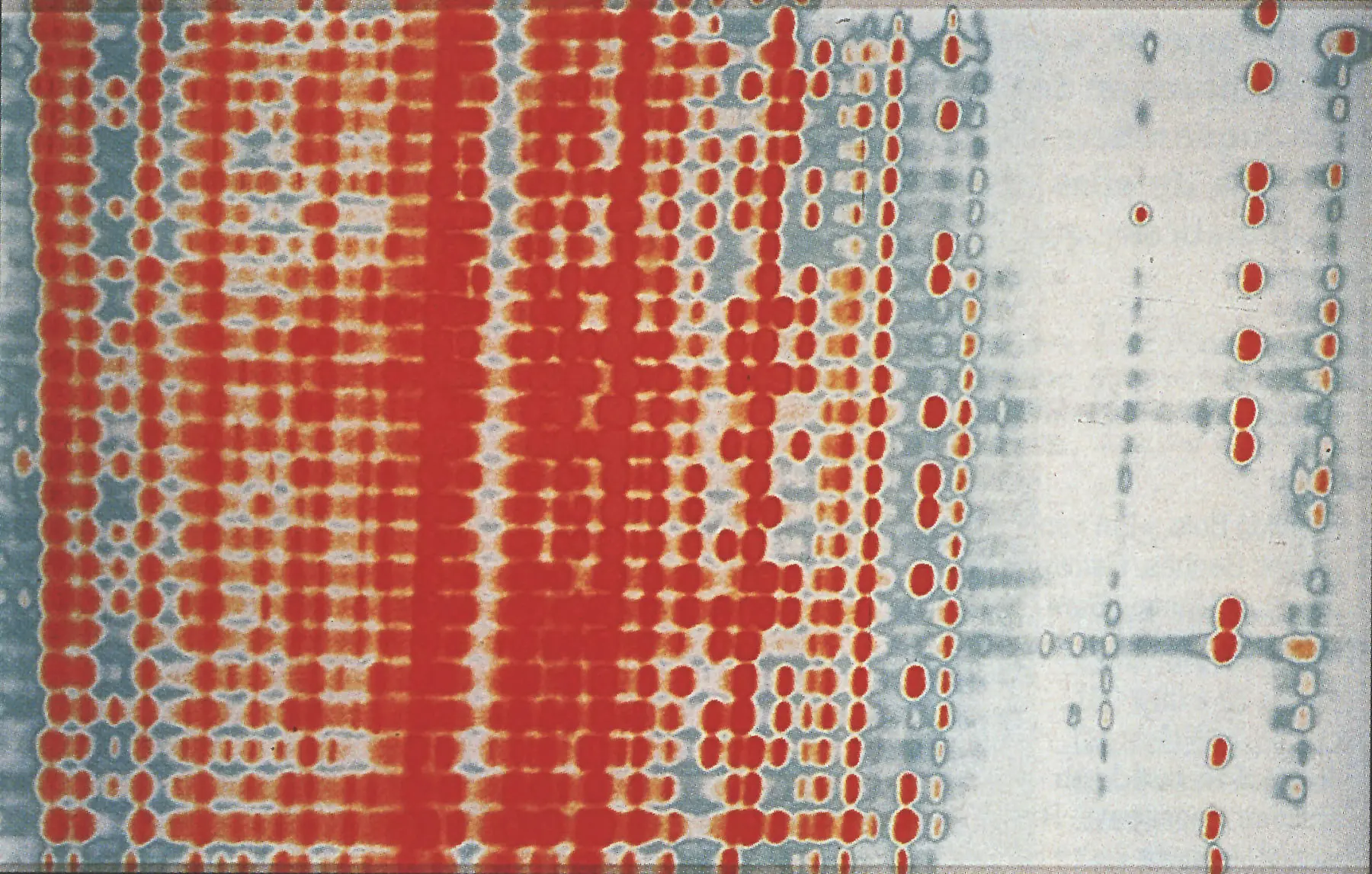
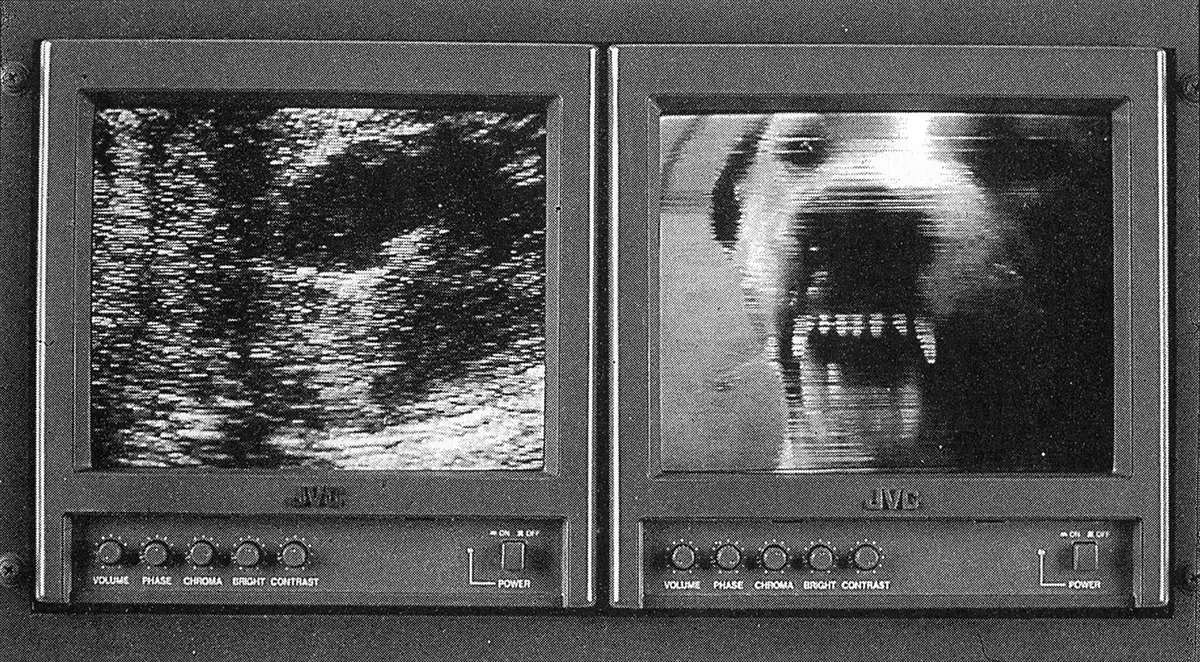
By using this kind of information, the installations bring together several communication levels constructed out of metaphors, and sophisticated artistic use of language that suggests a constant contradiction between violence and beauty, the real and the illusory. Woofer-Woofer (1996) and Sub-woofer (1995) are the results of investigations that the artist carried out with his community. For these pieces, Manglano-Ovalle snatched basic elements for his artistic output directly from street culture. The artist not only used the music made in the workshops but also car sound systems and their speakers (for trunks) in order to emit the work's soundtrack. En Woofer-Woofer, the video presents images of dogs barking, juxtaposed with fetuses in the womb; the speakers and the sound system are placed in the middle of the space in custom-made consoles. The music maintains a dialogue with the video through the intrinsic rhythm of the image and the detached rhythm of the sound. These pieces divest themselves of a specific narrative that departs from the same interaction with members of the community and which, when distorted — through image and music— acquires a laconic quality, under which its aggressive and violent nature is transformed into a spatial element that allows meditation and, finally, the interpretation of the work's critical content. We also witness the conception of an atemporal situation where the narrative is confused within a relative ambiguity of form and space, thus creating a language without certainty.
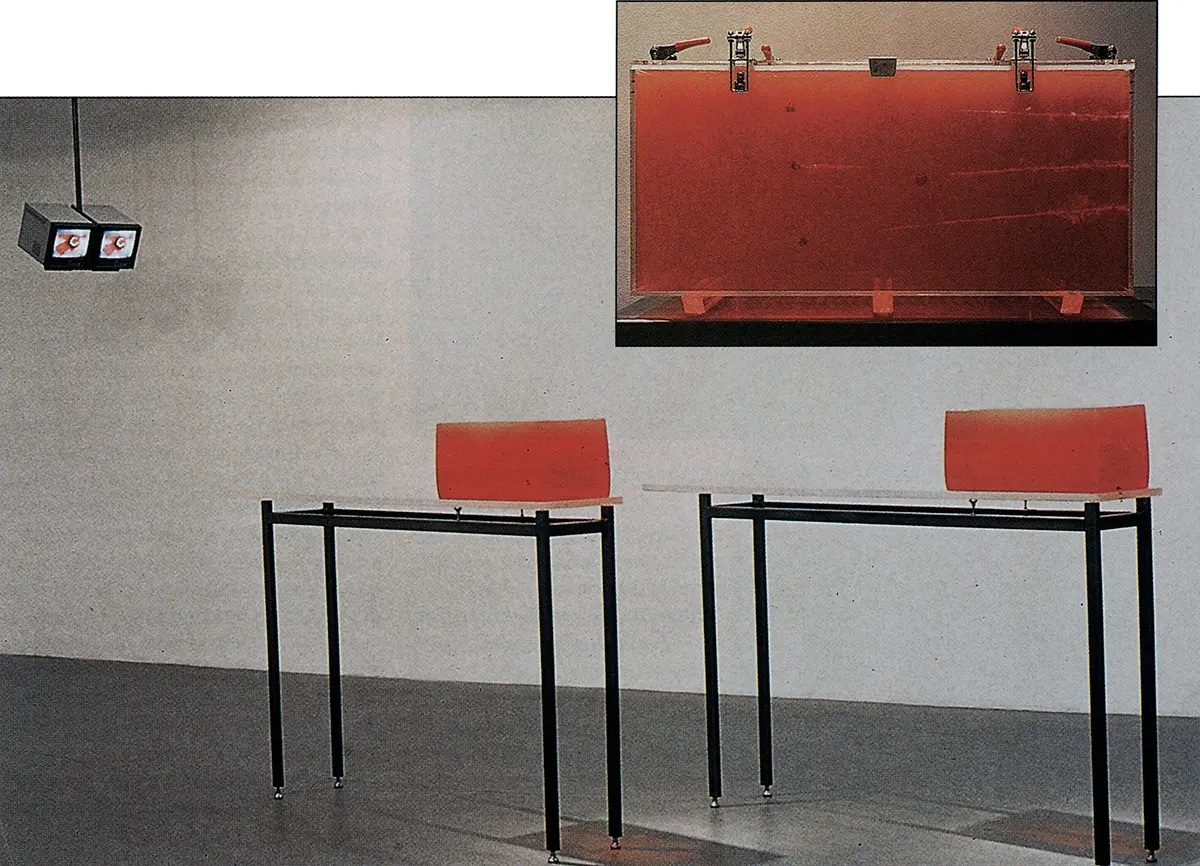
Between 1995 and 1996, Manglano-Ovalle executed the series titled Bloom. He began with ballistic studies in order to represent the cohabitation of the individual with violence in America's poorer neighborhoods. The work was made out of tables that looked like those used in an operating room, where he placed rectangles made of special gelatin that imitated the density and structure of the human body. This gelatin had suffered the violence of bullets, whose trajectory could be seen clearly, due to the gelatin's transparency. There was also a soundtrack that continuously and distortedly repeated the sound of gunfire. Ballistics plays a primordial role here in representing violence as a problem inherent to minorities, playing a primordial role in revealing a public image. Paradoxically, it is through the sum of images and events born of these minorities that we arrive at an ideal nation. Today, the construction of national identity and, consequently, the utopia of the new global community depend precisely on plurality and urbanity. Here, organic traditions converge with innovation, understood as a sense of freedom that rises from plurality itself and allows the emancipation of the state and social system3.
Flora and Fauna (1997) is an aestheticized version of the same theme in which Manglano-Ovalle controls —through the video image of a flower and a dog, and the soundtrack— the concepts of displacement, dismantling, and domination. In the context of the gallery, where there are only four monitors emitting images and the speakers emitting sound, these elements assume diverse meanings and even make reference to a universal code, all within a utopian space where difference and an established social order live as one.
In more recent works, the artist has taken interest in performance, where the gallery space becomes a field of action for an inquiry into the work's content. In this case, the actor is not the artist but rather the spectator casting aside his role of voyeur. The work titled El Niño Effect (1997-1998) depends, almost exclusively, on the participation of the visitor in order to communicate its meaning4. Two sensory deprivation tanks are found in the center of the exhibition room. A new-age soundtrack —which is really the sound of a revolver shot, digitalized and mastered to sound like a summer storm— plays constantly. Two bathrooms are located in the back of the gallery, each one has a video loop that repeats the clouds passing over the U.S./Mexico border. Whoever wishes to interact with the work must use the bathrooms. Each element, for example, the tanks, the bathrooms, the music, the mirrors in the gallery, and even the towels, supplies a dialogue with the others.
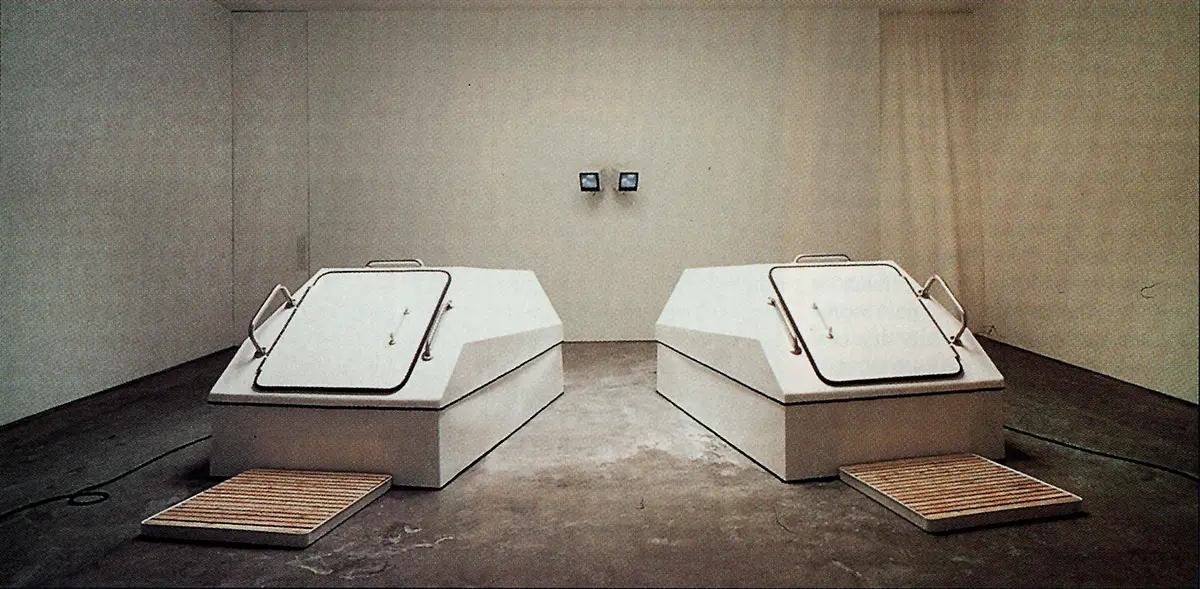
There is a plurality of texts to be read or discovered by the visitor, texts which function analogously to the work as such (the final object). The manipulation of the information given to the spectator begins with two elements of the work and their juxtaposition in space, but it is the very experience of the subject that leads to meaning. There is a tacit demand on the viewer, who is invited to wash up in the showers and submerge himself in the tanks. The perception of the object becomes a total sensorial experience since all of the senses are stimulated. There is an exchange between the artist and the visitor that leads to reflection and the elaboration of the visitor's own narrative.
The artist, following a Duchtimpian tradition, firmly believes that the meaning of a work of art cannot be immediately appreciated. Thus, he consciously controls the space and the elements that make up the work, with the aim of seeking a redundancy of meanings and stimuli for the spectator. This allows for a reading where the cultural baggage of each visitor will also play a major role in the appreciation of the work's content. In critical terms, El Nifto Effect makes a direct allusion to geopolitical borders and to the social pressure that these spaces exert on the individual, who must adapt to rules and models of behavior that have been pre-established by the various nations. Here, the subject tends to be stereotyped and trivialized, doing away with individuality and uniqueness. Just as psychoanalyst Julia Kristeva maintains, it is of special importance to preserve the individual's psychic reality through the recovery of memory and the subjectivity of himself. Kristeva mentions the individual's ability to make sudden associations through multiple layers of culture, allowing him to enrich his own life, and thus build his own identity, also understood as freedom5. Finally, each layer of information leads to reflection and helps to establish a utopian field of change, where contradictions converge, and where the difficulties of making connections between the public and the private, the national and global, are lessened.
In Manglano-Ovalle's work, there is a constant awareness of current problems and an attempt to display chaos in order to derive a new order. Through his artistic collaboration, an intermediate culture takes shape. In the spaces, he creates there is a cohabitation of an entire series of definitions and political strategies that lead to a new narrative of the individual and his social context. The artist proposes a utopia based on the ideas of the transnational and the national, with allegories of travel, displacement, and change enriching the individual identity6.
The strong symbolism derived from the absence of reality when creating utopian spaces gives cogency to the criticism of actual reality. As Victor Zamudio-Taylor mentions, Manglano-Ovalle invents a tradition and recovers a cultural inheritance through multimedia installations7. Displacement is always present, both on a conceptual and cultural level. It is the space of negotiation and translation of two realities.
NOTES
1. Jo-Anne Berelowitz, “Conflict over Border Art," Third Text, no.40 (1997) 71.
The Border Art Workshop, created in 1984 by artist David Avalos, then curator of San Diego’s Centro Cultural de la Raza, gathered a group of conceptual creators, among them Guillermo Gdmez-Pefta, to rethink the definition of the term “border." Instead of accepting it as a barrier that divides two nations, they explored the idea that a frontier territory operates like the threshold of a fluid and negotiable space. Rather than seeing it as a space that paternally defines or constructs a nation's parameters, they saw it as a space of interconnection and interdependence. Instead of assuming it to be a static space or rigid dividing line, they saw it as a zone of transformation for the two confronting cultures, as a laboratory for social and aesthetic experimentation. In short, these visionaries defined “border" as a complex space where tragedy may be transformed into the utopia of a borderless future. Today, Manglano-Ovalle and other artists like Félix Gonzáles-Torres, Quisqueya Henriquez, and Consuelo Castañeda have carried this theme to a more complex structural level. By removing meaning from the purely representative image when they incorporate it into the more complex structural frame, they have created a new discourse on the multicultural identity of a determined society. The new reading also reestablishes the social structures of an era.
2. Free choice implies that the individual has the right to choose, act, or avoid participation in society, whenever he or she makes the correct decision and decides to participate freely. This principle contains a traumatic arbitrariness that tends to determine a particular behavior in the individual. The most evident case of this type of power relationship is the army. However, in urban social relationships, free choice is also present, always limited to a series of rules of tacit behavior that lead to the creation of urban and rural nuclei that respond to the individual’s identification with such rules. That is, the individual's behavior responds to the expectations of the imposed rules. If we enter into the idea of multiculturalism, this idea leads to the differences and difficulties of the individual's adaptation to certain societies. It also leads to racism and a search for one's own identity, in which there is a great mix of sources that specifically translate into cultural manifestations like music, oral and written traditions, and others. See Slavoj Zizek, The Plague of Fantasies (New York: Verso, 1997) 57.
3. Homi K. Bhabba, The Location of Culture (New York: Routledge, 1994) 3. Néstor García Canclini makes a lengthy reference to the survival of cultural traditions of minority communities in Latin American countries. Néstor García Canclini, "Memory and Innovation in the Theory of Art," The South Atlantic Quarterly, no. 3 (1993) 423-43. See also Geeta Kapur, “Globalisation and Culture," Third Text (1997) 30.
4. The work was presented at Art Pace (San Antonio) and at the Christopher Grimmes Gallery (Los Angeles) in 1997.
5. Julia Kristeva, El límite del museo (Barcelona, 1997) 13.
6. Utopia, seen from the point of view of imaginary and ideal space that, precisely because of these characteristics, is non-existent and impossible. There is only a semblance of this space and ideal state.
7. Víctor Zamudio-Taylor, "Donde está el corazón ensangrentado. Donde está el cactus’ [Where the bloody heart is. Where the cactus is] Atlántica (1997) 90.
ANA SOKOLOFF