"Might it be that in the constructivists like me the exit is the real space." Lygia Clark, 1960
"A complete life may be one ending in so full identification with the non-self that there is no self to die."1 Bernard Berenson
An early statement by Lygia Clark, "The surface is only two-dimensional when it pre-exists the time-space, "2 already in 1959 indicated not only the complexity of her work but also its unconventional character. Indeed, a glance at this body of work reveals that it engendered an artistic praxis signaled by a systematic undoing of artistic conventions. It is not surprising then that a review of the artist's recent retrospective should begin with a question relevant to many contemporary artists and certainly unavoidable in the case of Clark (who at some point considered herself as a non-artist): how to apprehend a work that was not intended for the institutional space of the museum, that was not conceived as an autonomous object, that was not only ephemeral but that required the direct and continuous participation of the spectator without whom the "work" did not exist? It is unquestionable that Clark's late practice broke radically with the system of production, circulation, and reception that characterizes the work of art, but one could easily argue that the seed of that rupture was already contained in the above statement written in reference to her early geometric, constructivist-influenced paintings. By appealing to the intertwined philosophical categories of time and space, not in their abstract and absolute mode but in their phenomenological dimension, Clark underlines the aprioristic, conventional, and artificially fixed status of the pictorial surface. She reveals it as only a concept destabilized when exposed to the contingencies of time and space.
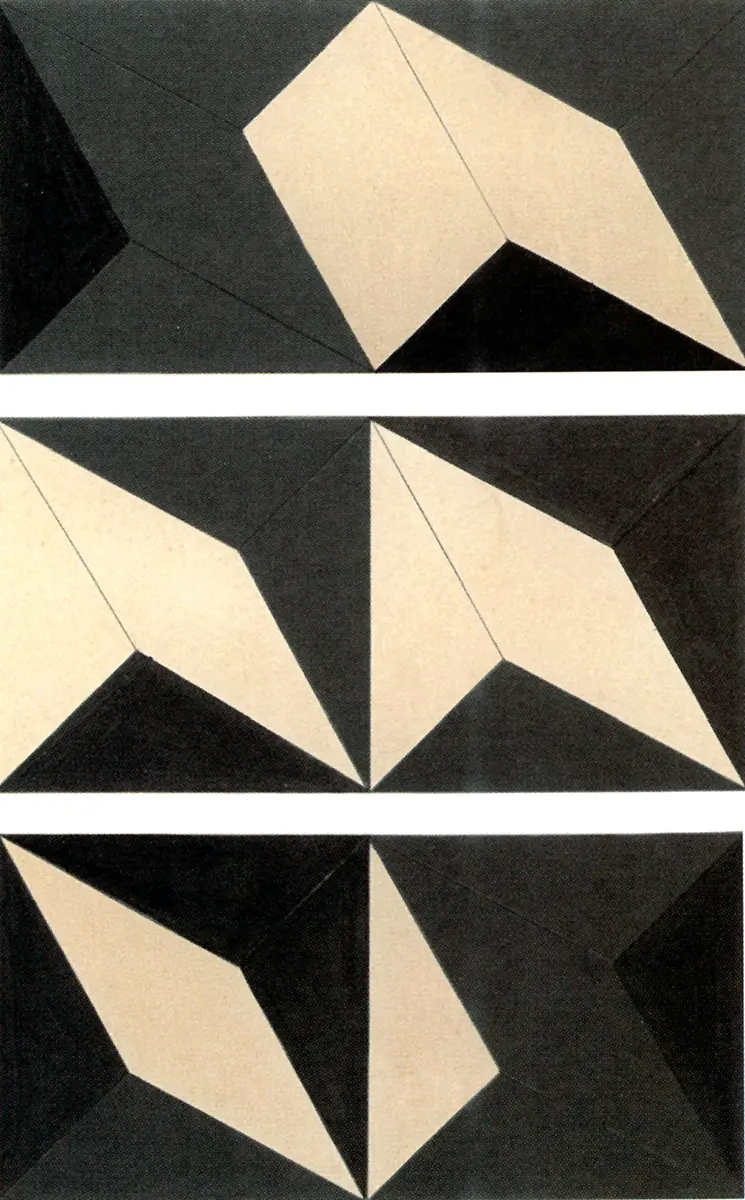
The show, a meritorious effort of the Fundacion Antoni Tàpies, opened in Barcelona in October of 1997 and then traveled to Galeries Contemporaines des Musees de Marseille (MAC) in January of 1998. The two other venues were the Fundasão de Serralves in Oporto and the Societe des Expositions du Palais des Beaux-Arts, in Brussels, where the exhibition concluded its tour at the end of September 1998. In Marseille, the exhibition space was signaled by white walls and quadrilateral spaces populated by low pedestals on which part of the work rested. The first gallery included the artist's paintings from the mid-to-late fifties, of which the most important series is the Modulated Surfaces. These pieces were considered by the artist "experimental fields which integrate within an environment,"3 a proposal that recalls not only canonical figures like Mondrian, Van Doesburg, and the members of De Stijl in general, but also figures closer to home like the Argentinean Raul Lozza, who since the forties has devoted himself to the development of pictorial environments through paintings conceived as maquettes, that would supersede the figure-ground relationship inherent to visuality.
But unlike the earlier Argentinean concrete artists, or for that matter, her contemporary Brazilian colleagues —also practicing a rationalist committed concrete art with which Clark and other artists like Helio Oiticica and Lygia Pape broke to inaugurate Neo-concrete art in Brazil—, Clark was exploring destabilizing venues that would lead her away from painting. The Modulated Surfaces occupy a transitional place in this process. They manifest the artist's interest in questioning the fixed bidimensional pictorial plane by giving the line, the line-space as she called it (later lifetime), a new role. This line or space between the wood panels that structured the surface, was not compositional but tried to dismantle the surface as ground by penetrating it with real space. Here, as Ferreira Gullar lucidly pointed out, "the space becomes a vehicle of time, and time reveals it."4 These pieces colored with liquid industrial paint concluded her investigation of the conventional nature of the frame and the surface.
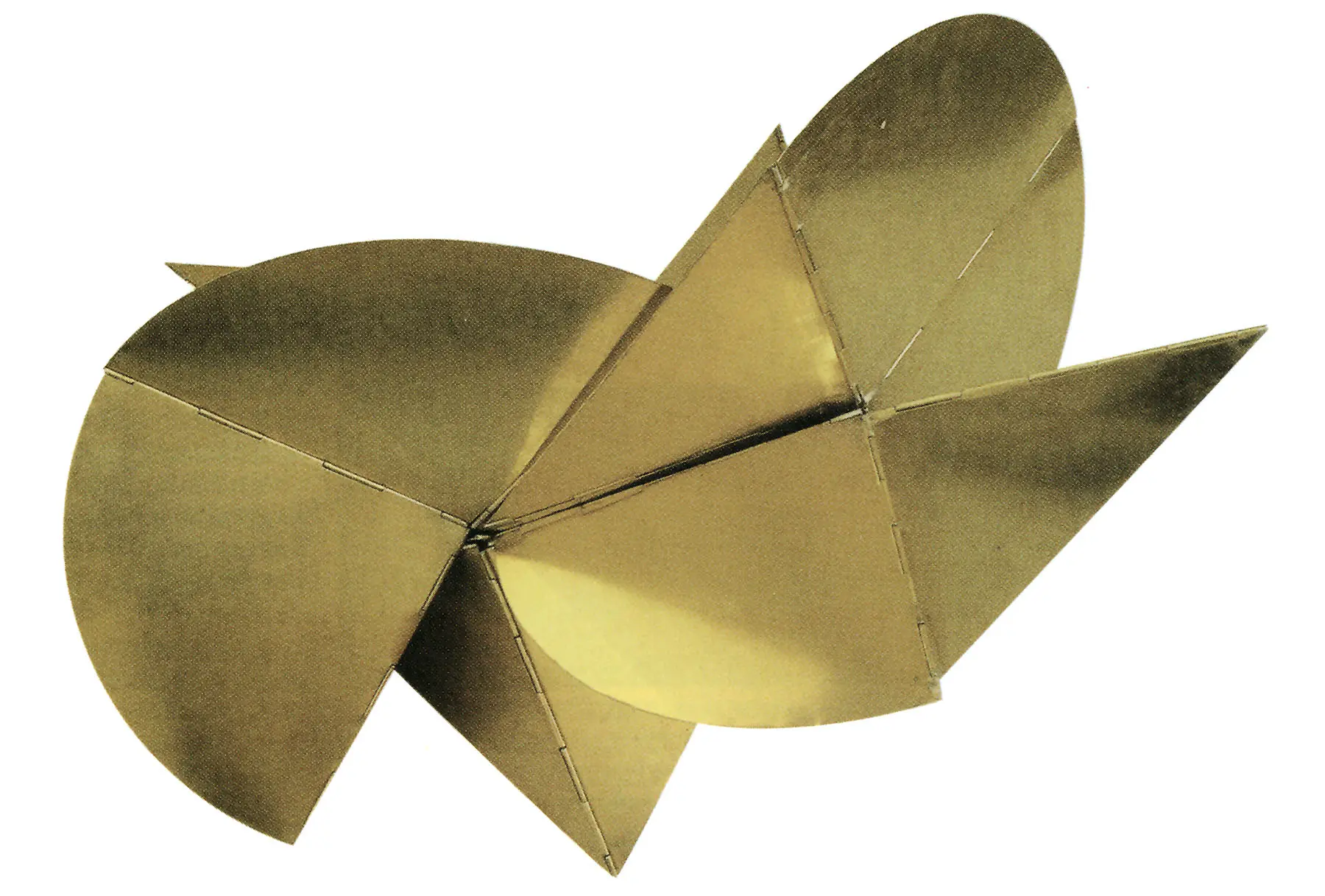
The next series of works exhibited in this gallery, the Casulos (meaning womb or egg in Portuguese), are plaques made of metal, tin, or iron, which unfold themselves to incorporate space in a literal way. The small pieces split, creating irregular geometric structures halfway between painting and sculpture. They attest to the artist's initial effort to break away from the pictorial object, an effort that would conclude in her groundbreaking Bichos5 initiated in 1960. The Bichos, exhibited in a continuous gallery, is made of aluminum plaques, circular, triangular, and rectangular, articulated by hinges. These pieces were created to be manipulated by the viewer and to be mass-produced so, from the outset, the show could not deliver what was intended. Only one Bicho was available for manipulation, and though the opportunity to see the great variety of structures together resting on a low large pedestal was very impressive, the Bichos merely looked like beautiful objects (albeit of an experimental nature). As conceived by the artist their flexible but carefully developed structure incorporated contingency by relying on the intimate temporal dialogue between spectator and object, since it is mandatory that the viewer manipulates the Bicho, altering it continuously. Here, there was no pre-established way of apprehending the object, no correct point of view, and no final composition. By making the work rely on the viewer and vice versa, Clark undermined the clear-cut separation between the observing subject and the observed object on which so much constructivist (rationalist) sculpture is predicated.
Although Clark's Bichos antecedents can be traced back to the "spatial forms" of the Russian Constructivists— the former shares with the latter the rejection of sculpture's "traditional connotations of mass, gravity, immobility, and permanence" and the incorporation of empty space as "concrete" material6 —the Bichos' structure is unpredictable and is never fulfilled because it relies on something other than itself. Nothing is further from the Constructivist's spatial forms than this lack of distancing from the object. For the Russians, objective, organized, and planned structures predicated on clarity and coordination was necessary metaphors used to fight the shattered political and economic situation that characterized post-Civil War Russia. In Brazil, Fifties Concrete art absorbed the legacy of the Constructivist avant-garde to build models of representation that would suit the aspirations of an underdeveloped country eager to supersede its backwardness through State planning and industrial growth. But the last link in the long chain of Constructivist tendencies of the twentieth century, and the one that influenced the Brazilian art scene, was the Concrete art of Max Bill and his Ulm School. In its Swiss mascarade, the legacy of Constructivism, built upon the pitfalls of the Bauhaus, represented an effort "to instruct with aesthetic values, the production of forms in society..." As Ronaldo Brito explains, "At the base of its (the Ulm School) reasonings, is the old reformist project of rationalizing production relations at the interior of the capitalist system."7 The artistic production concomitant with this ideology predicated on seriality, mechanical movement, and objectivism derived from a fetishization of technology that finds its best examples in the optical games of Kinetic art. It is against this exacerbated appeal to scientific (calculated) models, mannerist examples of the logical structures in which the constructivist mind recognized itself, that the Bichos stood. Their utmost complexity drew from Constructivism an emphasis on coordination and structure but imbued the bodies of these unpredictable animals with an arbitrariness that emerged from the fluid interaction of boundaries between subject and object. It is interesting to note that while much of Western sculpture has been associated with the organic metaphor in the sense that the former follows the functionalist models of nature, the Bichos are organisms that one does not associate with exemplary natural models. While Clark adheres to the organic metaphor as a functionalist model, Bichos are rather debased animals, bugs that one is not eager to cultivate, like cockroaches. That they do not quite stand for an idealist paradigm of artistic production is exemplified by their latter transformation into rubber pieces arranged according to the "laws of chance"8.
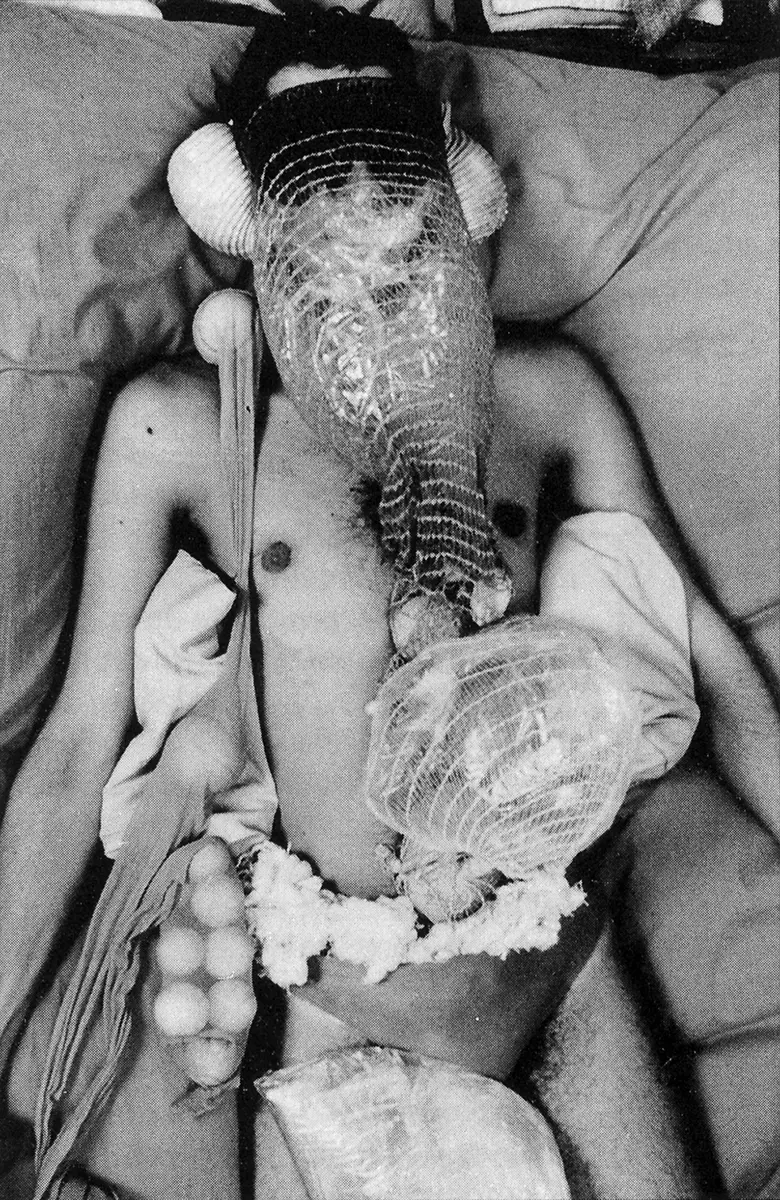
The rubber pieces, titled Trepantes (Obra mole), and Grubs (Soft work) from 1964 were to be seen in front of the Bichos, falling from the white pedestals to arrange themselves onto the floor. The installation of these pieces was the most effective as it seemed to defy the institutional paraphernalia designed for traditional sculpture. The Trepantes do away with the structure and signify Clark's rupture with the residues of Constructivism still present in her Bichos. The circular and linear cutouts inscribed on the black rubber allow space to penetrate the work and let these pieces hang from trees or rest on rocks, as photographs of the period show. More importantly, they submit to gravity and thus radically break away from western sculpture's aspirations to elevate itself from the ground.9
The jump into space, prompted by Constructivism, paradoxically led Clark away from this artistic movement, and into the precariousness of form exposed to time and action. The triggering gesture that led her towards this new paradigm of production was her proposition (as she called her post-objects works) Caminhando (Tradings) which took place in 1964. Here, Clark not only does away with structure and construction but with the object itself; it is now the subject that creates the precarious experience that will substitute for the work of art. It all starts with a Mobius strip:
"Then take a pair of scissors, stick one point into the surface, and cut continuously along the length of the strip. Take care not to converge with the pre-existing cut—which will cause the band to separate into two pieces. When you have gone through the circuit of the strip, it's up to you whether to cut to the left or to the right of the cut you've already made. This idea of choice is capital. The special meaning of the experience is in the act of doing it. The work is your act alone. To the extent that you cut the strip, it refines and redoubles itself into interlacings. In the end, the path is so narrow that you can't open it further. It’s the end of the trail. (If I use a Mobius strip for this experiment, it's because it breaks with our spatial habits: right/left; front/back, etc. It forces us to experience a limitless time and a continuous space.)"
Later in the same text, she adds that there is "no more separation between subject and object. It's an embrace, a fusion."10 And precisely, what signals Clark's post-object work is a continuous undoing of the conventions that allow us to establish identities. Her project becomes then a systematic shattering and fragmentation, a problematization of the notion of art and self.
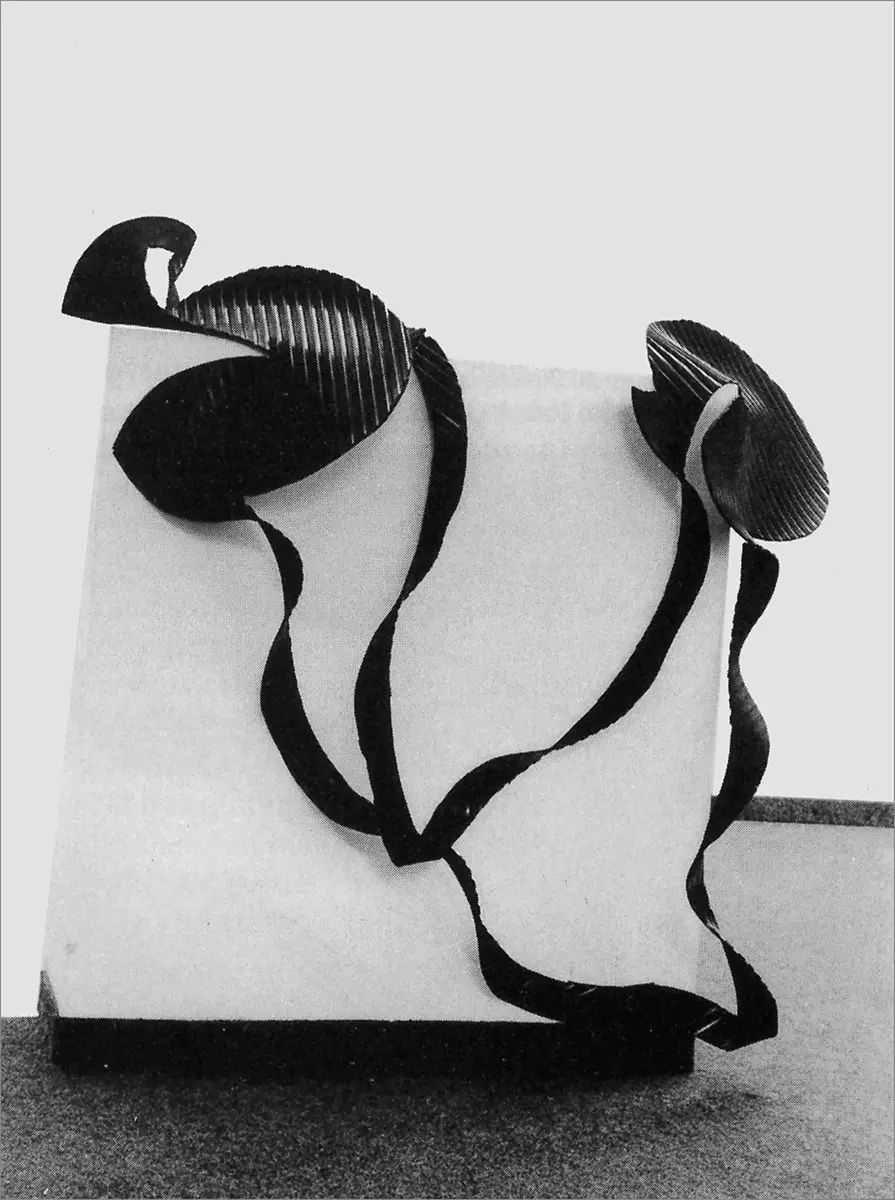
An important text of 1964 entitled "On the Act" establishes the epistemological parameters within which the artist's work will be deployed. An emphasis on the dispersal of boundaries, on the continuous destabilization of the body as a fixed entity, on the ephemeral, and the imminence of the act, will give place to the precarious, not only as a paradigm of production, as I already indicated above, but as a conceptual principle to understand the instability of the self, the uncertainty of the Cartesian cogito. "I am sucked in by the others. Such an impressive perception that I feel pulled up from my roots. Unstable in space, it seems like I am coming apart. To live perception, to be perception...."11 And in a diary entry from October 28th, 1963 she asks herself, "how can I feel that I am a total unity if precariousness, permanent movement, is the essence of my work, and has therefore become mine also...".12 It is this type of thinking that will inform the propositions that took place between 1966 and 1968 under the title of Nostalgia do Corpo (Nostalgia of the body), a series of gestures that stood between the impossibility of recovering something lost and a desire, a longing for it. "I am crying for stability that doesen't t make sense anymore instead of accepting the precarious with great joy as a concept of existence,"13 Clark wrote. In this series of propositions, Clark used simple materials with which the viewer interacted through touch, while vision, as the privileged sense through which we apprehend the world was almost obliterated. In Pedra e ar (Stone and air) from 1966, for example, one takes a bag of plastic filled with air and puts a little stone on one of its comers. With both hands, one spectator pushes the bag so that the little stone moves up and down. What interested Clark was the perception of the very simple materials interacting together as a living thing. To recognize the body outside one's own body. Another proposition, Respire Conmigo (Breath with me) from 1966, emphasized the fragmentation of the body through perception by alluding to the respiratory system. She described it thus: "A rubber tube, normally used in underwater swimming equipment. Pressing it with one's hands, one puts one end into the other. Stretching and pulling the tube back repeatedly produces a sound similar to that of breathing, due to the air that enters and leaves the interior of the tube."14 This dispersal of the bodily underscores a model of identity that does away with the transcendental "'I', uprooted with respect to the spatiotemporal bearings of (the) body"15 in order to dwell on the logics of alterity. These concerns were further explored in her seminars in the late sixties and seventies where she created interactive corporeal situations with her students at La Sorbonne.
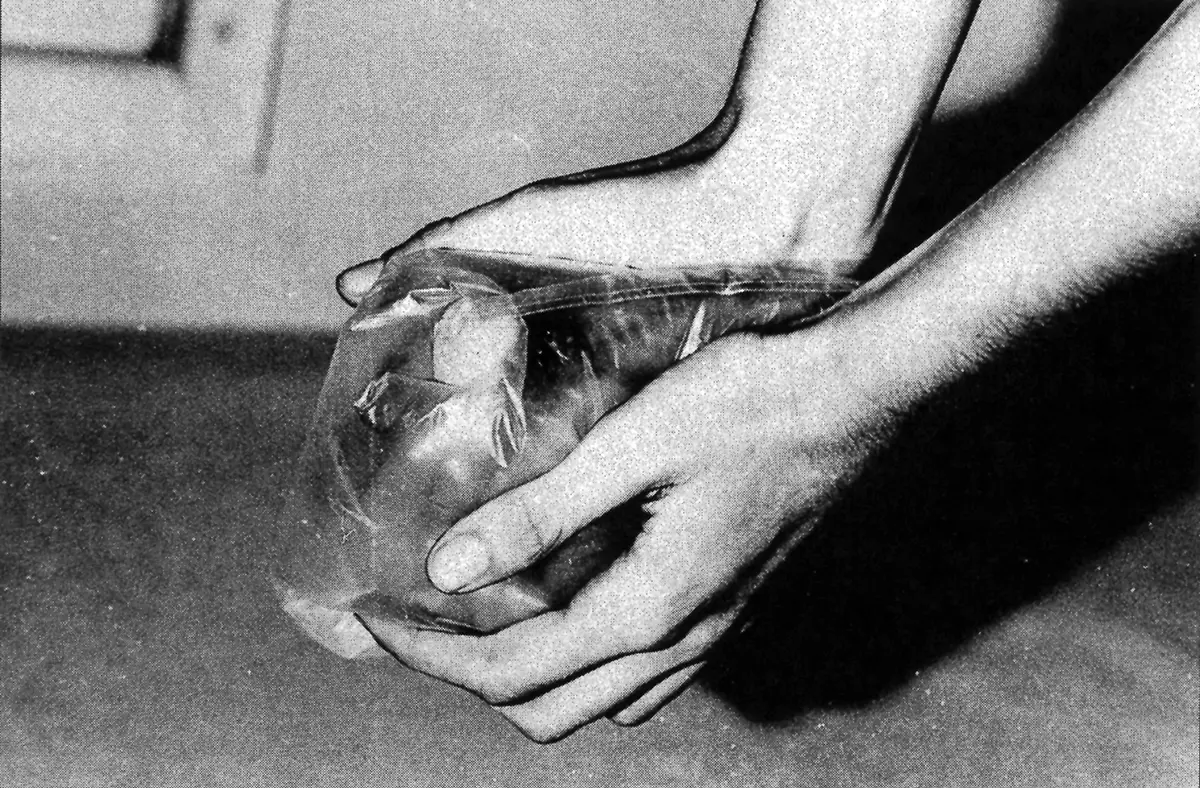
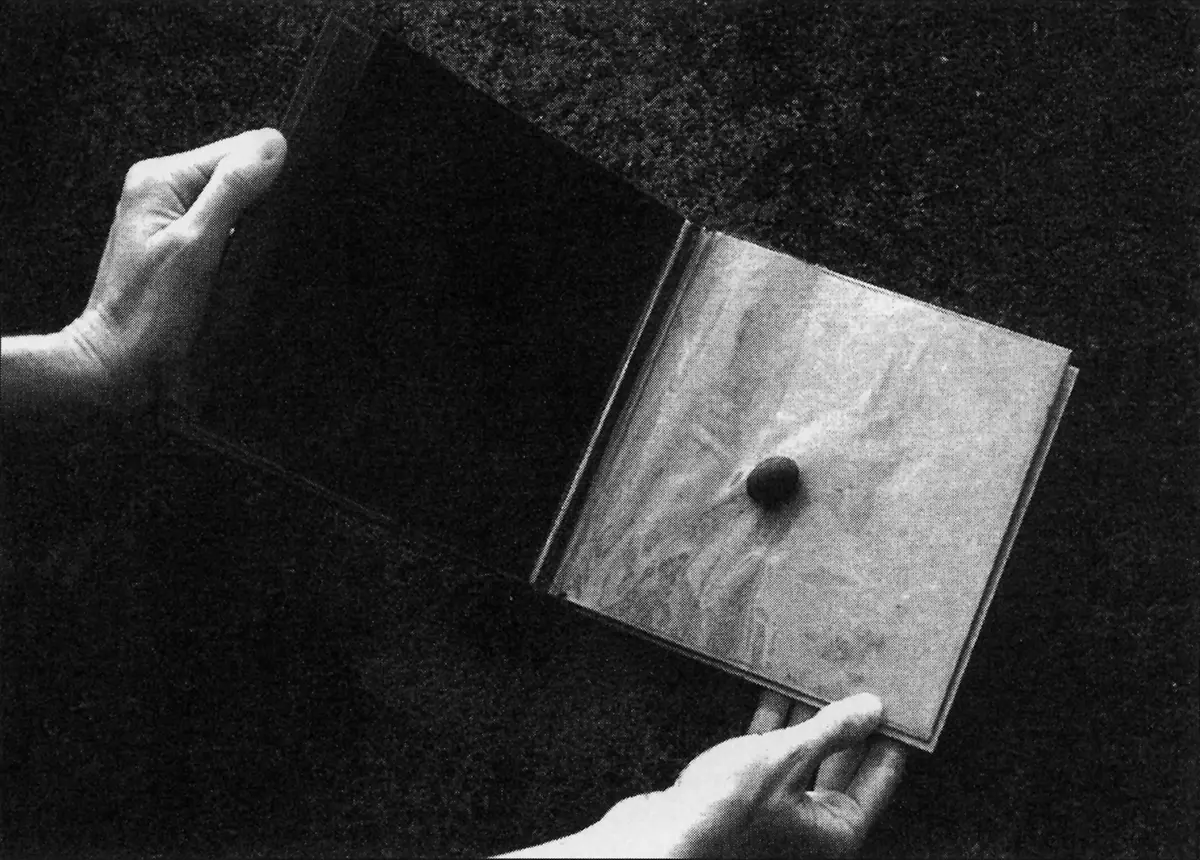
But Nostalgia of the Body points at something else —the body as a site of cognition in opposition to an objectivist perspective that assumes a purely mental God's eye view that transcends human contingency to access a rational and universal structure that explains how the world is. Livro Sensorial (Sensorial book), a work from 1966, and not recreated for the show, is emblematic of this. Made from transparent plastic bags (18 x 18 cm) that act as pages, the book is composed of different materials: aluminum, wool, shells, stones, and water bubbles contained inside the paginated plastic bags that the reader is supposed to touch as opposed to reading. As the artist explains, "...in the last page —something that I think is very important in dialectical terms— there is a mirror where man finds his own reality and that of the world, after having touched everything, through a sensorial and tactile way."16 By relying on the tactile manipulation of objects, bodily deployment in space, and perceptual interactions, Clark opens up the boundaries of the body, now posited as a producer of meaning in its interaction with the world. Imagination plays here a crucial role as a mediator between the body and the mind as sites of understanding. As Mark Johnson points out, in a "non- Objectivist theory of meaning (...) understanding is treated as a historically and culturally embedded, humanly embodied, imaginatively structured event."17 This impossibility of separation between the inside and the outside was systematically thematized by Clark starting with her Bichos: "In his dialogue with my work O Dentro e o for a (The Inside is the outside), the active subject re-encounters his own precarious nature. He also —like the Bicho— does not have a static physiognomy that defines him. He discovers the ephemeral in opposition to any type of crystallization. Now space belongs to time, continuously metamorphosed by action".18 As Johnson describes it, "the key notion is embodied understanding," which points out to the fact that "we are never separated from our bodies" and that "the world is always with us." Structures emerge from "our meaningful interaction with things outside us," from the "mediated understanding of our experience." Like Clark he concludes that "it is a mistake... to think of an organism and its environment as two entirely independent and unrelated entities; the organism does not exist as an organism apart from its environment. The environment as a whole is as much a part of the identity of the organism as anything "internal" to the organism."19
The above was to signal Clark's late sixties and seventies projects in a way that her work becomes a reflection on the complex issue of subject identity. The failure of the exhibition to convey this essential aspect of Clark's work should not surprise us. How can a work predicated on the contingency of interaction, precariousness, and alterity be submitted to the structures of fixation, exhibition, objectification, and fetishization that inform museum practice? Although an effort was made to allow the viewer to touch duplicates of the sensorial objects that Clark worked with, the inappropriateness of the site was instantly felt. The carelessness of the installation failed to make an effective impression on the uninitiated viewer (water from one of the pieces was running through the table where some of the sensorial propositions were located, fading and peeling labels were hard to read, and dirty white painted pedestals, covered with hand's prints, were the norm). The feeling of archaic remains was most strongly felt in this part of the show. In a contiguous room, the most informative images on Clark's practice of the period came forth from two slide projectors; they were very impressive due to the great variety of formal configurations that these interactions achieved. The room also contained, hanging on the wall, or scattered around an empty arena where weekly performances took place, all the ephemera that the nonartist used in her seminars.20 A video (not in working order at the time of my visit, but later sent to me by the Fundación Tàpies) was supposed to be projected by a monitor located in the corner of the space. It showed a recreation of Clark's activities with her students at La Sorbonne. But, as I said, the slides were the most effective medium to convey the non-theatrical quality of these dialogues. They concentrated on the array of collective gestures developed by Clark under different titles that indicate her concern with the complex constitution of the self. Thus, under the titles The House is the body, Man, living structure of biological and cellular architecture, and Phantasmagoria of the Body, Clark deployed proposals of a philosophical and poetical nature that pondered on the dynamics of identity.
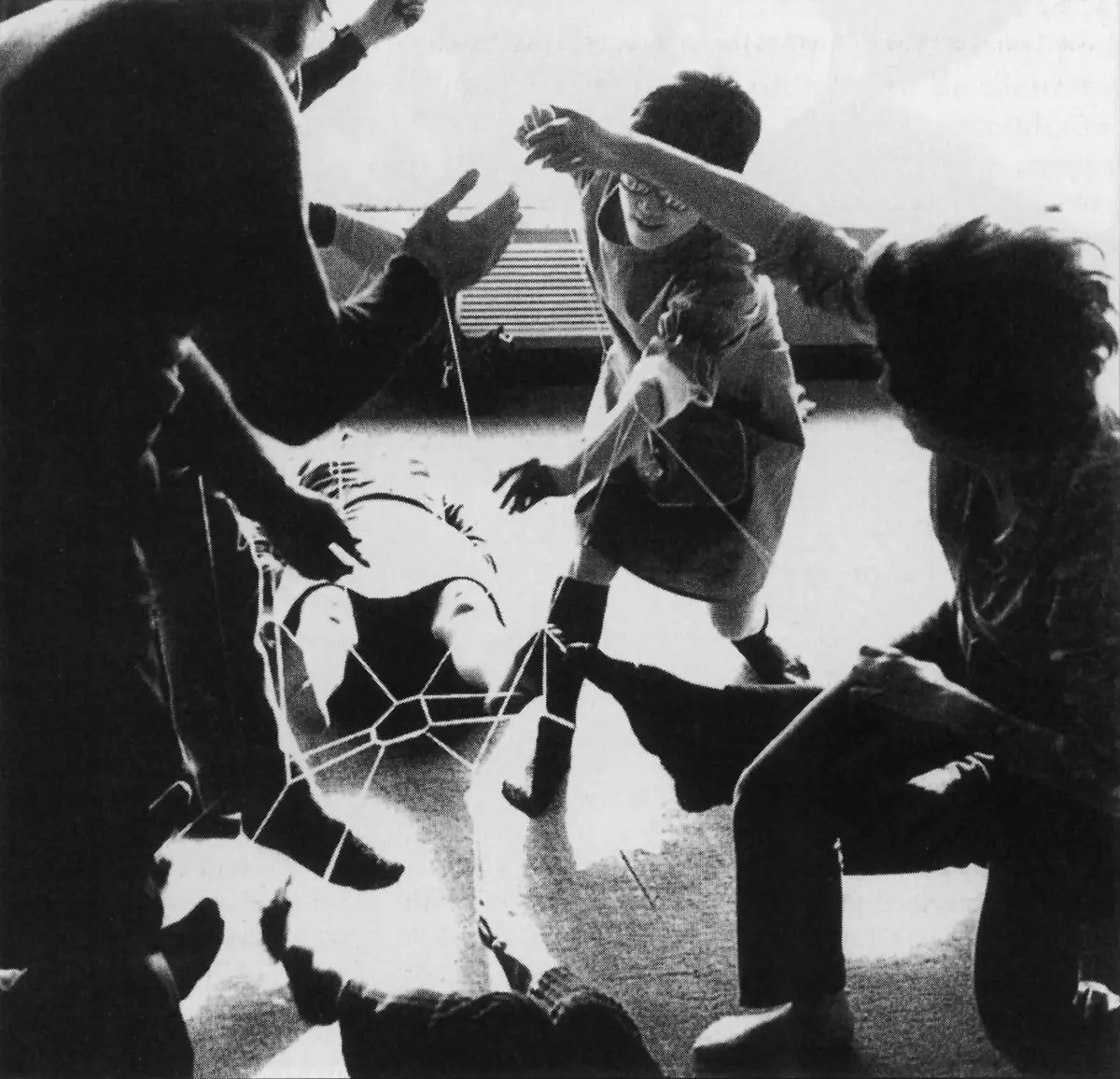
Three propositions were particularly relevant in regards to the above; Estructuras vivas (Living Structures) from 1969, Baba antropofágica (Cannibalistic Slobber), and Red de elástico (Elastic Net) both from 1973. The first was made up of elastic bands attached to the feet of four people lying down and to the hands of four people standing up. As Clark explains it, the location of these people in space obeys the design of a web and the ordering of the movements of the group forms a structure that is lived through the gestures of its participants. It is fascinating to imagine this disintegration of one of the most cherished structures of Constructivist and Concrete artists alike —the grid— by an operation that relies, not on the mind of the constructor but on the bodily interactions of ordinary people. More importantly, whatever form the web achieves, it is the product of a collective movement in which one gesture affects the whole and the gestures of others.
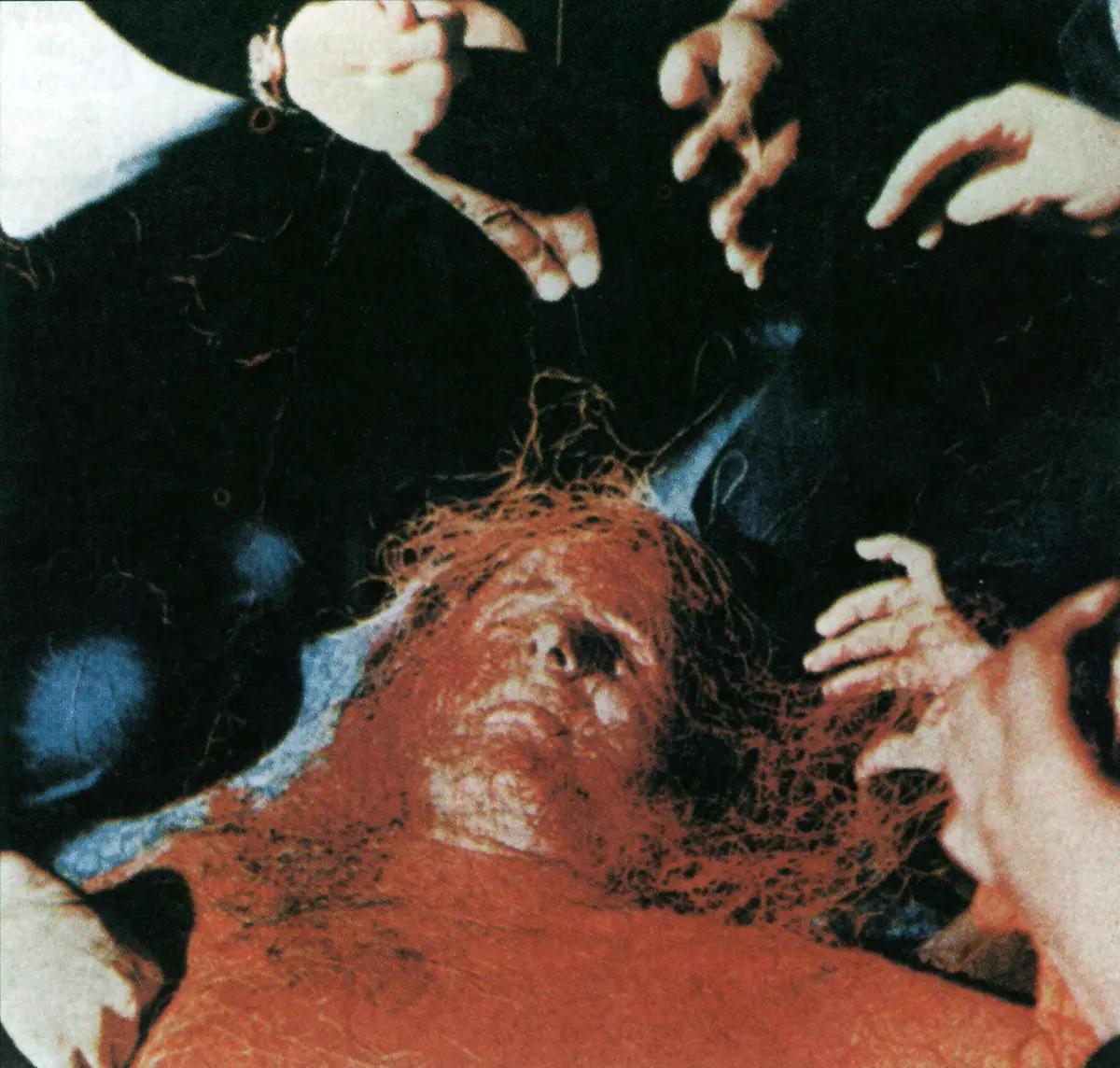
These operations through which the constructive subject gives up authorship (by revealing how the other is constitutive of the work's meaning), the object, and the possibility of a fixed, graspable structure, were further developed in Cannibalistic Slobber.21 Here the disintegration of the self is elaborated symbolically but in a revealing way that explores further Clark's interest in the dialectics of the inside and the outside. A group of participants introduces bobbins of colored cotton threads in their mouths that are to be pulled out slowly and then used to cover the body of another participant who is lying on the ground. In the end, the fully covered body is re-covered through the participants' entanglement with the threads. The cannibalistic metaphor is of course related to a model of identity that had been profusely elaborated by Oswald de Andrade in his writings, specifically in his "Manifesto Antropofagico" of 1928. In it, de Andrade proposes that Brazilian modernity and Brazilian identity are signaled by the incorporation of otherness, of things foreign, and by "a persuasive appetite that urges it to devour constantly, a genuine process of building a body by continually incorporating fragments of other bodies."22
Faithful to this model, Clark elaborated on it to propose a model of subject identity predicated on the self as another. Her Elastic Net proposal of 1973 is emblematic in this regard. In it, the participants weave with elastic bands a net in which later the bodies intertwine themselves to form, as Clark defined it, a collective body. As in Living Structures, the movements of the participants do not follow any predetermined pattern. But due to the greater number of participants and the simultaneity of their movements, the absence of structure is, at times, total, because the net disappears as a form in this exchange of bodies mediated through a flexible structure that undoes itself in the absorption of its surroundings. Clark herself indicated the link between these propositions: "I am aware that the elastic band 1 proposes to attach people is the slobber that has crystallized in the real space."23 And aware of the conceptual implications of her practice she wrote in 1975: "I have lost my identity, l am diluted in the collective. I see myself through all people independently of sex or age. I try to reconstruct the architecture of my face, by appropriating the physiognomies I see. T am the other.' l feel so elastic and malleable that I adapt to all sorts of contacts. I live out all sorts of secret and imaginary situations."24
The clear thread that runs through Clark's work is emphasized when one approaches her particular take on the notion of subjectivity. If Constructivism posited a rational subject, a productive imagination that would recognize itself in the mathematical transparency deployed by the constructive mind, Clark postulates, following Neo-concrete's search for a total experience, a model of subject identity bound to the contingency of time and thus not grasp- able by conventional structures of representation. Akin to Paul Ricoeur's model of identity, where a dialectic between otherness and selfhood produces otherness of a kind that can be constitutive of selfhood as such, Clark's concept of subject identity displaces the classical structure of the "I". Oneself as Another, as Ricoeur entitled his book on the topic, "suggests from the outset that the selfhood of oneself implies otherness to such an intimate degree that one can not be thought of without the other, that instead one passes into the other...(oneself in as much as being other)."25 This dialectic, which Ricoeur differentiates from the dialectic of the Same and the Other begun by Plato in the 'metaphysical' dialogues, is characterized by the polysemic character of otherness which implies that it does not refer only to the otherness of another person. Otherness in Ricoeur's scheme is deployed by the experience of one's own body (the flesh); by the relation of the self to the foreign (intersubjectivity); and by the relation of the self to itself. This dimension of otherness is traceable in the phenomenologically oriented work of Clark, particularly in her conception of the body as a site of cognition, as a mediator between the self and the world, but also as a body among bodies, a condition in which "the multiple ways in which the other than self affects the understanding of the self by itself marks, precisely, the difference between the ego that posits itself and the self that recognizes itself only through these very affections."26
The collective body, a series of proposals in which Clark's students practiced "collective relaxation" is emblematic of her search for an identity that would supersede the oneness of the "I." Here, some people would lie on the floor while others touched them and made them experience tactile stimuli from materials applied directly over their bodies.
Air blown through a tube, bags filled with polystyrene balls, sea shells over the ears, plastic bags filled with air, and tactile contact in general were Clark's means to disassociate the body from its feeling of enclosure. At times, she would create a labyrinthian structure with strings that her blindfolded students followed until arriving at a sink where water was running. On their way, the students interfered with each other and tried to recognize themselves through touch. The idea was, once again, to eliminate the image of the individual body that reconstitutes itself through a collective body. These experiences led Clark to develop what she termed "Structuring of the self" or "Therapy", private sessions in which the non-artist manipulated her "Relational Objects"—an array of sensorial devices that included all those mentioned above plus others like rubber tubes, socks, honey, and particularly bags, bags filled with air, with sand, with water, with polystyrene balls—onto the body of her patients in her "consultation room." One can still recognize in this work a commitment to identity as a process through a decentering of one's inferiority. The latter takes place via an intensification of the perceptual, a situation where Clark pushes to the limit the dismantling of art's conventions, (through her particular dialogue with western sculpture's logic) while at the same time deploying a plastic knowledge of the body that functions in intimate dialogue with her understanding of materials, space, and form.27 Ultimately it is this indissoluble entanglement between body and mind, form and concept, life and art that her work embodies through and through. Clark does, however, abandon the collective dimension of her propositions to engage in a therapeutic practice that dismisses this very important aspect of her work. Her radical break with artistic practices is definite as if the impossibility of representing the self and the inability of the artistic institution to deal with it had pushed her away from art and into the abyss of a search, for a "Structuring of the Self," leading nowhere.
NOTES
1. Quoted as an epigraph from the book by Clarice Lispector, Passion according to G.H.. (Barcelona: Ediciones Peninsula, 1988).
2. Lygia Clark, “Lygia Clark e o espaCco concrete expressional," reprinted in Lygia Clark (Barcelona: Fundacio Antoni Taàpies, 1997), p. 86.
3. Ibid., p.84.
4. Ferreira Gullar, “Lima experiencia radical (1954-1958), in Lygia Clark, (Rio de Janeiro: Edigao Funarte, 1980), P 12.
5. Usually translated as beasts or animals but rather used to define the latter in a pejorative way or to refer to bugs.
6. Maria Cough, “In the Laboratory of Constructivism: Karl Loganson’s Cold Structures," October 85, (Spring 1998), p.95.
7. Ronaldo Brito, Neoconcretismo. Peak and rupture of the Brazilian constructivist project, (Funarte: Rio de Janeiro, 1985), p. 101.
8. Here, the paradigmatic (and paradoxical) figure is Jean Arp. His work and his writings embody clearly the organic metaphor so dear to Western sculpture. In 1944 he would write in relation to Concrete art: “We don’t want to copy nature. We don’t want to reproduce, we want to produce. We want to produce like a plant that produces a fruit, and not reproduce. We want to produce directly and not by way of any intermediary. Since this art doesn't have the slightest trace of abstraction, we name it: concrete art." See ‘Concrete Art, "1944, in Arp on Arp, ed. Marcel Jean, (New York: Viking, 1972, p.139.) The causality implied in this model of creativity in which as God. the artist creates forms suspended in a process of growth is reflected in those sculptures of the artist that seem to expand outwards or grow upwards. An exception to the rule though was his Collages Arranged According to the Laws of Chance (1916-1919) and his Tom Papers (1930's), based on tearing and pasting to create the effect of a chance to detriment of composition and virtuosity, and in opposition to the geometrical structures, he had explored in his first collages. Moreover, the Torn Papers freed Arp from the demands of artistic creation: “When I make papiers déchirés I feel happy. What diverts me once again from these procedures is the fact that there is no longer a person forming within me. I gain peace and calm but lose as a creator. Thus I am forced to become a 'shoemaker' again, for in a state of relaxation I am no longer capable of forming." (my emphasis) It is this spirit, rather than Arp's commitment to “an essential order, and to “harmony’ which one can detect in the early sculptural work of Lygia Clark. In regards to the implications of this paradox in the work of Arp see also. Yve-Alain Bois and Rosalind Krauss, Formless, A User's Guide (New York: Zone Books, 1997) p. 208.
9. It is interesting to note that Clark'sTrepantes, in their anti-compositional, anti-monumental quality, and in their submission to gravity, keep a close affinity with the post-Minimalist work of Richard Serra. Robert Morris, and Eva Hesse, whose process-oriented experiments she precedes. See Yve-Alain Bois and Rosalind Krauss, op. cit, pp. 89-103.
10. Lygia Clark, “1964: Trailings." reprinted in October, no. 69, (Summer 1994), p.99.
11. Lygia Clark, “On the Act,’ reprinted in Lygia Clark, (Fundacid Antoni Tàpies), p. 164.
12. Ibid, 168.
13. Ibid
14. Ibid, p.209.
15. Paul Ricoeur, Oneself as Another (Chicago: The University of Chicago Press, 1992), p.5
16. Lygia Clark. Lygia Clark, (Fundacid Antoni Tàpies), p.206.
17. Mark Johnson, The Body in the Mind. The Bodily Basis of Meaning, Imagination, and Reason. (Chicago: The University of Chicago Press, 1987), p. 175.
18. Lygia Clark, Lygia Clark, (Fundacid Antoni Tàpies), p. 165.
19. Mark Johnson, Op. Cit., p.207.
20. ‘It is around this time that Clark," Yve-Alain Bois recounts, “dismiss(es) the art world, once and for all." Not long ago he wrote: “It was 1973, and Lygia...asked me to be present for a visit from a museum curator who wanted to propose a retrospective exhibition of her work... Lygia categorically rejected the idea of an exhibition, arguing that since 1968 all she had done was distance herself even further from the object—that her current work, in which the individual bodies of participants became a collective body in the forming of ephemeral architecture, no longer bore any relationship to art—particularly since the very notion of the spectator was entirely banished from it.“ See Yve-Alain Bois, “Lygia Clark. Introduction,' October #69, (Summer 1994), p. 87.
21. These experiences and Clark’s commitment to an undoing of structures are clearly related to her, and other neo-concrete artists like Hélio Oiticica and Lygia Pape, engagement with a “mobilizing space" that defied the Gestalt perception advocated by Concrete artists. It is worth noticing that by the same time, two other women artists, Gego in Venezuela and Eva Hesse in the United States, were also engaged in dissolving: the grid, seriality, and the search for a clear Gestalt that characterized prominent artistic movements in their respective countries. I am referring to Kinetic art in Venezuela and Minimalism in the United States.
22. Carlos Basualdo. “Bodywise," Future. Present, Past, La Biennale di Venezia, 1997, p.62.
23. Lygia Clark, Lygia Clark, (Fundación Antoni Tàpies). p. 292.
24. Ibid, p.266.
25. Paul Ricoeur, Op. Cit.. p. 3.
26. Ibid, p.329.
27. I am indebted to Carlos Basualdo for his thoughts on the therapy as intimately related to Clark's plastic practice.
MÓNICA AMOR
Candidate in the Ph.D. program of Art History at the Graduate Center of the City University of New York. She writes regularly on contemporary art.