Over the last decade in Buenos Aires, Jorge Macchi (1963) has shown himself to be one of the very few young artists to use in his work materials, images, and resources that have become canonical in the history of conceptual art. In 1993, Macchi won a scholarship from the French Government, enabling him to go to Paris, from where he began a long journey through Europe, winning other scholarships and participating in workshops. His journey, which took him from Amsterdam to Rotterdam, and on to London and Berlin, seems to have intensified certain characteristics of his work and modified others in a very special way. The show recently presented at the Ruth Benzacar Gallery offered an opportunity to examine these various movements, to see how his work has become lighter and more economical in terms of materials, and more exact as regards the artist’s identification with the ideas of hazard and death.
In this sense, the reference to travel is not anecdotal: Macchi's constant moves in recent years seem in principle to have forced him to change the conception of his materials, to valorize the circumstantial elements which are to be found in every city—materials which are almost banal and which can be easily transported and substituted. The excessive elaboration of his work in earlier years has given way to a lighter, more ephemeral, and incidental kind of production.
The material which seems to have produced the best results in this process is the newspaper—material that is readily available and subsequently discarded and which has been transformed by Macchi into a rich source for his plastic speculations.
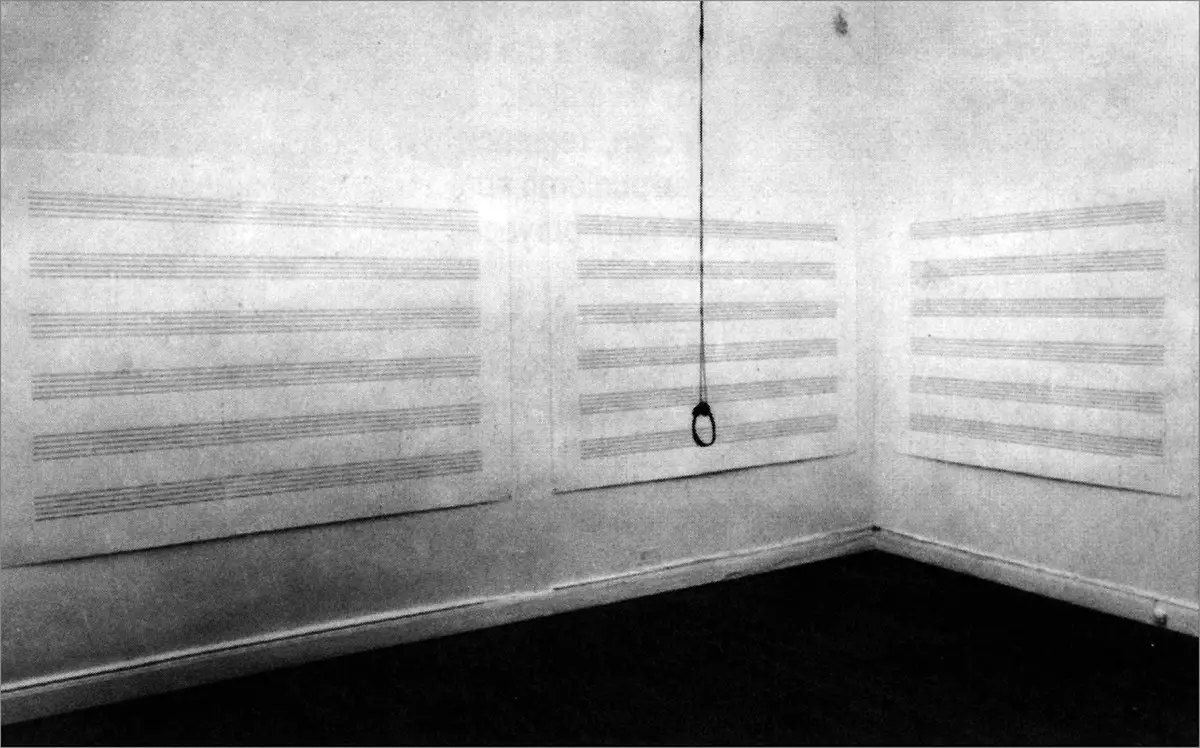
The title of the exhibition, Incidental Music, was taken from one of the works in the show: an enormous musical staff whose lines were drawn with quotations cut from newspaper reports by the police of accidents and murders. Each time these short stories reached their end, the artist left a blank space and continued with the next story.
The blank spaces between each story appear, from a distance, like musical notes randomly distributed along the musical staff. By placing them in this way, Macchi composed, in a kind of mad mathematical and musical obsession, a piece for the piano which the visitors could listen to through earphones as they peered at the wall and read the stories displayed on the musical staff.
The idea of the incidental event was conveyed by both the content of the newspaper stories—which told of tragic deaths, sinister events, and the murder of anonymous persons—and the capricious and visual nature of the musical composition. Macchi’s operation consisted of working with the consequences, the figures created by chance and random effect, to which he gave a new kind of legitimacy.
Something similar occurred with a work done with scratched glass which the artist found in one of his workshops. The work consists of the presentation of two pieces of glass that are scratched in exactly the same way, set side by side on a stand, in a tacit homage to the damage suffered by Duchamp's Grand Verre.
Another work in the show was related to Duchamp. This was a page from the funeral notices of a newspaper, where the information from the advertisements was perforated in such a way that the page appeared like an empty piece of checker-work, with only the religious symbols providing a source of information. The work, which hung from the wall from one of its corners, curled and twisted itself, curiously recalling the fragile form of Duchamp’s work from 1918, Sculpture du Voyage.
In line with the twin structure in broken glass noted above, Macchi also presented a small work with a box of matches, in which the disordered matches were arranged in exactly the same way in the two halves of the box. Both this work and the pieces of broken glass represent impossible moments in which a figure taken from chaos appears to be duplicated, which would theoretically imply the existence of an underlying order or guiding principle. In these works Macchi appears absolutely melancholic: he reveals the traces and marks of a full concordance of chance which can become transmuted into a perfect plastic order. Fatality would appear to be a special kind of force that can generate images and unleash stories, tragedies which here do not produce any anguish or pain because they are frozen —including in the musical staff of crimes and murders—by the absence of any subject.
INÉS KATZENSTEIN