For the inaugural exhibition of their new Coral Gables’ location, Durban Segnini Gallery celebrated the work of one of the great Latin American masters of art, Jesús Rafael Soto, with a small but elegant selection of works from the 1990s. The exhibition also marked the 25th Anniversary of the creation of the Fundacion Jesús Soto in the Museum of Modern Art, in Ciudad Bolivar, Venezuela.
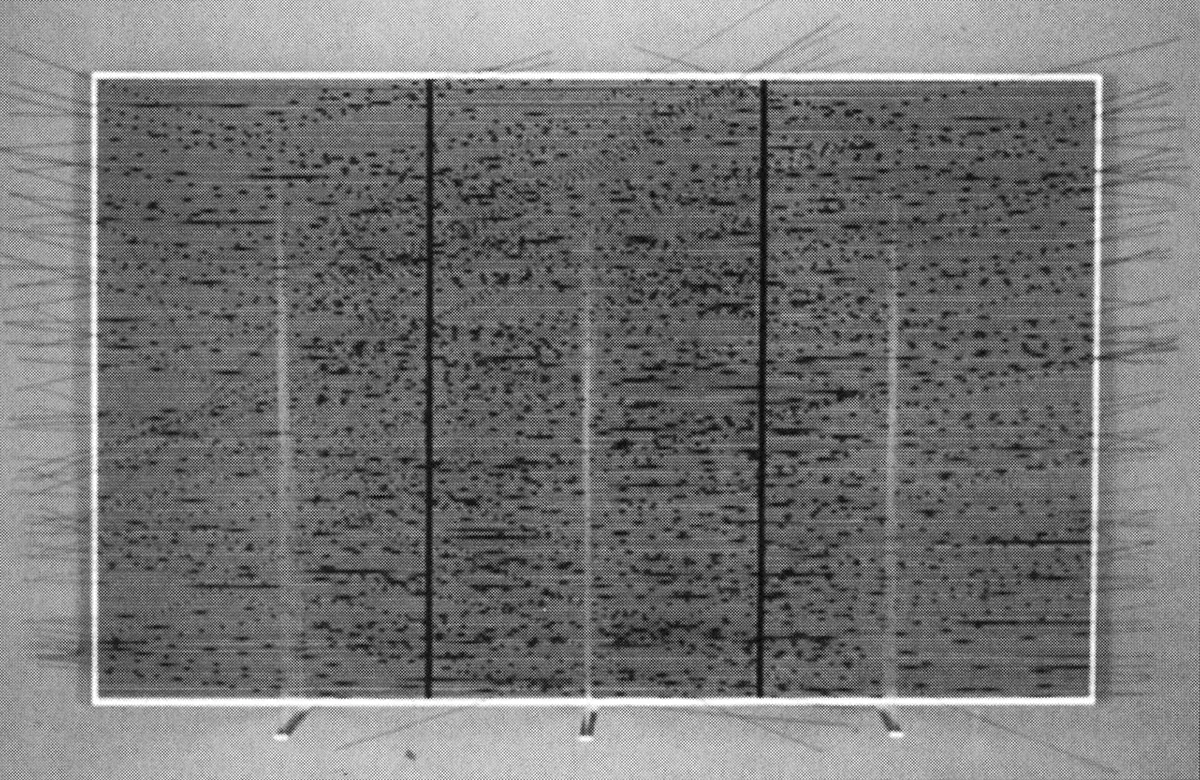
Even before his Paris sojourn in the 1950s, Soto was interested in the plastic dynamics and interrelationships of form, space, and movement. For years, he has concerned himself with the elements of materials and movement, in a multi-dimensional dialectic that addresses conceptual issues of time and space. His kinetic works create their own space—a fluid, imprecise locale cultivated by a linear interplay. He has often stated he wants to draw in space; that his works are like symbolic notations in space that move. But the movement that he creates is not an overt physical movement, but rather a sensory vibration, set off by the viewer’s actions in relation to what appears to be a static structure. The scintillating effect on the retina is as fascinating as it is mesmerizing.
The works in this exhibition include a variety of different forms that have become distinctive of his oeuvre over the years. They include small-scale penetrables, the astonishing feats of hanging linear constructions that invite viewer participation or entry into their visual and sonoric rhythms; modest-sized three-dimensional objects that also contain kinetic elements; and wall pieces called Escrituras (Writings), that demonstrates his acute sense of geometric organization and linear design —his drawing in space. Soto considers himself a painter who intends to go beyond the merely kinetic (moving) dimensions of quite ordinary materials in space, but he is also concerned with the transformation of elements, perceptions, and metaphysical experiences. This is particularly evident in his Escrituras. In Escritura Hilda, 1998, the energy of his linear dynamics reaches beyond the confines of the frame and into space, deconstructing the prescribed composition and forcing an assessment of the plastic variables of line, shape, color, and form. It is the very essence of the abstract painting taken to the third dimension. Similar effects result in the Vibración Azul y Negra (Vibration in Blue and Black) from 1998, and Vibracion en Color (Vibration in Color) from 1994, but in very different ways. Vibración Azul y Negra is composed of freely drawn linear elements, while Vibración en Color merges a more rigorous geometric aesthetic based on the repetition of cubic structures and the precision of the linear grid.
The consistency of Jesús Rafael Soto’s vision through the years is still evident in this group of contemporary objects that display his hallmark optical effects and the breadth of his imagination. His works still stand the test of time.
CAROL DAMIAN