
In the hands of Jesús Desangles, painting has become an exercise in demystification. All the myths relating to the eternal feminine, for example, the archetypal Three Graces, have been the focus of his interests. However, any profanation, through an inherent dialectic, becomes a new kind of mythification, a consecration of the opposite of that which is wounded by sacrilege. In this sense, the artist's action is reminiscent of the work of the Christians who constructed basilicas on the exact sites where pagan temples stood, or those faithful Moslems who put minarets on a church.
The paintings of Desangles also reflect an obvious fascination with the female figure, as well as the creation of female characters, whereby the image becomes a synthesis of a story, even though it has no absolute narrative element. Examples of this include Profile of Marcelina after becoming rich and Nana, the sister of Neno, both of which were included in this show at the Museum of Modern Art.
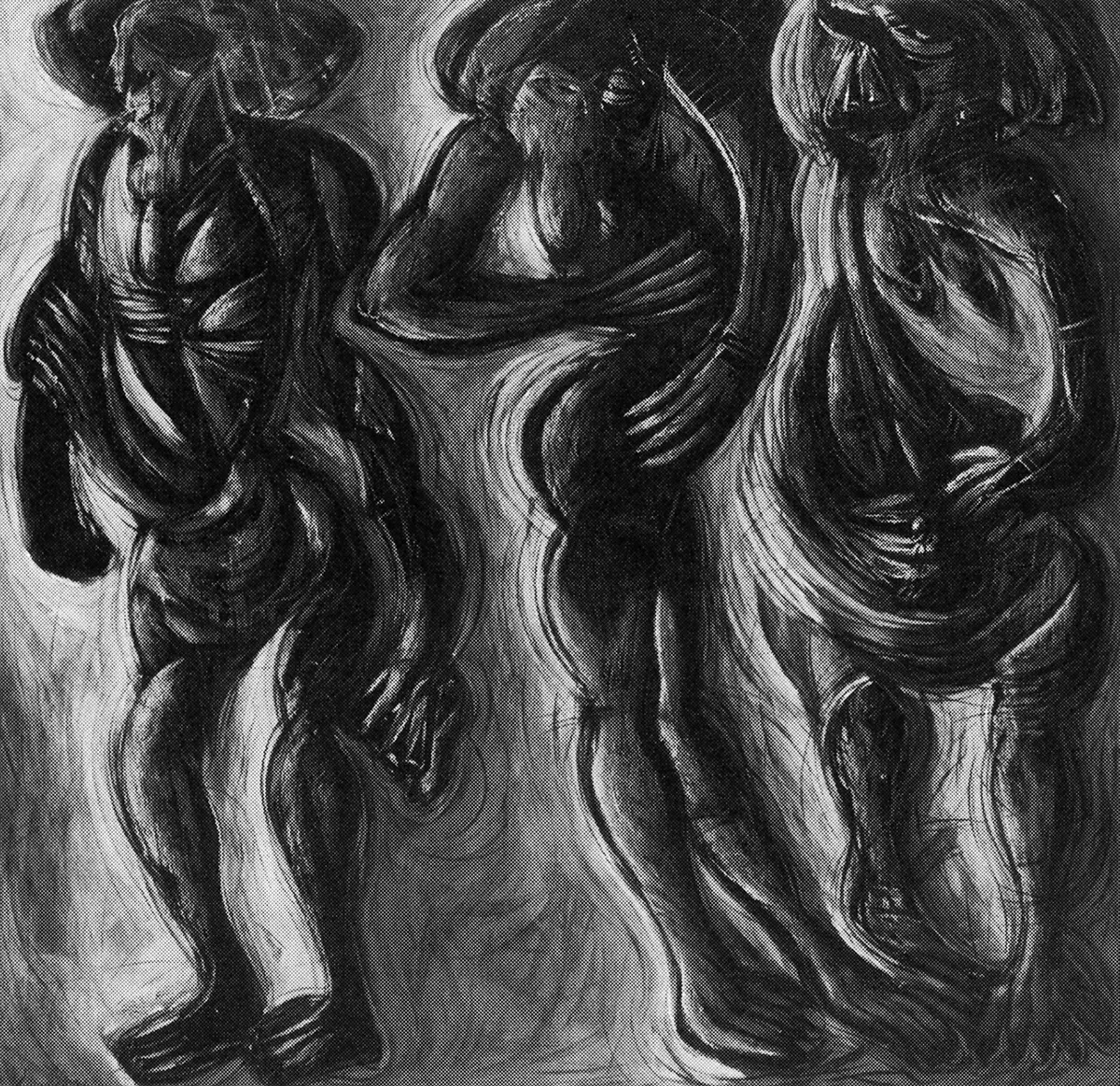
But the most significant element in all these cases is the recurrence of aesthetics of transgression and fascination. More than the diva, Desangles presents the anti-diva, unmasking the conscious specter of vanity, making his gestures like those of a puppet on a string, suggesting certain cruelty and creative fury that people used to attribute to Degas in his time when he depicted his dancers and bathers at their most intimate and least graceful moments— features which we also find in the pictorial experiences of Picasso, De Kooning, and Antonio Saura —in particular his formidable and grotesque portraits of Brigitte Bardot and Geraldine Chaplin.
All of this leads to the destruction of the classical canons of beauty with regard to the proportional harmony of the body, which often recalls the macrocephalic of the primitives, but also the distortion of movement which is not lacking a very Caribbean sense of rhythm, particularly in the linework, which is often syncopated like a bass drum. All these deformations of line and proportion, as well as the reiteration of profiles with their emphatic emphasis, are the result not of a descriptive but expressive intention, as well as a desire to transgress which refuses to accept any limits on creative freedom on canvas.
Color is the most characteristic feature of this work, and it has a violent and dramatic intensity, with increasingly gestural, overflowing and. Dionysian brushstrokes. Through color, the world reveals itself to Desangles as feminine. Its power and mystery are incarnated in this goddess who moves the winds, who immediately becomes transformed into a bird or dog, and who holds the key to ancestral secrets.
As in the ancient myths of India, Dionysius becomes Kali and dominates all the forces of both creation and destruction. The irony is thus nothing more than the other facet of the fascination which motivates the artist in his recognition of the misterium tremendum.
In all this process the body is both subject and object, the place of fascination. It is also the domain of instinct, to which Desangles entrusts the entire artistic creation process since as he himself has said, he never works according to some pre-conceived plan or idea since that would not be genuine artistic creation, but mere illustration. To delve deep into instinct and release it is to enquire into the secrets of the body, which lie deeper than its merely physiological mechanics, and which have much more to do with the great rhythms of the cosmos, the imagination, and the freedom revealed by indeterminism, than with the metaphor of the machine which fascinated the scientists of the Renaissance. The artist studies the body looks at it, deforms it, and disarticulates it. He does so in an attempt to capture its hidden essence which is perhaps what some people still call the soul—the pure psychic breath which inspires it, the only thing which in itself is above all an enigma and open-ended interrogation, but which may yet provide us with some answers.
LAURA GIL