The Time of Things was the title of this exhibition by Ignacio Iturria which was held from September 3rd to November 1st at the Rufino Tamayo Museum in Mexico City.
Iturria's work compels the spectator to return to the house and home. Armchairs, chests of drawers, and tables-either painted on canvas or constructed with cardboard and paper-take us back to the simple and everyday world. Life in an enormous and noisy city may be different behind the walls of a room in which people live, eat and sleep. It is these rooms that the artist opens up to us, where moments of intimacy are shared and where human beings establish relationships and discover one another. Iturria, through his creative work, draws the spectator into these domestic scenes and allows him or her to become a voyeur, who inevitably stops and thinks about the image.
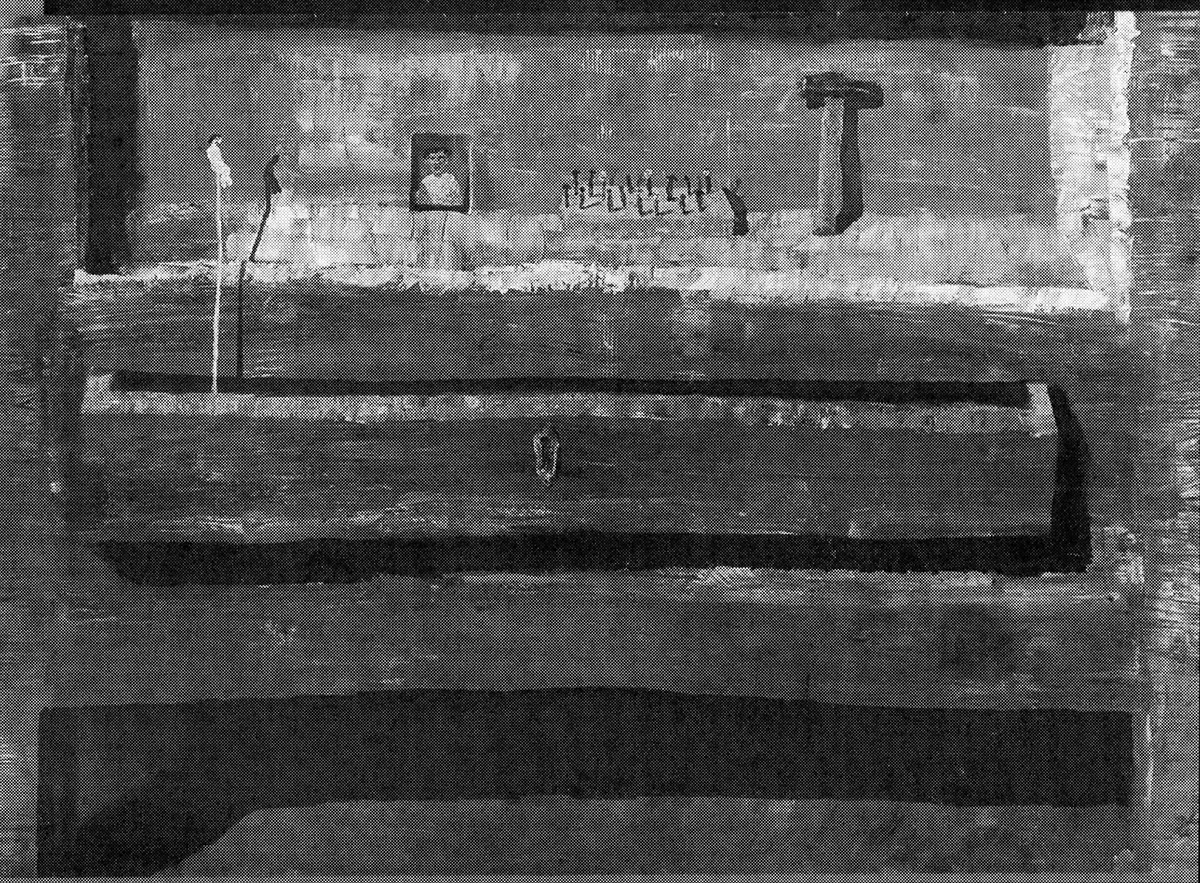
This gives rise to nostalgia about the time of things, the familiar things which are not very important but which are, at the end of the day, the things of everyday life. The allusion to time in the very suggestive title of the show reveals the artist’s desire to capture and freeze these brief moments that are normally taken for granted but which constitute the essence of life.
These objects and figures that reconstruct the domestic world are the means used by the artist to express the concerns that have haunted him for almost a decade and which have become the leitmotifs of our century: a sense of solitude and isolation, the rigor of modernity, and the search for identity.
The many portraits of figures whose faces are barely sketched remind us of photographs of prison convicts in the grips of some deep solitude. They are contemporary effigies placed before the spectator so that he can interpret the past and construct a future for themselves. The concept of time, which is so evident in Iturria’s work, is described in these images like a high-speed train passing in front of the figures that no one can stop.
The iconographic invariables in Iturria's work reiterate his humanist discourse: the chimera always encloses a riddle that will be resolved, one way or the other, by the spectator, in the same way as he will have to resolve his own life. The airplane always in flight transports fragments of memory, reminding us of the constant journeys and changes that human beings endure in the contemporary world.
The technical elements are used by Iturria to reinforce his message: it seems as if these beings extracted from his imagination have been devoured by the vastness of the canvas covered with rich impasto. In other pictures, the simplicity of the color taken straight from the tube allows Iturria to create figures which appear flattened by the broad sweep of the background. Works such as Reflection of the elephant sucking demonstrate his sense of craft and clear development, and this is when the expected happens-the transmutation of two dimensions into three. Iturria passes directly from painting to sculpture constructed with metal and cardboard. In this exhibition, with its oil paintings, sculptures, and constructed objects, Iturria proposed a profound exploration of the human spirit and its contradictions, showing himself to be a contemporary philosopher whose final premise is the careful contemplation of his surroundings.
ANA ELENA MALLET