The Arte Mexicano Gallery in Mexico City recently presented an exhibition of paintings by Gustavo Monroy (Mexico City, 1959). Monroy is one of the most outstanding artists of his generation. He recently joined the so-called Zona Group, which includes artists from his generation, including Boris Viskin, Mauricio Sandoval, Fernando Acvedes Humana, and Roberto Tumbull, among others—although the fact that they are of the same age group and have similar concerns does not mean they share the same pictorial motifs as has been the case with other artistic and stylistic movements.
Monroy is a painter who has experienced a number of geographical displacements which have undoubtedly left their mark on him. In recent years, he spent long periods in Chihuahua with the Tarahumara Indians, and in Slovakia with his companion. He spent short periods in other parts of Europe, particularly in Italy, and Mexico City. He even temporarily abandoned painting and returned to it later as the only manual means available to make himself understood during the long and implacable European winters. A splendid printmaker and artist who has caused some controversy because of the treatment of religious themes in his work, Monroy has won some of the most important prizes in Mexico, including the Rufino Tamayo Biennial Prize in 1998.
I have seen how this painter continues to keep in his heart and before his eyes the houses in which he has lived throughout his life. In order to explain them and to talk about them, he has chosen painting. These houses continue to form part of his surroundings and, irrespective of where he might be, they accompany him as an inevitable part of his own history.
The house is a total universe, a point of departure and arrival, and by its surroundings outside, a cardinal point in our journey on earth, Contrary to what we might expect, it is not Monroy who has left these dwelling places, but rather they who seem to have acquired a life of their own by freeing themselves from his hand, and, in a mutual pact of understanding with the artist, agreed to travel always alongside the artist who has given them life. Taking them where he may be is the only way of keeping them alive. Houses need to be inhabited to justify their existence. To abandon them is to allow them to die, to condemn them to rapid decay. Although they may appear to be standing intact, such abandoned houses are dead in their foundations and a gust of wind, like the wind of oblivion, is enough to make the landscape become what it was before.
It is perhaps for this reason that Monroy has wanted to fill his paintings with houses—the stations of a life being told in an emphatic manner, with fragile references which are nevertheless sufficient to fill an intense and energetic journal. The body, the city, the country, and the memory are all places in which we live. We inhabitant them and they take refuge in us.
In Painting, there are two main paths of interpretation. A solid narrative element provides a thread that connects the intimate events with the world at large. The most descriptive elements include the unusual fires which affected the country a few months ago. But alongside these fires, we see others—the fires of purgatory, the fires of souls being burned for all eternity without ever being fully consumed; the fires of the church, where the flames are higher and more intense each day, increasingly detrimental to the eyes of those who naively used to believe in the incorruptibility of the representatives of the divine spirit on earth and in the church as an institution.
There is also water, not as something present or as a means of putting out the fire, but as something which never comes and which, although it flows, has its source in an open mouth that seems to be crying out for help rather than resolving tragedies. It is freshwater; there is not a drop of salt water in any of Monroy’s work. The water always comes from the earth, or in the form of rain, forming small puddles or falling into the depths of Lake Arareko which has had such importance for the painter following his residence in Chihuahua. It is good water which, although about to fall to the earth, brings with it a message of sweetness and dreaming.
This bridge that exists between the personal history of Monroy and that of Mexico is represented not only with a map of the republic but through elements of enormous importance—such as some of its most representative icons, the colors of the flag, the architectural drawings of the colonial churches, words like “fatherland” “my city” and others—reveals how Monroy reworks some of the themes which affect him in a very personal way. He places himself within the works, in the form of a self-portrait, as an additional element in the composition and as a way of marking out his own attitude toward certain matters.
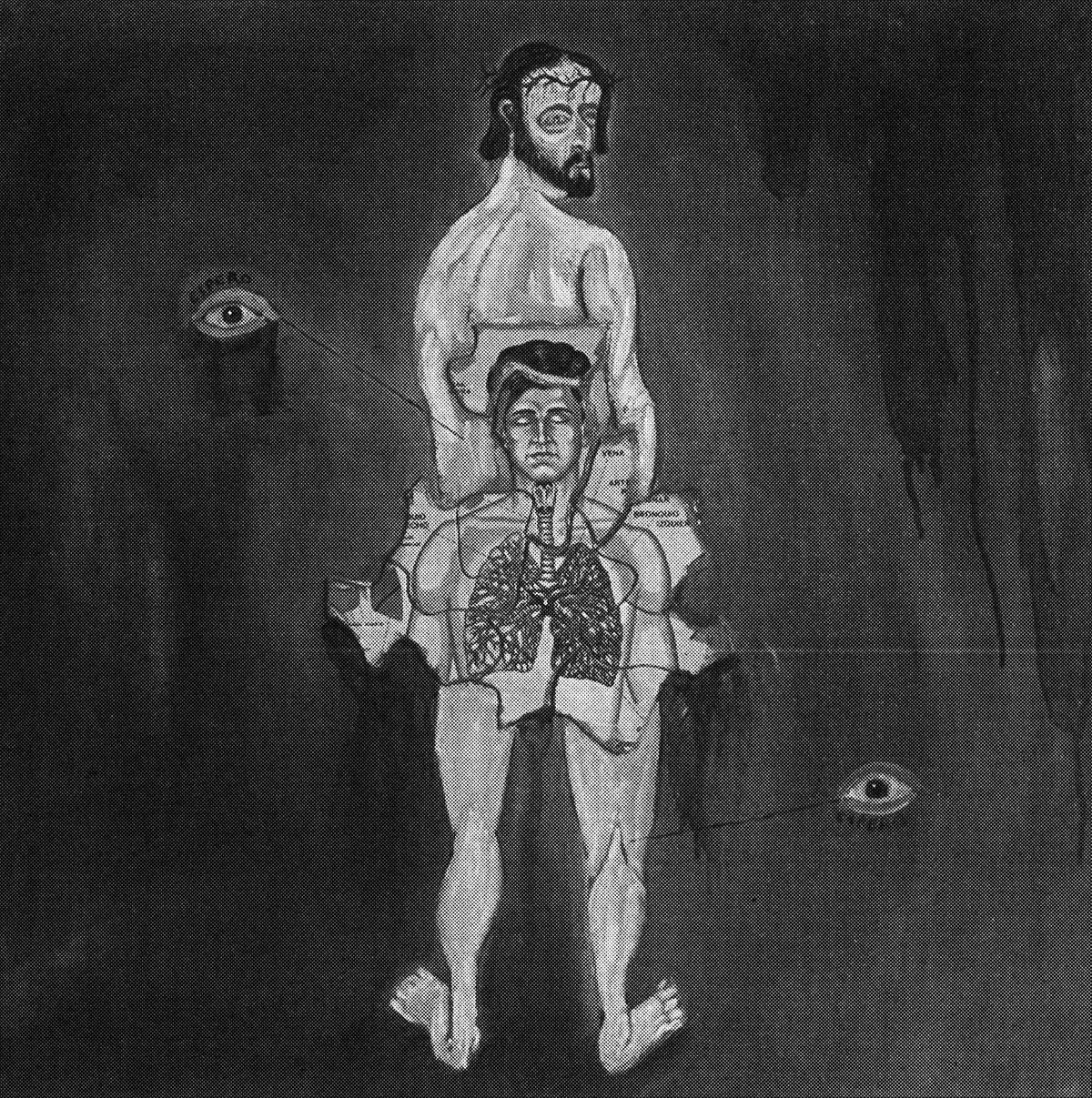
In the case of the picture titled Acteal, an enormous Monroy appears with a gunshot wound to his chest. This was originally part of a work done in 1994 from which the artist took the figure and included it in a new work from 1997, with the wound which neither he nor the country had three years prior. Both are now mortally wounded, including Adam and Eve, inspired by Masaccio’s Expulsion from Paradise (which can be seen in the Brancacci chapel in the Carmelite Church of Florence). The figures appear full of blisters and blood, their bodies are clearly injured and they are escaping a site of misfortune. They pass by, without looking, a Slovak Madonna who holds in her lap the reclining body of her son.
A painter of deep religious feeling, and a believer who is familiar with clerical orders, Monroy has been able to rework the theme of belief as an intimate thesis for confronting the subjects of faith. He once said to me that great erotic art, the most contemporary and apparently avant-garde, as well as the great apocalyptic and perverse kind of painting, was not to be found in the museums but in the churches—where such art when he finds it, provides a source of deep introspection.
This is one of the main reasons why there are so many religious elements in his work. This is the path that Monroy has chosen to talk to himself. His body, his references, the didactic plates of anatomy, maps, and words, including dissected words, which name and rename things and animals (such as the contaminating factory known as CA-PI-TAL) constitute a new kind of biology and geography: two subjects which reflect our human limits. They provide a new reading of surroundings which, although intimate in the painting of this artist, become shared by those who look with surprise at his work.
His painting does not leave any room for the direct memory of childhood but prefers the memory of more recent recreation. Monroy does not seek out moments from his childhood but rather places of repose for the years to come, idyllic regions to which he can go when his soul needs repose. There we find him, bleeding or with his eyes bandaged, praying, or fatally wounded by a REALITY that he cannot fight off.
And all the places are himself because they all take him inside. Monroy inhabits all that is offered and embarks on the terrible and tender experience of the loss of love and internal exile —traveling through himself, with painting as his native land.
SANTIAGO ESPINOSA DE LOS MONTEROS