Last summer Paris presented a number of major exhibitions devoted to Mexican artists. Frida Kahlo and Diego Rivera were exhibited at the Maillol Museum and at the Dina Vierny Foundation. The Museum of Modern Art presented work by a contemporary artist, Gabriel Orozco (Veracruz, 1962), who lives and works in Mexico City and New York.
The international reputation of the Mexican artist is not unrelated to the recognition which he was given very early on in France. From the time of his first one-man show (Chantal Crousel Gallery, Paris, 1993), featuring the famous truncated DS Citroën automobile, his one-man exhibitions (in 1995, Migrateurs at the Museum of Modern Art of the City of Paris and, in 1997, at the Musee de la Vielle Charity in Marseilles) and his participation in group shows (Réalités décalées at the FRAC Bretagne and the Morceaux Choisis show at the Magasin in Grenoble, both in 1995), his work has been warmly received in France.
The interest shown by the Parisian public (23,000 visitors in two months, catalogs sold out from the end of July and reprinted, with the decision to extend the show by one month) was surprising. Orozco is a complicated artist and the shows generally presented at the ARC venue (ARC: Animation, Recherche, Confrontation), a small space open to young artists with experimental work, is given a more confidential kind of reception, sometimes limited to a few initiés.
For the ARC show, Orozco undertook a specific project, including existing works and others specially created for the show, which invited the spectator to partake in an experience involving a variety of forms and uses of the senses.
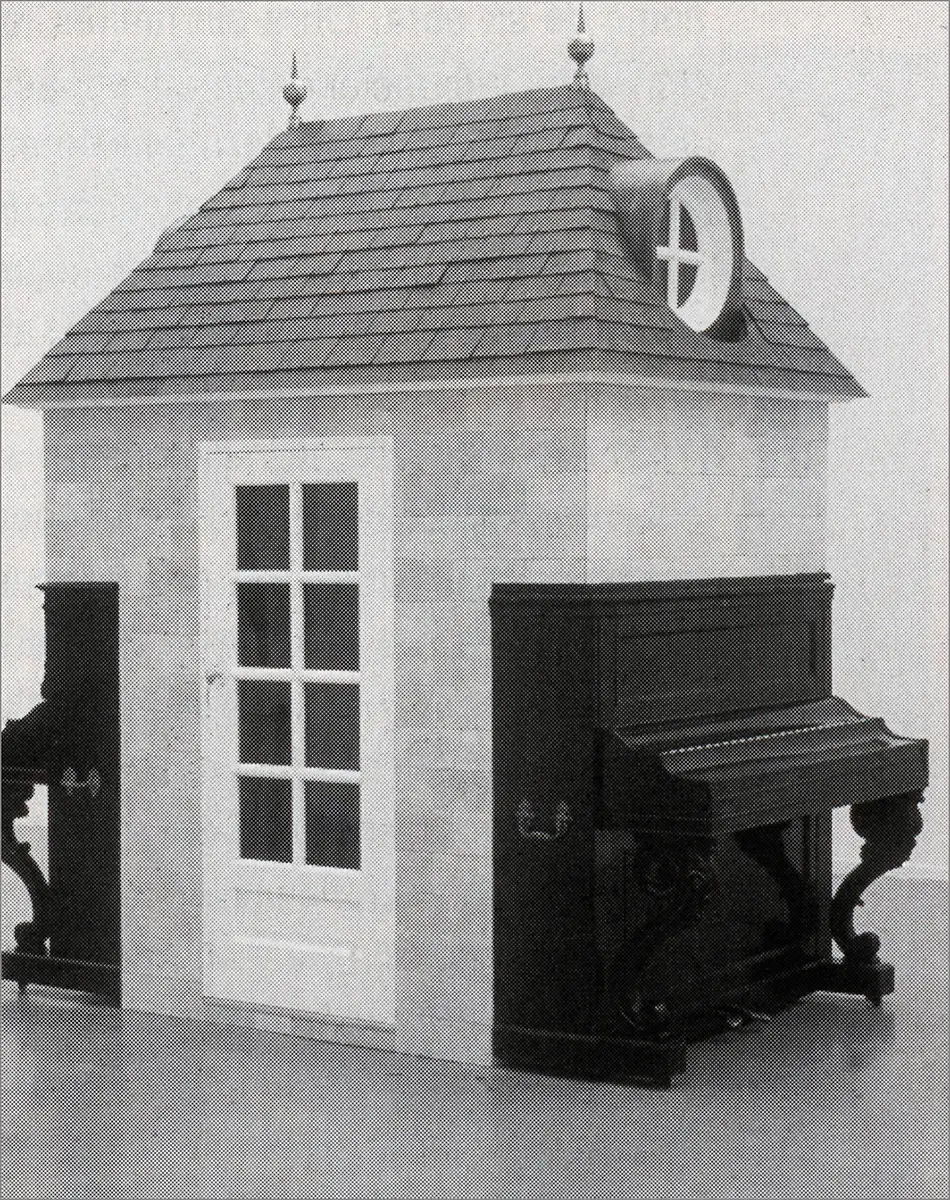
An enormous semi-circular panel opened the show with an enigmatic and impressive—virtue its size-message: "Clinton is innocent." The space then gave way to an immense curved corridor with a panoramic view: six ventilators caused strips of white toilette paper to flutter in the air. On the floor, there were ten bunches of white artificial flowers alongside nine sculpted pieces in the form of aluminum pipes. On the wall, there were six blackboards, pre-drawn with various serigraphic designs in white, inviting the spectator to intervene (chalk and duster provided). Before reaching a more intimate space (with a narrow corridor with walls painted in a deep blue), the visitor saw three construction installations: Ping Pong table (a table in the form of four clover leaves with water in the middle), Maman (a doll's house with two pianos) and Kiss of the egg (a structure-suspension of aluminum wires with egg). These three works dating from 1998 proposed alternative forms of games (visual conceptual and physical) such as playing the piano or playing Ping Pong. The last part of the show, like a “cabinet of curiosities," included photographs, objects, and drawings (with the very noble homeland My hands are my heart, from 1991). It was a labyrinth-like mental and geographical space under the seal of time.
In Sismographe (1997), Orozco created an object in the form of a star with pages from his diary. The photograph shows a mappamundi disintegrating in a tropical garden: objects such as a waterlogged watch, a game of chess with horses, or the used or sketched airline tickets are all signs of a nomadic spirit, characterizing both the artist himself and his work. It is a work without limits, in perpetual movement, which constructs and deconstructs, in an attempt to capture what is ephemeral and to perceive things that are fleeting sources of emotion.
The exhibition established relationships and contradictions between evocations and meanings, images, and conflicting experiences. The real and the virtual, stability and instability, chance and hazard set alongside systems all made up a metaphor of freedom, an essential feature of the artist’s work. The show, which came close to being a collage of sensations, dreams, and ideas rooted in the real and involving all the senses, was accompanied by a musical recording of Orozco improvising on the piano (suggestive of the musical accompaniment of silent films).
The visitor to the show seemed to be deciphering a musical landscape, full of diversity, and high and low notes, where the passages were sometimes subtle, sometimes physical. Despite the conceptual and apparently material dispersion, there was a feeling of the permanence of some overall work, which was presented according to a pointed discourse that proposed fragments of instants, fixed derisive elements, and caught the uncatchable by the juxtaposition of contradictory images (Foliage, photograph from 1997) and explored the other side of things (Under the table, photograph from 1993). While the first part of the installations, dominated by black and white, expressed a rather aseptic kind of poetics, the section with the photographs and objects introduced a more human, cultural dimension. Although it was rather immaterial, with dreams and illusions woven over the fabric of stability and instability, this first part did have magic that was brutally interrupted by the disordered banging of the visitors on the piano keys, noises that imposed themselves on the musical soundtrack. The charm could therefore at times come close to being a nightmare. The visitor was given a puzzle to solve, involving ideas, representations, games, possible and impossible freedoms, and mental associations. In doing so, he had to awaken all his senses without adopting any preconceptions, give rein to his imagination and sense of poetry, and harness his intelligence to the service of his emotion —in short, reconstruct the work in his own way.
CHRISTINE FRÉROT