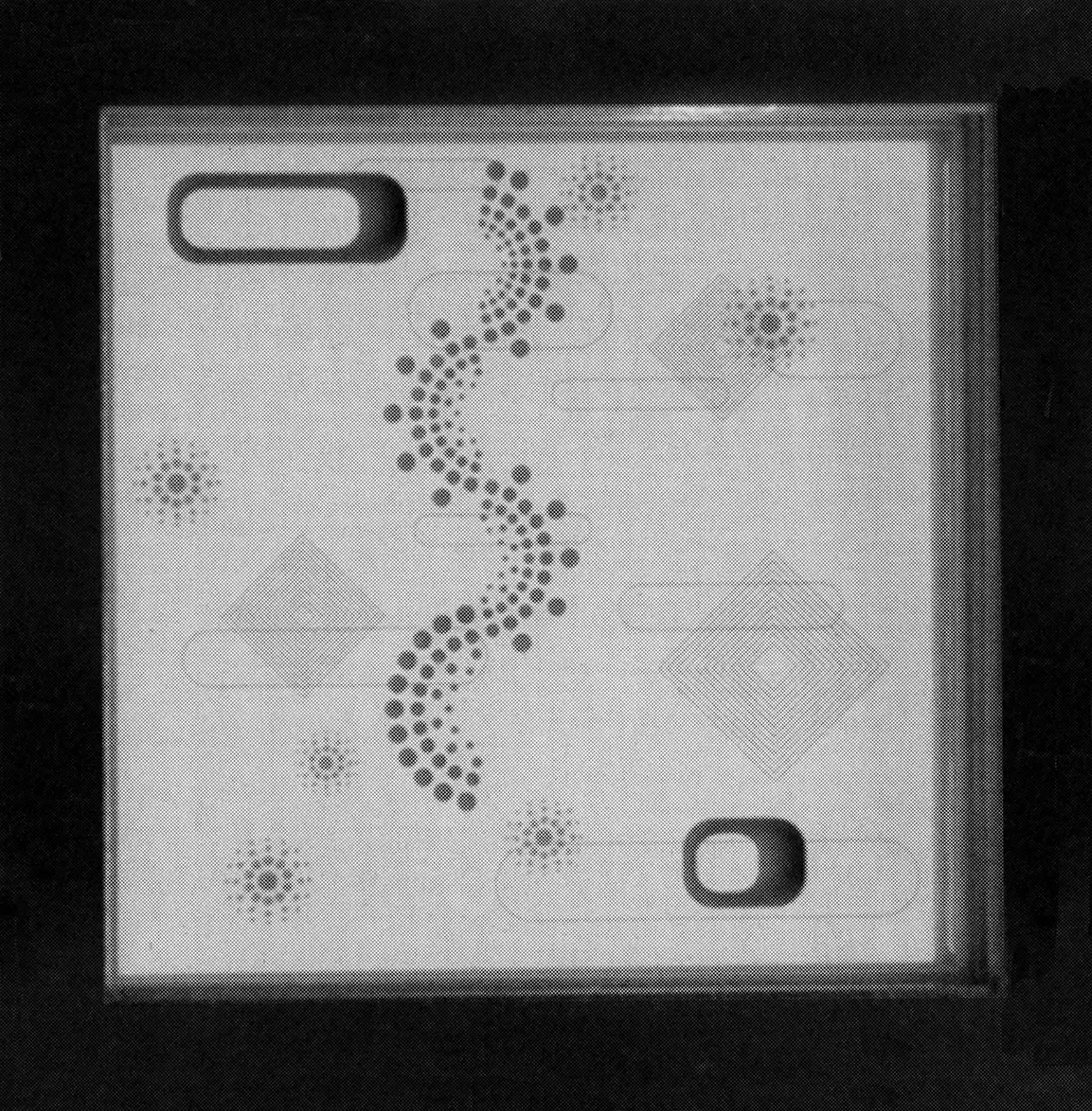
This is the second exhibition in New York by the Argentinean artist Fabio Kacero and his first one-man show in the city. Kacero belongs to an entire generation of Buenos Aires abstract artists -such as Pablo Siquier, Fabián Burgos, and Magdalena Jitrik- who have emerged in recent years, traveling and showing their work at the international level. In 1995, Kacero participated in The Rational Twist, an exhibition of work by young Argentinean artists, with a series of large “buttons" or “pills", whose quilted surfaces were adorned with abstract designs and patterns.
In their collaborative study titled La peinture moderne (Paris, Editions G. Crès, 1928), the French artists Amedee Ozenfant and Le Corbusier explained the importance of geometry in modern art and architecture. Geometry is one of the expressions of civilization: in the countryside, for example, fruits and vegetables lie in piles and heaps which lack any structural order, while in the city the same products, when they enter the market, are ordered into perfect symmetrical piles organized according to type and color. This is the same order that can be seen in the checkered structure of our modern cities, with their streets and avenues laid out in perfect perpendiculars. This association between geometry and the order of civilization was what led modern painters to subject their artistic creations to the most rigorous geometrical order. The entire career of Piet Mondrian can be seen as an increasingly perfect refinement of geometrical purity.
This is the modern tradition within which the new works of Fabio Kacero are set. The geometric elements come from industrial and architectural plans: patterns and designs which have been stripped of any practical function (the function which they served in the original diagrams and plans) and transformed into a minute but felicitous “ode to geometrical order."
Kacero’s work is characterized above all by a great sense of freshness. And this freshness has never been more evident than in these new pieces on show in Chelsea, New York. Chelsea, -the latest geographical fashion in the New York art world,- is a veritable aberration. Unlike the galleries in Soho, which in the 1970s became famous for the personal vision of each gallery owner, reflected in their highly subjective architecture and spatial design, the Chelsea galleries seem to have been produced en masse. Like the commercial units in the malls of America, the Chelsea galleries are all the same: the same floors, the same roofs, the same distribution of space, the same high-tech details, and probably the same architect. The Chelsea galleries are the ultimate impersonal product of a culture industry that homogenizes everything-the McDonald's of the art world.
It is for this reason that within this fragile world of Chelsea such small galleries as Kravets/Wehby stand out as modest exhibition rooms whose small size (this gallery has only one room measuring less than 20 square meters) brings a breath of fresh air to the bulky clutter of Chelsea. The small scale of this gallery accords perfectly with the small -but substantial- scale of these new works by Fabio Kacero: utopic miniatures which contrast with the monumental ambitions of the New York art world.
RUBÉN GALLO